Multi-Channel Prospecting Strategy for B2B: Combining Calls, Email and LinkedIn
More channels do not automatically create more qualified pipeline. For UK technology, SaaS and IT services teams, a multi-channel prospecting strategy for B2B can fall short when email, social and telephone outreach run as separate campaigns, with different messages, data and measures of success.
When response is low, adding another channel can seem like the obvious next step. But activity alone does not show whether the right decision-makers are engaging or whether opportunities meet your sales criteria. Prospects may receive disconnected messages, while replies and objections fail to shape the next campaign step. The answer is to give each channel a clear role and connect them around a relevant, consultative conversation.
This guide explains how to coordinate email, social and telephone outreach, use prospect feedback to refine targeting, and distinguish engagement from qualified pipeline. You will learn how to apply consistent qualification standards, including BANT, and report outcomes in a way that helps sales and marketing make better decisions.
Key Takeaways
- Build a multi-channel prospecting strategy for B2B around clear roles for email, telephone and LinkedIn, rather than simply increasing outreach volume.
- Choose channels to suit your audience, proposition, available data and campaign objective, then coordinate their messages and follow-up.
- Use prospect responses to sharpen your ideal customer profile and identify the right decision-makers, rather than counting activity alone.
- Use a five-step framework to plan engagement, qualify opportunities consistently and review campaign feedback.
- Separate illustrative scenarios from verified results, and assess performance through qualified opportunities and useful reporting.
What is a multi-channel prospecting strategy for B2B technology sales?
A multi-channel prospecting strategy for B2B coordinates outreach across channels such as email, telephone and LinkedIn. Each channel has a clear, complementary role, and each interaction supports a shared campaign objective: engaging relevant business decision-makers and progressing suitable opportunities.
It is not simply a matter of using more channels or sending more messages. Without coordination, prospects can receive repeated or conflicting approaches, and sales teams may struggle to see which activity is creating meaningful engagement. A joined-up strategy gives each channel a distinct purpose while keeping the proposition consistent.
Start with an ideal customer profile (ICP): a practical description of the companies and decision-makers most relevant to your offer. For a technology business, this could include organisations likely to need a particular software or IT service, as well as the roles involved in assessing or approving it. A clear ICP helps you shape relevant messages, select appropriate channels and assess prospect feedback against the campaign objective.
In brief: a multi-channel B2B prospecting strategy coordinates distinct outreach channels around a shared goal of creating relevant conversations and qualified sales opportunities.
How does multi-channel prospecting differ from multichannel activity?
Disconnected activity treats each channel as a separate task: one team sends emails, another makes calls, and social outreach follows its own plan. A coordinated campaign gives every interaction a reason to exist. For example, an email can introduce a relevant business issue, a LinkedIn interaction can add professional context, and a telephone conversation can explore whether that issue matters to the prospect.
The sequence should suit your audience and proposition, rather than follow a fixed formula. Keep the central positioning consistent, but adapt the interaction to each channel. Prospects should encounter a coherent business conversation, not the same message repeated in different formats.
Which business outcomes should the strategy support?
Measure progress by the quality of engagement and opportunities, not message volume alone. Lead generation identifies and engages prospective business customers to create potential opportunities. B2B appointment setting engages decision-makers to arrange qualified sales appointments. A qualified BANT lead meets, as a minimum, criteria covering Budget, Authority, Need and Timeline.
These distinctions help sales teams decide what should happen next and give managers a clearer view of pipeline development. Consistent prospecting can also help internal teams focus follow-up on relevant accounts and understand how campaign activity contributes to potential opportunities.
This article focuses on UK technology businesses, including SaaS, software and IT services companies. VSL also supports technology companies in the USA, using consultative outreach to engage relevant decision-makers.
How email, telephone and LinkedIn can work together in B2B prospecting
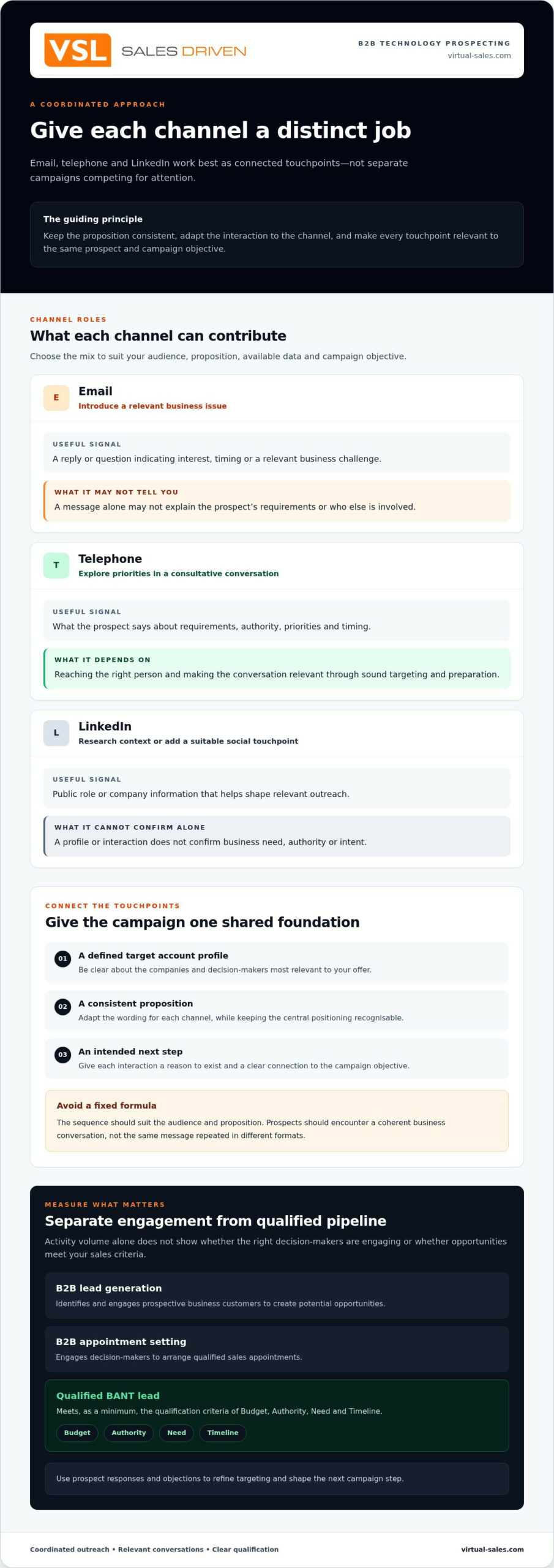
Assign each channel a distinct job. Email can introduce a relevant business issue, LinkedIn can help research an account or provide a professional touchpoint, and telephone outreach can explore a prospect’s priorities through a consultative conversation. The right mix depends on your audience, proposition, available data and campaign objective, not on a universal sequence or fixed cadence.
Email
Purpose: Give the prospect relevant context and a clear reason for contact.
Useful signal: A reply or question that indicates interest, timing or a relevant business challenge.
Limitation: A message alone may not explain the prospect’s requirements or who else is involved.
Telephone
Purpose: Hold a direct, consultative conversation and understand the prospect’s needs.
Useful signal: What the prospect says about their requirements, authority, priorities and timing.
Limitation: Reaching the right person and making the conversation relevant depend on sound targeting and preparation.
LinkedIn
Purpose: Research professional context or engage through a suitable social touchpoint.
Useful signal: Public role or company information that helps shape relevant outreach.
Limitation: A profile or interaction alone does not confirm business need, authority or intent.
What role should each prospecting channel play?
Use email to make the reason for contact specific. For example, a software provider might connect its offer to a business challenge relevant to the recipient’s role, rather than send a broad product introduction. LinkedIn can help the team understand the prospect’s professional context and keep engagement appropriate to the platform.
Telephone adds a different kind of insight. A consultative conversation can clarify whether the issue is a current priority, what the prospect needs and whether the person is involved in the decision. Those details can be difficult to establish from a digital touchpoint alone. The B2B Sales Strategy Framework also emphasises defining customer segments and targeting outreach as part of a repeatable sales approach.
How should teams coordinate channel activity?
Give every touchpoint the same foundation: a defined target account profile, a consistent proposition and an intended next step. Adapt the wording to each channel, but make sure prospects can recognise the connection between interactions. A LinkedIn note should not introduce an unrelated offer after an email has raised a different business issue.
Record useful engagement and outcomes so the next interaction reflects what the prospect has already shared. VSL manages campaign activity through a cloud-based CRM and can output campaign data for use with platforms such as HubSpot and Salesforce. For further guidance, read about outbound sales strategies for SaaS growth.
For an example of VSL’s technology appointment-setting presence, view its Clutch appointment-setting profile.
Real insight: what a coordinated prospecting campaign can reveal
Illustrative scenario only: this is not a VSL client campaign or a verified performance result.
Imagine a fictional software provider whose prospect list includes a wide mix of organisations and job titles. The team sends emails, connects with people on LinkedIn and makes calls, but receives mixed responses. Some recipients have no responsibility for the problem the software addresses; others work at organisations outside the provider’s intended market. The issue is not necessarily a lack of activity. The targeting needs more definition.
What does the illustrative scenario show?
The provider refines its ideal customer profile (ICP) around a defined account type and identifies the roles likely to recognise, assess or approve the relevant business need. It reviews its account data and adjusts the proposition so each touchpoint addresses the same business problem.
An email gives a prospect context for the conversation. LinkedIn research helps the team understand the person’s role and company. During a consultative telephone conversation, the prospect asks whether the software can support a particular workflow. Rather than repeat the original pitch, the team explores how that workflow operates, what the prospect needs and who else may be involved in assessing a solution.
That response informs the next step. The provider can clarify the proposition around the workflow, check whether similar accounts face the same issue and refine its qualification questions. If the question points to a requirement the product may not meet, the team can record that distinction and avoid treating interest as a suitable opportunity. The scenario shows how prospect feedback can inform messaging, data priorities and follow-up. It does not establish a result or prove a market-wide pattern.
Which campaign mistakes weaken channel coordination?
A multi-channel prospecting strategy for B2B works best when targeting, messaging and qualification reinforce one another. Common weaknesses include:
- An unclear ICP: Broad account criteria direct outreach towards organisations that may not have the relevant need or decision-makers.
- Disconnected messages: If email, social and telephone outreach present different problems or offers, the prospect may not recognise a coherent conversation.
- Weak qualification: A reply, profile interaction or positive call is a signal to explore, not proof of a qualified opportunity. Establish Budget, Authority, Need and Timeline before treating a lead as qualified to BANT criteria.
- Activity-only reporting: Counts of messages and calls show work completed, but not whether the campaign is reaching suitable accounts, learning from responses or creating opportunities for sales follow-up.
Review outcomes alongside the feedback behind them. Repeated questions may point to unclear positioning; a pattern of poor-fit responses may call for tighter account criteria. These observations give the team a practical basis for its next campaign decision.
A practical framework for planning and improving multi-channel B2B prospecting
A useful multi-channel prospecting strategy for B2B needs clear ownership, consistent information and a review process that leads to decisions. Use this five-step framework to connect campaign planning with prospect conversations and relevant sales follow-up.
- Define. Owner: Sales and marketing leads. Output: An ideal customer profile, relevant decision-makers, a clear proposition and a campaign objective. Decision point: Are the target accounts and intended outcome specific enough to guide channel selection?
- Coordinate. Owner: The campaign lead. Output: A shared plan that gives email, telephone and LinkedIn distinct roles, with consistent positioning and an appropriate next step. Decision point: Will each interaction make sense in the context of the others?
- Engage. Owner: The people responsible for each channel. Output: Relevant outreach and clear records of responses, questions and objections. Decision point: Does the prospect’s response call for follow-up, further research or a change in approach?
- Qualify. Owner: The person handling the prospect conversation. Output: A record of Budget, Authority, Need and Timeline. Decision point: Does the opportunity meet the agreed qualification standard and warrant sales follow-up?
- Review. Owner: The campaign lead with sales and marketing input. Output: A review of target fit, engagement, qualification and agreed next steps. Decision point: What should the team refine, continue or stop?
Coordinate engagement around the prospect
Define the audience and objective before choosing channels. Then make sure each touchpoint supports the same proposition without repeating identical wording. VSL works as an extension of the client’s team, with a dedicated caller and campaign manager. Its callers use consultative, script-free conversations to understand requirements and qualify leads to BANT criteria as a minimum.
For more ideas on planning coordinated outreach, read these outbound sales strategies for SaaS growth.
Use qualification and feedback to improve
VSL provides weekly campaign reporting and 360-degree feedback to support outcome reviews. VSL uses a cloud-based CRM to manage campaign activity and can output campaign data for use with platforms such as HubSpot and Salesforce. Review campaign records alongside prospect feedback to refine targeting, messaging and qualification questions.
Simple campaign scorecard
- Target fit: Is the account and contact within the agreed profile?
- Engagement: What response, question or objection did the prospect share?
- Qualification: What is known about Budget, Authority, Need and Timeline?
- Next step: Is follow-up agreed, required or not appropriate?
To explore how VSL can support coordinated prospecting for technology companies, visit the UK technology appointment-setting service.
Evidence, results and when to use a multi-channel prospecting strategy
Assess a multi-channel prospecting strategy for B2B by the quality of opportunities and the decisions campaign evidence helps your team make, not by activity totals alone. Review qualified meetings, BANT outcomes, campaign outcomes and contribution to the sales pipeline. Keep definitions consistent: an engagement signal is not the same as a qualified lead or a sales opportunity.
Which evidence can support a prospecting decision?
Keep evidence types distinct. A VSL campaign result or Clutch review should support a claim only when the published details verify the client context, service and outcome. You can review VSL’s Clutch appointment-setting profile and make sure any specific detail accurately supports the point you want to make.
Attribute third-party research to its original organisation and check that the finding is relevant before using it. An illustrative scenario can explain a planning choice, but it is not a verified result. Likewise, a response or meeting does not, by itself, prove revenue impact. Campaign outcomes and meeting volumes are not guaranteed.
When should a technology company consider VSL support?
This approach may suit a technology business entering a market, testing a new proposition or targeting a new ideal customer profile. It can also support a team building qualified pipeline while internal sales staff focus on progressing opportunities. Set the campaign objective first, then review evidence against that aim rather than relying on assumed activity targets.
VSL works as an extension of your sales and marketing team. Each campaign has a dedicated caller and campaign manager, supported by experienced UK-based callers who use consultative, script-free conversations. Weekly reporting and prospect feedback help the team assess outcomes and inform campaign decisions. Leads are qualified to BANT criteria as a minimum.
Explore VSL’s technology appointment-setting service to see how coordinated outreach can support your campaign planning.
Build a more coordinated prospecting approach
A strong multi-channel prospecting strategy for B2B gives email, LinkedIn and telephone outreach complementary roles, all directed towards relevant conversations and qualified opportunities. Define your ideal customer profile and campaign objective first, then use prospect responses to refine your message, targeting and next steps.
Measure more than activity. Review target fit, engagement, BANT qualification and agreed sales follow-up to understand whether campaign work is contributing to useful pipeline. Treat evidence carefully: distinguish verified results from illustrative scenarios, and do not assume any channel or sequence guarantees a particular outcome.
VSL has supported technology companies since March 2001. Campaigns include a dedicated caller and campaign manager, with campaign managers bringing over 20 years of telemarketing experience. Weekly reporting supports campaign reviews, and leads are qualified to BANT criteria as a minimum. VSL works as an extension of your sales and marketing team, using consultative conversations to engage business decision-makers.
With a clear plan and consistent review, your team can turn prospecting activity into better-informed decisions and stronger opportunities. Keep learning from prospect conversations and build a pipeline that reflects your business goals. If you are planning coordinated outreach for a technology business, find out how VSL’s UK technology appointment-setting service can support your team.
Frequently Asked Questions
What is a multi-channel prospecting strategy for B2B?
A multi-channel prospecting strategy for B2B coordinates channels such as email, telephone and LinkedIn around a shared audience, proposition and campaign objective. Each channel has a distinct role, so prospects receive relevant interactions rather than the same message repeated. For a technology company, start by defining the ideal customer profile and decision-makers, then connect engagement to consistent qualification and clear sales follow-up.
Which channels work best for B2B prospecting?
No single channel mix suits every B2B campaign. Email can give a prospect useful context and explain why you are getting in touch. A consultative telephone conversation can clarify business requirements, while LinkedIn can support professional research or engagement. Choose channels based on your audience, proposition, data quality and campaign objective. Then assess whether they help you reach relevant people and create qualified opportunities.
How do you create a multi-channel prospecting strategy?
Begin by defining your ideal customer profile, relevant decision-makers and campaign objective. Give each selected channel a clear purpose, then align the proposition and intended next step across touchpoints. Record engagement and outcomes consistently so follow-up reflects what prospects have shared. Apply agreed qualification criteria, review campaign outcomes and use prospect feedback to refine targeting and messages. Do not treat activity volume alone as proof of progress.
How many channels should a B2B prospecting campaign use?
Use the number of channels your team can coordinate effectively. The right mix depends on your audience, proposition, available data and capacity to manage follow-up. Each channel should have a clear purpose and contribute to the same campaign objective. Adding channels without shared context can fragment the prospect experience. Start with a manageable plan, review engagement and qualified opportunities, then adjust based on campaign evidence.
How can you measure multi-channel prospecting success?
Measure whether the campaign reaches suitable accounts and decision-makers, then review engagement, qualification outcomes, agreed next steps and contribution to the sales pipeline. Set clear outcome definitions so sales and marketing interpret results consistently. Activity totals can show what the team completed, but they do not prove commercial progress on their own. Compare campaign outcomes with the objectives you set, rather than relying on unverified benchmarks.
How does BANT qualification fit into B2B prospecting?
BANT assesses Budget, Authority, Need and Timeline. It gives sales and campaign teams a shared structure for understanding an opportunity and deciding what follow-up is appropriate. Apply the same criteria across relevant prospect conversations and record the outcome clearly, regardless of which channel began the engagement. VSL qualifies leads to BANT criteria as a minimum, helping clients focus on opportunities that meet the agreed qualification standard.
Can an outsourced team work as part of an internal sales team?
Yes. An outsourced team can work as an extension of your sales and marketing function when campaign objectives, positioning, qualification and reporting are aligned. VSL assigns a dedicated caller and campaign manager to each campaign, uses consultative, script-free conversations and provides weekly reporting. Agree how qualified BANT leads and other campaign outcomes will be handed to your internal team, so follow-up stays connected to the prospect’s context.

Disclaimer
Disclaimer: Content is for general information only and does not constitute professional advice. Results may vary. Virtual Sales Limited accepts no liability for actions taken based on this content.
Tags: Appointment Setting, B2B Lead Generation, bant qualification, consultative outreach, multi-channel prospecting, pipeline development, SaaS Sales, technology sales