Why Too Much Sales Automation Fails to Book Meetings
More automated outreach can make your sales dashboard look busier while leaving your meeting calendar unchanged. Why More Sales Automation Does Not Always Mean More Meetings comes down to a simple distinction: automation can increase activity, but it cannot make an irrelevant message matter to the right prospect.
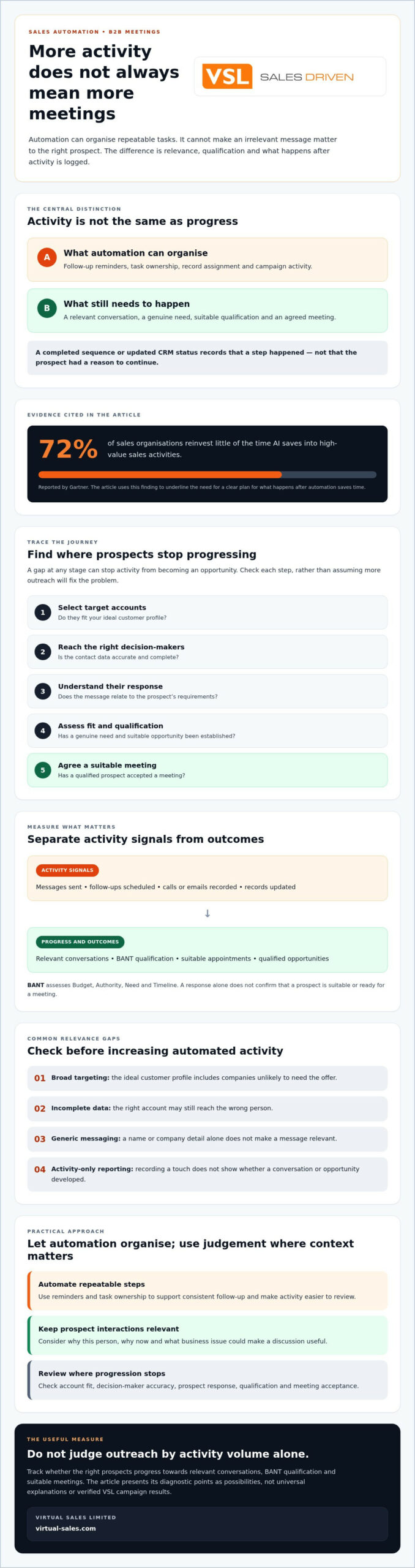
If you lead sales or marketing at a UK technology, SaaS or IT services business, you may recognise the frustration. Sequences are running, contacts are being added and follow-ups are going out, yet meaningful conversations remain scarce. Gartner reported in May 2026 that 72% of sales organisations reinvest little of the time AI saves into high-value sales activities. That points to a wider challenge: automation needs a clear plan for what happens next.
This article will help you identify where prospects disengage, assess whether your targeting and qualification are working, and decide which tasks to automate. You’ll also see how to preserve relevant, consultative conversations and track progress through qualified opportunities and meetings, not activity volume alone.
Key Takeaways
- Why More Sales Automation Does Not Always Mean More Meetings: higher outreach volume cannot compensate for weak targeting or irrelevant messaging.
- Trace the journey from ideal customer profile to meeting acceptance to find where prospects disengage.
- Check contact data and qualification criteria before increasing automated activity.
- Separate activity measures from outcomes such as relevant conversations, BANT qualification and appointments.
- Use automation to organise repeatable tasks, then bring in consultative human judgement where prospect context matters.
Why More Sales Automation Does Not Always Mean More B2B Meetings
Your team can send more messages, schedule more follow-ups and log more activity without booking more qualified meetings. Sales automation can support the process, but it cannot make an offer relevant or give a prospect a reason to talk.
Sales automation is software-led support for repeatable tasks, such as organising follow-up reminders, assigning records and recording campaign activity. These functions can help your team manage outreach consistently. A Customer relationship management (CRM) system can organise customer information and sales processes, but it cannot establish by itself whether a prospect has a need or is ready for a conversation.
Think of the journey in stages: select target accounts, reach the right decision-makers, understand their response, assess fit and qualification, then agree a suitable meeting. A gap at any stage can stop activity from becoming an opportunity. That’s why market and competitor research for sales can help you assess whether your target accounts and proposition reflect the market you’re approaching.
What does sales automation do in a B2B campaign?
Automation can prompt a follow-up when a prospect hasn’t replied, make task ownership clear, or record that an email or call has taken place. This reduces reliance on memory and makes campaign activity easier to review.
But recording a touch is not the same as creating a conversation. Each prospect-facing interaction still needs a clear purpose: why contact this person, why now, and what business issue might make a discussion useful? Automation can organise the steps around that interaction. It cannot guarantee engagement, qualification or a meeting.
Why can activity rise whilst meeting numbers stay flat?
Start by checking fit and relevance. If your ideal customer profile is too broad, automation may increase messages to companies that are unlikely to need your product or service. If contact data is incomplete, the right account may still reach the wrong person. Even accurate data cannot rescue generic outreach that says little about a prospect’s requirements.
These are diagnostic possibilities, not universal explanations or verified VSL campaign results. Review where prospects stop progressing: are target accounts responding, are conversations uncovering a genuine need, and are qualified prospects accepting a meeting? Why More Sales Automation Does Not Always Mean More Meetings is best understood as a process question. Automation can increase repeatable activity, while relevance, timing and qualification shape whether that activity leads to a suitable meeting.
Where Automation Can Lose Relevance Between Outreach and a Meeting
Relevance needs to hold at every stage: choosing accounts that fit your ideal customer profile, reaching the right decision-maker, responding to their interest, qualifying the opportunity and agreeing a suitable meeting. A prospect can disengage at any point. A completed sequence or updated CRM status shows that a step occurred, not that the prospect saw a reason to continue.
Data quality affects each step. An outdated job title, incorrect email address or missing company context can send a well-organised sequence to the wrong person. Personalisation also needs substance. Adding a prospect’s name or company to a standard message is not the same as explaining why your offer may relate to their business priorities. Check whether each detail changes the conversation, rather than simply making the message look customised.
A qualified BANT lead is a lead assessed against Budget, Authority, Need and Timeline criteria as a minimum. Qualification matters because a response alone does not confirm that a prospect is a suitable opportunity or ready for a meeting.
How does weak targeting affect automated sales outreach?
Your ideal customer profile should connect company fit, the decision-maker’s role and the purpose of the campaign. For example, a technology provider targeting firms with a particular operational need may get little value from contacting companies that lack that need, even if the message reaches the right job title. Market and competitor research for sales can help you test whether your assumptions about the audience and proposition match the market.
Where does a prospect need human judgement?
A live, consultative conversation can clarify what a prospect means by an initial response, uncover a relevant requirement or establish that the timing is not right. That context is different from an automated status such as “replied” or “follow-up sent”. VSL’s article on intelligent calling and prospect engagement explores why human judgement can matter in outreach.
Timing is another factor to examine. In research discussed by Harvard Business Review, firms that contacted potential customers within an hour were nearly seven times more likely to qualify the lead than firms that waited longer. The finding supports prompt follow-up, not indiscriminate automation: speed still needs to lead to relevant questions and sound qualification.
If you’re assessing how a human-led approach could support your campaign, explore VSL’s appointment-setting reviews.
Measure Meeting Progress, Not Just Automated Sales Activity
A campaign dashboard can show how much work is happening. It should also show whether the right prospects are moving towards a qualified meeting. Track activity to spot operational issues, then pair it with outcomes to understand campaign quality and decide what to change.
Activity indicators
- Accounts and contacts added to a campaign
- Emails sent, calls attempted and follow-up tasks completed
- Replies received or callbacks requested
Qualified outcomes
- Target accounts that match your ideal customer profile
- Relevant conversations with appropriate decision-makers
- BANT outcomes, including whether Budget, Authority, Need and Timeline have been established
- Suitable appointments accepted and scheduled
Activity measures are diagnostic signals, not proof of commercial success. A rise in completed follow-ups may point to consistent execution; it does not show that the accounts fit or that conversations are progressing. Outcome categories add useful detail. A callback request, a warmer contact who needs further information and a prospect with a defined requirement represent different next steps, even if none is yet a confirmed meeting.
Meeting performance should be read alongside qualification, target fit and the campaign context, not in isolation. There’s no useful universal benchmark to apply without knowing the audience, proposition and campaign conditions. Instead, compare performance with your own objectives and prior campaign data, using verified evidence where available.
Which sales automation metrics help explain meeting performance?
Choose measures that help you make a decision. If the right accounts are not responding, review targeting or message relevance. If conversations happen but few prospects meet your qualification criteria, examine the campaign purpose and qualification questions. If qualified prospects do not accept appointments, check whether the proposed meeting matches their needs and timing.
Record outcomes consistently so callbacks, future interest, poor-fit contacts and qualified opportunities do not get grouped into a vague “engaged” status. VSL, for example, classifies outcomes as Call Back, Warmer Contact, Warm Lead, Future Opp, Not Interested or Happy to Keep in Touch. These distinctions give your team a clearer view of where prospects are progressing or dropping out.
How should teams review the data behind a campaign?
Where your data allows, compare outcomes by target group, decision-maker role and campaign message. Then read the numbers alongside prospect feedback. Repeated comments about timing, missing features or unclear value may call for a change to follow-up, proposition or targeting, rather than more automated touches.
VSL’s weekly campaign reports include call metrics and outcome classifications. To explore how intelligent scoring can support pipeline decisions, see lead scoring for building a sales pipeline. This is a practical way to examine Why More Sales Automation Does Not Always Mean More Meetings: measure progression and qualification, then use what you learn to guide the next campaign decision.
A Practical VSL Framework for Turning Automated Activity into Qualified Meetings
Why More Sales Automation Does Not Always Mean More Meetings becomes easier to address when you treat automation as one part of a managed campaign, not the strategy itself. Use this five-step sequence to connect repeatable activity with relevant conversations and qualified outcomes.
- Define: Set the ideal customer profile, target accounts and decision-maker roles.
- Prepare: Agree the proposition, campaign purpose, follow-up process and qualification criteria.
- Engage: Use automation to organise repeatable tasks, while keeping prospect conversations relevant.
- Qualify: Assess Budget, Authority, Need and Timeline, or BANT, as a minimum before treating an opportunity as qualified.
- Review: Examine campaign activity, outcomes and prospect feedback, then adjust the approach where needed.
The sequence gives each activity a purpose. Automation can schedule follow-ups and help keep campaign records orderly; it cannot decide whether a company fits your target profile or interpret a prospect’s concerns. That calls for a clear campaign plan and informed judgement.
How should a team prepare the campaign before outreach?
Start by defining which companies fit your ideal customer profile and which decision-makers the campaign needs to reach. Brief the team on the proposition, the intended next step and the criteria for a qualified opportunity. For example, agree what evidence would indicate a genuine need and what should happen when a prospect asks to reconnect later. Automation can then support an agreed process, rather than dictate one.
How do conversation, qualification and feedback complete the process?
Experienced UK-based callers can add context through consultative, script-free conversations. They can explore a prospect’s requirements, clarify whether the timing is appropriate and assess BANT criteria as a minimum. Campaign managers review outcomes and prospect feedback, then provide weekly reporting and recommendations to inform campaign adjustments.
VSL uses a proprietary, telemarketing-focused CRM to track campaign outcomes. Campaign data can be imported and exported in CSV or Excel, and the CRM integrates with Salesforce. This gives your team a route to review campaign information in its wider sales process.
Use this framework as a working loop, not a one-off exercise. If feedback shows that the message is missing a key concern, refine the conversation; if accounts do not fit, revisit the target profile. Keep your team involved in those decisions so campaign activity stays aligned with your sales priorities.
Results, Evidence and When to Use a Human-Led Meeting Strategy
More automation is not evidence of stronger pipeline performance. To assess whether your approach is working, review the quality of opportunities created, how they were qualified and whether meetings are relevant to your sales team.
Separate evidence about a provider’s working methods from evidence of campaign results. Virtual Sales Limited’s approach includes experienced UK-based callers, consultative conversations and weekly reports covering campaign metrics and outcome classifications. These details explain how activity is managed and reviewed, but they do not guarantee a particular number of meetings.
What evidence should a buyer review before choosing an approach?
Check case-study claims against their original published sources. Look for the campaign context, target audience, measures and outcomes reported. Treat testimonials as attributed client feedback, not as a promise that your campaign will achieve the same results. Virtual Sales Limited provides weekly reporting and outcome classifications; calls are not recorded.
When can external appointment-setting support be relevant?
Human-led support may suit technology, SaaS, software and IT services teams entering a market, launching an offer or building pipeline without expanding their internal team. Explore Virtual Sales Limited’s B2B appointment-setting service to see how this support could fit your sales activity. Campaign outcomes depend on factors including your audience, proposition, contact data and objectives.
Experienced support for technology sales campaigns
Every considered campaign starts with a clear conversation.
Turn More Activity into Better Sales Conversations
Why More Sales Automation Does Not Always Mean More Meetings comes down to the difference between completing tasks and creating qualified opportunities. Automation can organise outreach, but effective targeting, relevant conversations and sound qualification move prospects towards a meeting.
For technology, SaaS and IT services teams, measure progress through target-account fit, prospect conversations, BANT outcomes and suitable appointments, not message volume alone. VSL has operated since March 2001. Its experienced UK-based callers hold consultative, script-free conversations, qualify leads to BANT criteria as a minimum and support campaign reviews with weekly reporting. Campaign managers have over 20 years of telemarketing experience.
If you’re reviewing how to add relevant conversations to your sales pipeline, explore VSL’s appointment-setting approach.
With clear campaign goals and informed human judgement alongside automation, you can build a more considered route from prospecting to qualified meetings.
Frequently Asked Questions
Can sales automation book B2B meetings on its own?
Sales automation can organise outreach and follow-up, but it cannot ensure a prospect is the right fit or give them a reason to meet. A booked B2B meeting depends on factors such as account targeting, message relevance, timing and qualification. Use software to support repeatable campaign tasks, then assess whether the conversations it helps organise meet your sales team’s criteria.
Why is sales automation not generating more meetings?
Review the journey from account selection to meeting acceptance. Your list may include companies outside your ideal customer profile, contact details may be out of date, or messages may not address prospects’ business needs. Some responses may also fall short of your qualification criteria. The issue may lie in relevance or progression, rather than the volume of automated outreach.
How can you measure whether sales automation is working?
Track activity, but do not treat it as proof of success. Compare accounts contacted, follow-ups completed and replies received with outcomes such as target-account fit, relevant conversations, BANT qualification and accepted appointments. Record outcomes consistently, including callbacks and future interest. Review results by target group or message where possible, then use them to decide whether to adjust targeting, the proposition or follow-up.
Does adding more automated follow-up increase meeting rates?
Not necessarily. Follow-up can maintain contact when it’s relevant and well timed, but more messages will not fix poor targeting or an unclear proposition. Review how prospects respond to each step, including whether they ask for a callback, show interest or disengage. Use those signals to refine the sequence instead of increasing the number of touches by default.
What is a qualified BANT lead?
A qualified BANT lead is a lead assessed against Budget, Authority, Need and Timeline criteria as a minimum. These criteria help establish whether the prospect has a relevant requirement, the right people are involved and there’s a suitable timeframe for action. BANT qualification gives your sales team a clearer basis for deciding whether to progress a lead and whether a meeting is appropriate.
When should a technology company consider outsourced appointment setting?
Consider it when your technology, SaaS, software or IT services business needs more qualified conversations but isn’t planning to expand its internal team. It may be relevant when entering a market, launching an offer or building pipeline in a new target group. Before choosing support, define your target accounts, qualification requirements and what makes a meeting useful to your sales team.

Disclaimer
Disclaimer: Content is for general information only and does not constitute professional advice. Results may vary. Virtual Sales Limited accepts no liability for actions taken based on this content.
Tags: B2B Appointment Setting, B2B Sales Strategy, consultative outreach, Lead Qualification, SaaS Sales, Sales Automation, technology lead generation