Train Better AI With Your Top Sales Conversations
What if AI learned the judgement behind a strong sales conversation, rather than copying its exact words? For technology and SaaS sales teams, What AI Can Learn From Your Best Sales Conversations is the pattern of effective behaviour: when a skilled seller asks a question, how they respond to an objection and what helps qualify a genuine opportunity.
Valuable insights sit inside successful calls, but teams don’t always capture them consistently. AI guidance can also become generic when it strips away context and turns nuanced selling into a rigid script.
This guide shows you how to identify repeatable behaviours in strong conversations and apply them to preparation, coaching and follow-up without replacing human judgement. You’ll also learn how to assess whether those insights contribute to qualified opportunities and meetings, rather than relying on activity metrics alone. The focus is practical: use evidence from real sales interactions to make outreach more relevant, support your team’s development and test whether recommendations improve outcomes.
Key Takeaways
- What AI Can Learn From Your Best Sales Conversations is the repeatable behaviour behind effective calls, not a script to copy word for word.
- Assess questions, buyer concerns, responses and next steps in context, then review which patterns may support better sales guidance.
- Turn useful observations into flexible principles that help sellers adapt to the conversation rather than repeat fixed phrases.
- Apply the VSL 5-Step Method: select calls, identify patterns, create guidance, test outcomes and review weekly.
- Connect conversation insights with qualified B2B meetings through human feedback, supported by a dedicated caller, Project Manager and weekly reporting.
What Can AI Learn From Your Best Sales Conversations?
Strong sales conversations contain useful lessons, but teams don’t always capture them consistently. A good call may reveal which discovery question brought a buyer’s priority into focus, how a concern was addressed and what next step both parties agreed. Without a clear review process, those insights can remain with one seller instead of informing team preparation and coaching.
Conversation learning means identifying repeatable patterns in questions, buyer responses, objections and agreed next steps, then using those patterns to support human judgement. The aim isn’t to reproduce a top performer’s exact wording. It’s to understand what they did, in what context and how the buyer responded.
Which parts of a sales conversation can AI analyse?
With suitable conversation data, language analysis can help organise what was said into useful themes. Natural Language Processing refers to techniques that enable computers to analyse human language. In a sales context, analysis might group discovery questions, buyer priorities, objections, responses and agreed next steps for a person to review.
Context matters. A phrase such as “we’re reviewing suppliers” could reflect an active evaluation, routine research or a polite way to end the call. It isn’t proof of buying intent on its own. Review the surrounding exchange and outcome: did the buyer explain a need, involve a relevant decision-maker or agree to a specific follow-up? Those details give the phrase meaning.
Why learn from successful conversations rather than generic scripts?
Generic scripts can provide structure, but they don’t capture the different questions and decision-making contexts that arise in real conversations. Reviewing successful calls can help a team spot adaptable behaviours, such as asking a follow-up question when a buyer raises a concern, instead of memorising one approved response.
One successful call isn’t enough to establish a reliable pattern. Compare multiple relevant conversations, including calls with different outcomes, and look for behaviours that recur in the right context. This reduces the risk of mistaking a lucky result or one-off phrase for a repeatable approach.
From call insight to practical guidance
For technology and SaaS teams, the useful question isn’t, “What exact sentence should everyone use?” It’s, “What should the seller listen for, and what response could help clarify the buyer’s position?” AI can surface themes for a person to assess, while coaching can focus on adaptable behaviours rather than matching phrases. It’s decision support, not an automatic closer.
That distinction is central to What AI Can Learn From Your Best Sales Conversations: identify patterns, retain the context and check whether the insight is useful before applying it. For a related perspective on using market evidence to inform sales decisions, see market and competitor research for sales.
Which Conversation Signals Help AI Improve Sales Guidance?
A useful sales signal is more than a phrase in a transcript. To assess whether a behaviour might inform better guidance, connect three things: what was said or done, the context in which it happened, and what followed. AI may help group repeated buyer concerns and responses for human review, but those patterns are clues to investigate, not proof of what caused a result.
Conversation signals need context and outcome data. Words alone can suggest a pattern, but they can’t show whether it helped move a qualified opportunity forward.
Buyer needs, objections and decision criteria
Repeated buyer questions can point to priorities or information gaps. For example, questions about implementation may indicate that a buyer wants to understand the work involved, while concerns about integration could signal a need for clearer technical detail. AI may group these themes and surface responses that appear in relevant calls, giving managers useful material for preparation and coaching.
Interpret the pattern carefully. A concern raised by several buyers doesn’t mean they share the same need or are equally ready to proceed. Qualification still depends on agreed criteria and human validation. If you use BANT, assess Budget, Authority, Need and Timeline against your team’s definitions rather than treating a phrase or automated label as a qualification decision.
Conversation structure, momentum and next steps
Look beyond positive language. A useful review can consider whether discovery questions uncovered a specific need, whether the response addressed it, whether relevant stakeholders took part and whether both sides agreed a clear next action. These signals give the team more to assess than call length or apparent enthusiasm alone.
Compare calls with similar conditions, such as the same type of prospect, offer and sales stage. In one call, a buyer might describe a business challenge and agree to a follow-up with another stakeholder. In a similar call that stalls, the buyer might hear a product explanation but leave without a defined next step. That contrast can prompt a coaching question: did the seller explore the challenge sufficiently before presenting a solution?
Then check what happened after the call. Did the meeting take place? Was it relevant to the sales team? Did the agreed follow-up happen? A phrase may appear frequently in successful calls because skilled sellers use it, but the phrase itself may not cause success. Timing, buyer need, account fit and follow-through can all affect the outcome.
Turn patterns into guidance, not verdicts
Use What AI Can Learn From Your Best Sales Conversations to generate questions for human review, not automatic conclusions about buyer intent or seller performance. Test suggested guidance against qualified meetings and follow-through, then refine it if the evidence doesn’t support the pattern. VSL’s appointment-setting client reviews offer another perspective on how teams assess qualified meeting outcomes.
Can AI Learn From Top Sales Calls Without Making Every Conversation Sound Scripted?
Yes, if you teach for judgement rather than imitation. Learning from calls should help sellers recognise useful behaviours, not make them repeat a high performer’s exact wording. A principle such as asking a follow-up question when a buyer raises a concern can guide different conversations. Rigid phrase matching may prompt a seller to use a line that doesn’t fit the buyer or the moment.
Why high-performing calls still need context
A call’s value depends on who is speaking and why. A first conversation with a technical evaluator differs from a follow-up with a budget holder. Company fit, deal stage and the call’s purpose all shape what a good response looks like.
One memorable success doesn’t establish a repeatable team behaviour. Review a suitable range of successful, stalled and, where relevant, lost conversations. Compare calls with similar purposes and buyer profiles, then ask whether the behaviour appears consistently and relates to a useful outcome. This helps prevent an unusual deal or one seller’s style from becoming a rule for everyone.
How to prevent AI guidance becoming robotic
Translate observations into flexible prompts and coaching questions, not mandatory wording. For example, guidance might ask, “Has the buyer explained what makes this issue a priority?” rather than instructing the seller to use one fixed question. Experienced salespeople should review recommendations against real buyer responses before the team adopts them.
Illustrative scenario: Several relevant calls show buyers raising concerns about implementation. A useful prompt could remind a seller to explore the concern and clarify what information the buyer needs. It shouldn’t prescribe one answer: one buyer may need technical detail, while another may want to understand the steps involved. Test the prompt in live sales work, gather feedback and check that it supports relevant conversations without limiting individual judgement.
Choose and protect conversation data carefully
Before analysing recordings or transcripts, define which calls are relevant and what the review is meant to improve. Include the context and outcomes needed to interpret them, and have a person check whether the selected examples support the proposed lesson. Don’t assume every call should be included or that a successful outcome makes every detail suitable for reuse.
Set clear controls for who can access conversation data, how it may be used and how long it is kept. Minimise personal information where possible, and make sure your approach to collection and analysis has been reviewed against applicable UK data protection requirements. Don’t describe a process as GDPR-compliant without evidence that its specific practices meet those requirements.
With these safeguards, What AI Can Learn From Your Best Sales Conversations can inform adaptable coaching while leaving the seller responsible for reading the buyer and choosing the right response.
How to Turn Winning Sales Conversations Into AI-Ready Learning
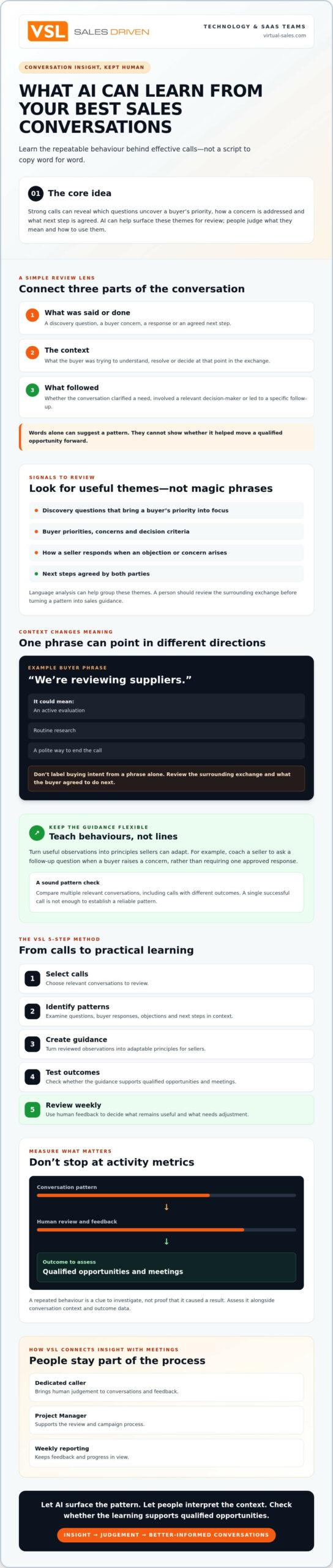
Conversation insight only has value when it leads to guidance you can test. The VSL 5-Step Method below is a practical editorial framework for reviewing calls and checking whether guidance supports sales outcomes. It isn’t a named software product, and it doesn’t imply that VSL trains AI on client conversations.
The VSL 5-Step Method for testing conversation insights
- Step 1: Select representative calls. Choose conversations from relevant buyer types and sales stages. Record why each call belongs in the review set, including its outcome.
- Step 2: Identify patterns. Have human reviewers note recurring buyer needs, useful responses and next-step behaviours. Separate observations from assumptions about what caused a call to progress.
- Step 3: Create flexible guidance. Turn a supported pattern into a prompt or coaching question, not a prescribed script. For example, remind sellers to clarify a buyer’s concern before responding.
- Step 4: Test outcomes. Apply one guidance change at a time. Define a baseline using comparable calls and consistent qualification criteria.
- Step 5: Review weekly. Check results and feedback, then keep, revise or remove the guidance. VSL’s service model includes weekly reporting and feedback between callers and clients.
Which results should teams track?
Connect the behaviour being tested to sales progress. Track qualified meetings, the proportion that meet your agreed criteria and subsequent campaign progression. Define how each measure is counted, the measurement period and the number and type of calls reviewed. For a conversion rate, record both the numerator and denominator so teams can compare like with like.
Test conversation insight against a defined baseline and qualified outcomes, so you can assess whether guidance supports progress rather than simply changing what sellers say.
Clutch reviews provide examples of reported outcomes, not guarantees or universal benchmarks. A May 2024 client review reported 12 meetings from 564 conversations, a 5% conversation-to-meeting conversion rate. A separate February 2026 review reported an average of three new meetings each week. These are distinct client accounts and periods, so use them as context, not as evidence that a particular conversation insight caused those results. Read VSL’s Clutch reviews.
For a related approach to connecting lead assessment with pipeline progress, see how lead scoring supports sales pipeline growth. The practical value of What AI Can Learn From Your Best Sales Conversations is a testable prompt, a clear baseline and a human review process that keeps recommendations tied to business outcomes.
How VSL Connects AI Insight With Qualified B2B Meetings
AI can help teams organise information and support sales preparation, but it doesn’t replace the judgement needed to understand a buyer. VSL works as a consultative extension of your sales and marketing team, combining experienced callers with structured feedback to support B2B lead generation and appointment setting. VSL offers AI-powered services, but doesn’t claim to train AI on client calls or guarantee AI-driven campaign results.
Where experienced callers add useful market feedback
VSL pairs a dedicated caller with a Project Manager. Callers with IT backgrounds and sales and marketing experience can share structured feedback on recurring buyer questions, objections and responses during campaign activity. That market intelligence can help you review agreed key messages and decide whether your campaign direction needs adjusting.
Weekly reporting and feedback create a regular opportunity to assess what’s happening in conversations and discuss next steps. This is human-led insight, not a claim that automated tools analyse or learn from the calls. The distinction matters: experienced callers can explain context that a phrase or metric alone may not show.
When to explore an AI-informed appointment-setting approach
This approach may suit technology businesses seeking qualified conversations and a clearer feedback loop between outreach and sales. Before choosing a partner, ask how they define a qualified lead, what information their reports include, how they work with your CRM and how campaign reviews are arranged. VSL can work with your CRM system or its cloud-based CRM.
Clarify the evidence you’ll use to assess fit. Agree qualification criteria in advance, including BANT where relevant, and ask to see reporting that explains how outcomes are counted. Review meeting quality and follow-through alongside activity, and distinguish campaign evidence from broader claims. These questions help you judge whether the process supports your sales team without overstating what AI contributes.
For teams considering What AI Can Learn From Your Best Sales Conversations, the practical opportunity is to combine AI-supported preparation with human understanding of buyer needs. Keep the source of each insight clear, validate recommendations with your team and assess results against agreed measures.
Explore VSL’s AI-powered B2B lead generation and appointment setting to understand the service and discuss whether it fits your sales process.
Turn Conversation Insight Into Better Sales Outcomes
AI can help surface patterns in sales conversations, but your team must assess them in context and test them against qualified outcomes. What AI Can Learn From Your Best Sales Conversations is not a script to copy. It is behaviour your team can review, adapt and use to improve preparation and coaching.
VSL works as an extension of your sales and marketing team, with a dedicated caller and Project Manager for each client. Weekly reporting and client feedback are part of the service model. VSL states that qualified BANT leads are its minimum lead qualification outcome; this does not mean AI is trained on client calls or guarantees AI-driven campaign results.
25+ Years Helping Technology Companies Generate Qualified Sales Meetings
Every successful campaign starts with a conversation.
UK technology appointment setting.
Want to discover how AI-powered insight combined with experienced appointment setters can generate more qualified B2B sales opportunities?
Keep testing insights against clear outcomes, and give your team the human judgement to turn learning into more relevant conversations. To discuss whether VSL’s B2B appointment setting and lead generation services fit your sales process, explore VSL’s appointment-setting reviews on Clutch.
Frequently Asked Questions
What can AI learn from sales conversations?
AI can help identify recurring patterns in discovery questions, buyer priorities, objections, responses and agreed next steps. What AI Can Learn From Your Best Sales Conversations is the behaviour and context that may inform better preparation or coaching, not a set of phrases to copy. Review patterns alongside call outcomes and buyer context, then ask an experienced salesperson to check whether the suggested lesson is relevant before applying it.
Can AI analyse sales calls to identify customer objections?
Yes, AI can help group similar objections from transcripts, such as concerns about implementation, timing or fit. A person should review those groupings because buyers may use similar words to express different underlying issues. Look at the surrounding conversation and what happened next. This can help your team prepare useful questions and responses, but an objection label alone doesn’t establish buyer intent or explain why a call progressed.
How can AI learn from successful sales conversations without using scripts?
Use successful calls to identify adaptable behaviours rather than exact wording. For instance, the useful lesson may be to ask a follow-up question when a buyer raises a concern, not to repeat the seller’s original sentence. Compare examples, check the buyer and deal context, then turn supported patterns into flexible prompts or coaching questions. Test the guidance with sellers and adjust it if it limits their judgement or sounds unnatural.
What data does AI need to analyse B2B sales conversations?
Analysis may use call transcripts alongside relevant context, such as the prospect’s role, company fit, sales stage, conversation purpose and recorded outcome. That context helps reviewers interpret what was said and assess whether a pattern relates to a useful result. Before using conversation data, define its purpose, limit access to appropriate people and consider how personal information is handled. Don’t assume a transcript alone can explain buyer intent or call quality.
Is AI conversation analysis accurate enough for sales coaching?
It can inform coaching, but its output shouldn’t be treated as a definitive assessment of a seller or buyer. Transcripts may miss context, and a phrase can be interpreted differently depending on the exchange. Ask experienced salespeople to review suggested patterns against the conversation and outcome. Use the analysis to raise coaching questions, then check whether guidance is useful in practice. Keep human judgement responsible for interpreting nuance and giving feedback.
Can AI predict whether a sales conversation will lead to a meeting?
AI may estimate patterns associated with meeting outcomes if it has relevant, consistently labelled examples, but a prediction isn’t a guarantee. Buyer role, company fit, need and timing can all affect what happens next. Treat any score as a prompt for review, not a qualification decision. Check whether predicted outcomes match actual meeting quality and follow-through, and assess the model against your team’s agreed criteria before relying on it.
How should sales teams measure the results of AI conversation insights?
Set a baseline before testing a change, then track relevant outcomes such as qualified meetings, meeting quality and campaign progression. Define how each measure is counted, the review period and the number and type of conversations included. Change one guidance point at a time where practical, and compare like-for-like results. Review weekly feedback from sellers as well as the figures. This helps distinguish a useful insight from a change that simply alters call activity.

Ready for a pipeline that AI alone can’t build?
See how our lead generation powered by AI combines intelligent automation with experienced SDRs based in the UK. You can also explore our appointment setting and lead generation services.
Get me more leadsDisclaimer
Disclaimer: Content is for general information only and does not constitute professional advice. Results may vary. Virtual Sales Limited accepts no liability for actions taken based on this content.
Tags: AI sales training, Appointment Setting, B2B Sales, Lead generation, SaaS Sales, sales coaching, sales outreach, technology sales