Master the First 30 Seconds: How AI Changes B2B Sales
What if the best use of AI on a sales call is to help you sound less like a script? How AI Is Changing the First 30 Seconds of a B2B Sales Call is not about handing the conversation to software. It is about giving a caller useful account context before they speak, so the opening has a clear, relevant reason behind it.
If prospects disengage when an opener feels generic, or your team starts calls without enough insight, adding more automation may not solve the problem. Callers need preparation that helps them make better decisions in the moment. AI can help surface relevant signals, but human judgement is what turns them into a natural conversation that earns the chance to continue.
This guide explains how to use AI to prepare and support callers without making conversations feel automated. You will learn how to open with relevant context, build trust through a consultative approach and assess whether stronger openings contribute to qualified conversations and meetings.
Key Takeaways
- A relevant opening gives a busy decision-maker a clear reason to continue the conversation.
- AI can help prepare account context and support learning after calls, while the caller stays in control.
- Effective use of AI depends on accurate information, clear messaging and attentive listening.
- Use the VSL 5-Step Method to test one defined change at a time and track its contribution to qualified conversations and meetings.
- Experienced appointment setters can support consistent outreach, particularly for complex IT propositions or limited internal calling capacity.
Why the First 30 Seconds of a B2B Sales Call Set the Direction
The first 30 seconds are an opening window, not a guaranteed conversion threshold. They give a busy decision-maker a quick way to judge who is calling, why the conversation may matter and whether they are willing to continue. An unclear or company-first introduction makes it harder to earn attention from the outset.
A strong B2B call opening identifies the caller, gives a credible reason for the conversation and makes space for the prospect to respond.
This matters in Business-to-business (B2B) sales, where a call should connect a business need with a relevant offer, not simply deliver a prepared pitch. The opening is not the time for a product demonstration or a long account of your company’s history. Its job is to establish relevance and invite a useful exchange. The principle behind market and competitor research applies here: preparation should give the caller a sound reason for speaking, rather than a detail to mention for its own sake.
That is where How AI Is Changing the First 30 Seconds of a B2B Sales Call becomes a practical question. AI may help a caller find and organise account context, but the opening still depends on how a person uses that information. A prospect might correct an assumption, raise a different priority or signal that the timing is wrong. The caller needs to listen and respond, not press on with a pitch.
What should a salesperson achieve in the opening moments?
Start with a natural greeting and identify yourself clearly. Give a concise reason for calling that connects to the prospect’s business or role, then leave a pause or ask a question that gives them room to answer. For example, a caller speaking with an IT decision-maker might briefly explain the business issue the call concerns, if that context is known and relevant. The aim is a conversation, not a monologue.
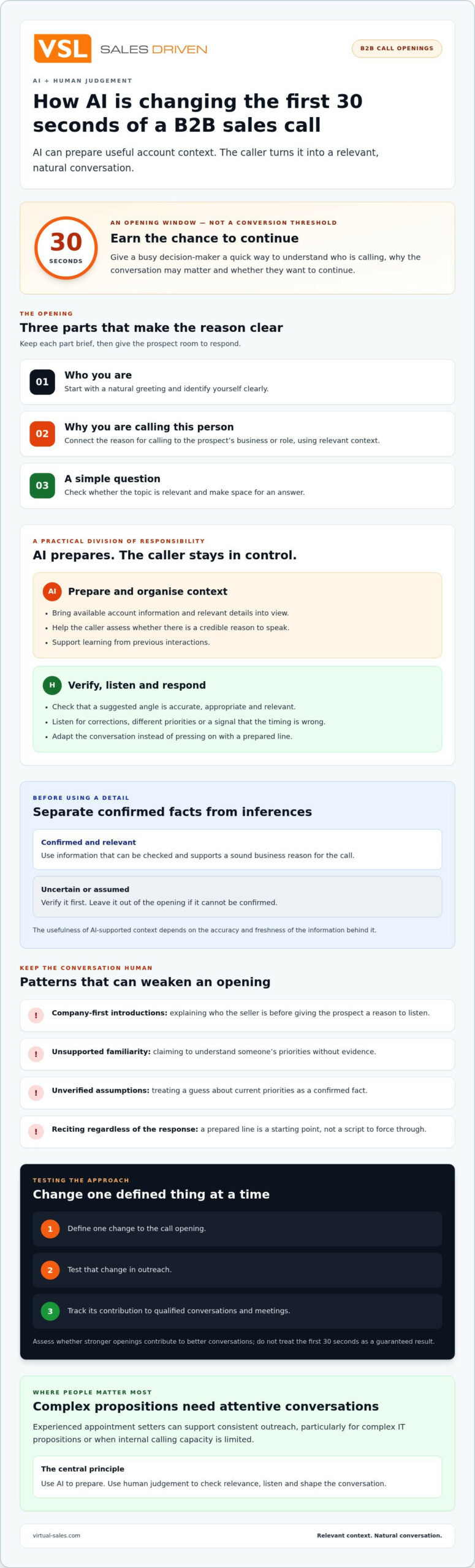
A useful opening can be prepared in three parts: who you are, why you are calling this person and a simple question that checks whether the topic is relevant. Keep each part brief. If the prospect’s response changes the direction of the conversation, follow that response rather than forcing the next prepared line.
Why do generic introductions lose attention
A company-first introduction can spend valuable opening moments explaining who the seller is before giving the prospect a reason to listen. Unsupported familiarity can also weaken credibility. Claiming to understand someone’s priorities without evidence may sound presumptuous. Relevance does not mean forcing a personal detail into the call. It means making a credible connection between what you know, the prospect’s likely business context and the reason you are calling, then checking that connection through conversation.
Keep the opening clear enough to follow and flexible enough to adapt. A prepared line is a starting point, not a script to recite regardless of the response. When the caller earns permission to continue, the next part of the conversation can explore whether there is a genuine fit.
How AI Can Prepare and Support a More Relevant Call Opening
How AI Is Changing the First 30 Seconds of a B2B Sales Call starts before the call connects. Depending on the tools and data available, AI can help organise account information, bring relevant details into view and support learning from previous interactions. Its value is preparation and focus, not a line-by-line script for the caller to recite.
AI can organise context, while the caller remains responsible for the conversation. Use that division of responsibility as a practical rule. AI may suggest a useful angle; the caller checks whether it is accurate, appropriate and relevant before using it.
What context can AI help a caller organise before dialling?
A useful pre-call view could bring together available account information, the contact’s role and the agreed ideal customer profile criteria. This helps the caller assess whether there is a credible reason to speak, rather than searching through notes while the prospect waits. The quality of the result depends on the accuracy and freshness of the underlying information.
Separate confirmed facts from inferences. A company’s published service offering is a checkable fact; a guess about its current priorities is not. Flag anything uncertain for a human to verify, and leave it out of the opening if it cannot be confirmed. Strong market and competitor research for sales can help teams build context around a sound business reason, rather than reaching for a personal detail simply to make a call seem tailored.
For example, consider a hypothetical SaaS provider calling an IT director. Its preparation notes identify the prospect’s role and a publicly stated technology focus, but offer no evidence of a current project. The caller can use the confirmed information to frame a relevant question without claiming to know the director’s priorities. This is an illustration only, not a VSL client result.
Before dialling, the caller can also check whether the contact is the right person, whether the organisation matches the agreed criteria and whether existing customer records should be excluded from prospecting. These checks help prevent an opening from relying on outdated details or addressing the wrong role.
How can live prompts help without making the call sound robotic?
If a calling system supports live prompts, treat them as optional cues, not instructions. A prompt might remind the caller to clarify a point, ask about a stated requirement or pause to listen. The caller should decide whether it fits the exchange and deliver it naturally, using agreed key messages as guardrails.
IBM’s overview of AI for sales discusses ways AI can support sales activity. Capabilities vary by tool and configuration, so check what a system actually does before relying on it. Do not read generated scripts aloud or repeat speculative output as fact. If the prospect introduces a new concern, respond to that concern rather than following a prompt that no longer fits.
After the call, AI-supported analysis may help identify recurring questions or openings worth reviewing, where the tools support that function and the use of the data has been appropriately approved. Human review keeps the learning grounded in what prospects actually said. If you are assessing an experienced appointment-setting partner, you can review VSL’s appointment-setting profile as part of your research.
AI Prompts or Human Conversation: What Works in the First 30 Seconds?
AI can support a call opening, but it cannot make an irrelevant reason for calling sound relevant. Human-only preparation, AI-assisted preparation and poorly controlled automation each produce a different experience. The right choice depends on the quality of the account context, the clarity of your agreed messages and whether the caller can listen and adapt.
With human-only preparation, a salesperson can apply experience and judgement directly, but may have to search through account notes or rely on memory. AI-assisted preparation can bring useful details into view sooner, provided the information is accurate and the caller checks it. Poorly controlled automation is different: it can push generic scripts or unverified suggestions into the conversation, leaving the caller focused on prompts instead of the person on the line.
The concern that AI can make sales calls sound impersonal is valid when prompts are followed mechanically. A prompt may be grammatically polished yet still feel wrong if it assumes a prospect’s priorities or ignores what they have just said. AI does not guarantee a stronger response, higher conversion or more meetings. It can help with preparation, but outcomes also depend on the offer, audience, timing and quality of the conversation.
When does AI assistance improve relevance, and when can it distract?
Use AI when it brings verified, relevant information into reach at the moment it can help. A concise note about a prospect’s role or a confirmed company development may help the caller frame a useful question. By contrast, long summaries, frequent alerts and unverified recommendations create extra work. If a prompt does not fit the prospect’s response, ignore it. The caller’s attention belongs on the conversation.
For example, in a hypothetical call, a contact says their team is focused on a different priority from the one suggested in the caller’s notes. A useful response is to acknowledge that priority and ask a relevant follow-up, not steer back to the prompt. This is an illustration, not a VSL client result.
A simple test is whether the information helps the caller ask a better question or respond more accurately. If it only adds detail to the opening without helping the prospect, leave it out. More personalisation is not automatically more relevant.
What makes a call opening conversational rather than scripted?
Agree the key messages and the reason for calling in advance, then treat them as guardrails rather than a word-for-word script. Identify yourself, explain the connection to the prospect and leave room for an answer. The next question should reflect what they actually said. That exchange is more useful than delivering a flawless introduction without checking whether it matters to them.
For more on the role of caller judgement in an organised calling process, read about intelligent calling versus spin dialling. The principle is straightforward: use prompts to support attention, not replace it.
A Five-Step Framework to Test AI-Assisted B2B Call Openings
To understand how AI Is Changing the First 30 Seconds of a B2B Sales Call, test the opening as part of a measured campaign, not as an isolated line of copy. Change one defined element, such as giving callers a short, verified account-context note. Keep the audience, qualification criteria and campaign period consistent where possible, and record relevant campaign context so you can interpret the results fairly.
The VSL 5-Step Method is a practical campaign framework, not a proprietary AI product. It connects preparation and caller judgement with evidence your sales team can review.
How does the VSL 5-Step Method apply to call openings?
- Step 1: Define the ideal customer profile. Specify the target organisations and relevant decision-makers.
- Step 2: Build agreed messaging. Set the reason for calling, key messages and boundaries for using account information.
- Step 3: Test outreach. Have experienced callers use the agreed approach. Record the version tested and note where context was missing or a prompt did not fit.
- Step 4: Track KPIs. Record qualified conversations, BANT outcomes and meetings booked where applicable. Note the campaign, reporting period and call or conversation totals.
- Step 5: Optimise weekly. Review campaign evidence and caller feedback, then make and document a defined adjustment.
Changing several elements at once makes results harder to interpret. If you alter both the opening and the target audience, for example, you cannot confidently attribute a change in meeting outcomes to either one. A controlled test gives your team a clearer basis for its next decision.
Which results can sales leaders measure responsibly?
Review the sequence from calls attempted to conversations, qualified conversations, BANT outcomes and meetings booked. Agree what counts as qualified before testing. For each conversion rate, state the numerator, denominator, measurement period and source. Meetings booked divided by conversations, for instance, is not the same measure as meetings booked divided by calls attempted.
A published Clutch client review reports that a contact centre solutions campaign ran for 30 hours per month and recorded 3,143 calls, 564 conversations and 12 meetings, with a reported 5% conversion from conversation to meeting. This is a specific campaign outcome, not a forecast or evidence that AI caused the result. Compare your own results using consistent definitions, then check meeting quality and sales-team feedback before deciding whether an opening change is worth keeping.
Also review what happened after a meeting was booked. Did the appointment match the agreed qualification criteria? Was the contact the appropriate decision-maker? Did the salesperson consider the conversation a useful next step? These checks add context that a meeting count alone cannot provide.
When to Combine AI Insight with Experienced Appointment Setters
AI-supported preparation can help when your team has limited calling capacity, your IT proposition is complex or you need consistent outreach to a defined audience. Account context can help callers prepare, while experienced people explain the offer and respond to prospects’ questions.
Before choosing an approach, check that your account data, messaging and qualification criteria are ready to use. Ask how callers receive feedback, how outcomes reach your sales team and whether reporting fits your CRM workflow. Virtual Sales Limited uses a cloud-based CRM and can exchange data through CSV or Excel files, or work with client CRM systems. Agree the fields, outcomes and transfer process your team needs before a campaign begins.
How can VSL support qualified B2B appointment setting?
VSL’s callers take a consultative, conversational approach based on agreed key messages. Dedicated callers and a Project Manager provide a single point of contact for each client, connecting campaign activity with the sales and marketing team. Weekly reporting and feedback help the team review progress, raise questions and make adjustments. VSL positions its service as an extension of your sales and marketing team, rather than as an AI tool vendor.
VSL specialises in B2B appointment setting and lead generation, particularly for IT and software businesses. Its callers have IT backgrounds and sales and marketing experience, which can help when a proposition involves technical products, several decision-maker roles or a considered buying process. Qualified BANT leads are the focus, rather than meetings booked without checking fit.
Explore B2B appointment setting services to consider how this activity could fit your outreach. AI can support preparation; experienced callers bring judgement to live conversations and adapt to the prospect’s response.
Make Every Opening Earn the Next Moment
How AI Is Changing the First 30 Seconds of a B2B Sales Call comes down to preparation, not automation for its own sake. AI can help organise relevant account context, but a caller still needs to judge what is accurate, explain why they are calling and listen to the prospect’s response.
Test one defined change at a time. Track qualified conversations, BANT outcomes and meetings booked, and make sure any reported conversion rate includes its source, period and denominator. This gives your team evidence to guide the next adjustment, rather than relying on assumptions about what works.
For technology businesses, experienced callers can bring useful context to complex propositions. VSL provides dedicated caller and Project Manager support, with weekly reporting and feedback. Its callers have IT backgrounds and take a consultative, non-scripted approach, helping the campaign work as an extension of your sales and marketing team.
Start with a clear reason to call, stay responsive to the conversation and use campaign evidence to keep improving. To discuss how VSL’s B2B appointment setting and lead generation services could support your outreach, review VSL’s appointment-setting profile.
Frequently Asked Questions
What should happen in the first 30 seconds of a B2B sales call?
Identify yourself, give a clear and relevant reason for calling, then allow the prospect to respond. The opening is a chance to establish context and invite a conversation, not to deliver a full company introduction or product pitch. Keep the reason credible and concise. If the prospect signals a different priority or says the timing is not right, listen and adapt rather than continuing with a prepared monologue.
Can AI help a salesperson during a live B2B call?
It can, if the chosen system supports live assistance and the caller finds its prompts useful. How AI Is Changing the First 30 Seconds of a B2B Sales Call includes preparing relevant context and, where available, offering cues to help a caller clarify or follow up. Check the tool’s actual capabilities before relying on them. Prompts should support attention and judgement, not distract the caller or dictate what to say.
How can AI make a sales call sound less generic?
AI can help organise available account information, the contact’s role and details relevant to your ideal customer profile. The caller can use verified context to explain why the conversation may matter to that prospect. Check facts before using them, and separate evidence from assumptions. Personalisation is not adding a detail for its own sake; it is making a credible connection and asking a question that gives the prospect room to respond.
Will AI replace human B2B sales callers?
AI can support research and preparation, but it does not replace human judgement in a live conversation. A caller needs to interpret tone, respond to unexpected questions and adjust when a prospect raises a different concern. This is particularly relevant for complex IT propositions, where the discussion may need to follow the prospect’s specific context. Treat AI as an input to better-prepared calls, with experienced callers responsible for the conversation.
How do you measure whether an AI-assisted call opening works?
Define the opening change and qualification criteria before testing, then compare results over a stated period. Track calls, conversations, qualified conversations, BANT outcomes and meetings booked where applicable. For each conversion rate, record the numerator, denominator, period and data source. Review feedback from the sales team as well: booked meetings matter more when the conversation matches your requirements and supports a relevant next step.
Should salespeople read AI-generated scripts word for word?
No. Use generated wording as a draft or prompt, then check it for accuracy and fit with your agreed key messages. Reading it verbatim can make the exchange sound unnatural and make it harder to respond to what the prospect says. A caller should be able to introduce themselves, explain the reason for calling in their own conversational style and change direction when the prospect’s response calls for it.
Can an appointment-setting agency work with our CRM?
CRM arrangements depend on the agency’s systems and your campaign requirements, so confirm the process before work begins. Virtual Sales Limited uses a cloud-based CRM and can exchange data through CSV or Excel files, or work with client CRM systems such as Salesforce. Agree which fields, outcomes and reporting your sales team needs, and how campaign information will be transferred. This helps ensure appointment and qualification details fit your follow-up workflow.

Ready for a pipeline that AI alone can’t build?
See how our AI SDR support combines intelligent automation with experienced SDRs based in the UK. You can also explore our appointment setting and lead generation services.
Get me more leadsDisclaimer
Disclaimer: Content is for general information only and does not constitute professional advice. Results may vary. Virtual Sales Limited accepts no liability for actions taken based on this content.
Tags: AI in Sales, Appointment Setting, B2B sales calls, Lead generation, sales outreach, sales prospecting, Telemarketing