Essential Human Skills AI Cannot Replace in B2B Sales
What if the biggest risk in B2B sales isn’t that AI replaces your team, but that automation makes every prospect conversation sound the same? For technology and SaaS businesses, The Human Skills AI Cannot Replace in B2B Sales are the ones that turn buyer context into relevant, qualified next steps.
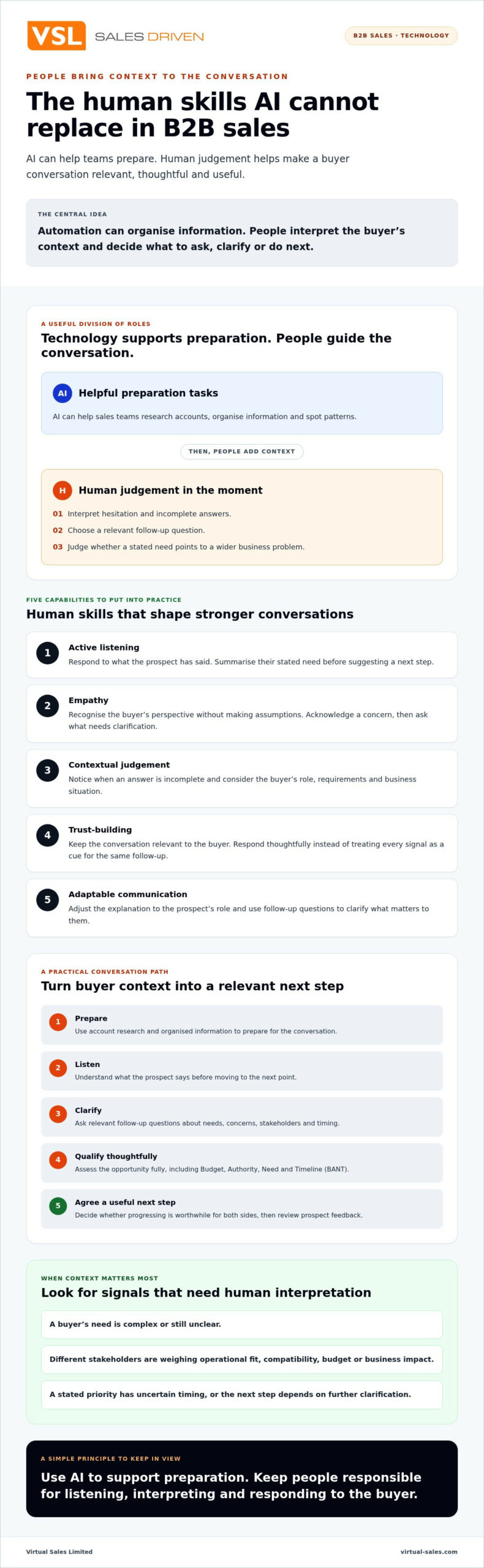
AI can help sales teams research accounts, organise information and spot patterns. It can’t reliably interpret hesitation, choose the right follow-up question or judge when a stated need points to a wider business problem. You may be weighing up which tasks to automate without weakening trust or making outreach feel impersonal. That balance matters in complex sales, where relevance and sound judgement help a conversation progress.
This article explains which human capabilities make a practical difference, how to build them into repeatable team behaviours, and where AI can support your sales process without taking over the buyer conversation. You’ll also find ways to qualify opportunities thoughtfully and assess whether a next step is worthwhile for both sides.
Key Takeaways
- Identify where human judgement adds value, especially when a buyer’s needs are complex or unclear.
- The Human Skills AI Cannot Replace in B2B Sales include listening, empathy, contextual judgement, trust-building and adapting communication to the conversation.
- Define your ideal customer profile clearly and qualify opportunities fully to keep sales conversations relevant.
- Use a practical framework to prepare your proposition, engage consultatively, qualify to BANT and review prospect feedback.
- Consider human-led B2B appointment setting when entering a market, targeting a new ICP or building qualified pipeline with a dedicated caller and campaign manager.
Why human skills still matter in B2B sales when AI handles more tasks
AI can help sales teams research accounts, organise information and prioritise activity. But activity creates value only when it leads to a relevant conversation. In technology sales, a buyer may need to weigh operational fit, internal priorities and timing before deciding whether to take a next step. Human judgement helps a salesperson respond to that context, rather than simply deliver more information.
This isn’t a choice between people and technology. AI-supported prospecting can help teams prepare; human interaction helps them test assumptions, understand what matters to a buyer and decide what should happen next. That distinction is central to The Human Skills AI Cannot Replace in B2B Sales, without suggesting that AI cannot perform any individual sales task.
What counts as a human skill in B2B sales?
Human sales skills are the judgement, listening and relationship behaviours people use to understand a buyer and guide a useful business conversation. They include noticing when an answer is incomplete, asking a relevant follow-up question and adapting an explanation to the prospect’s role.
These capabilities differ from routine administrative work, such as recording details or organising research, which technology may support. For example, if a prospect says a software project is under review, a salesperson might ask who else needs to assess it and what would make the timing workable. The answer can clarify the prospect’s needs and help shape an appropriate next step.
Why technology buyers need more than information
A technology purchase can affect several teams. A technical lead may focus on compatibility, whilst a finance stakeholder considers budget and a business leader weighs the expected impact. Their priorities may not align, and the original requirements may still be uncertain. A generic message can provide facts without resolving those questions.
A useful conversation makes space for clarification. If a prospect says a new platform is a priority but can’t confirm timing, the salesperson can explore what needs to happen before a decision. That response is more relevant than assuming the buyer is ready or pushing for a meeting without understanding the context.
Listening and responding with empathy are part of emotional intelligence, which offers a useful way to understand how people recognise and manage emotions. In sales, these behaviours help a representative recognise concerns and respond thoughtfully, rather than treat every buyer signal as a prompt for the same follow-up.
For a practical view of how judgement can guide technology-supported selling, see VSL’s article on human judgement in AI-supported sales. The aim is not to resist automation. It’s to use it where it supports preparation, whilst keeping buyer context at the centre of the conversation.
Five human sales skills that shape stronger B2B conversations
Knowing which capabilities matter is useful. Making them visible in day-to-day sales behaviour gives managers something concrete to coach. The Human Skills AI Cannot Replace in B2B Sales are not abstract personality traits; they show up in how a salesperson listens, responds and decides what to do next.
Listening and empathy reveal what the buyer actually needs
Active listening means responding to what the prospect has said, rather than rushing to the next point. A leader can coach this by asking salespeople to summarise a buyer’s stated need before suggesting a next step.
Empathy means recognising the buyer’s perspective without making assumptions. If a prospect raises a concern about implementation, a salesperson can acknowledge it and ask which part needs clarification. Follow-up questions should uncover relevant business context, not seek private information.
Listening helps clarify both the requirements a prospect states and the concerns they may not yet have put into words.
Judgement and trust keep conversations relevant
Contextual judgement helps a salesperson choose whether to clarify, qualify or agree a suitable next step. If a prospect mentions an internal review, for example, the salesperson can pause the planned discussion and ask what the review needs to establish.
Trust-building comes from consistent, prepared and clear communication. Sales leaders can observe whether representatives set accurate expectations, answer questions honestly and follow through on agreed actions. Trust isn’t a promise of a particular outcome; it’s the basis for a credible business relationship.
Adaptive communication puts the buyer’s priorities first
Adaptive communication is the ability to adjust language, pace and detail to suit the person and situation. A technical stakeholder may want to discuss requirements, whilst a commercial decision-maker may need a concise explanation of the business issue. Coach this behaviour by reviewing whether the salesperson checks what the buyer wants to cover and adjusts accordingly.
These five skills can be practised in team reviews. Discuss a real interaction, identify the buyer’s question or concern, then agree on one behaviour to repeat or improve. This turns broad advice such as “be more empathetic” into observable actions tied to prospect understanding and qualification.
For an example of how buyers assess an appointment-setting partner, review VSL’s appointment-setting reviews on Clutch.
Common mistakes that weaken human-led B2B sales conversations
Human judgement can only help when the sales process gives it room to work. In technology prospecting, four avoidable mistakes can make conversations less relevant and leave sales teams with a less useful picture of their pipeline.
- Weak ideal customer profile (ICP): If target companies and decision-makers aren’t clearly defined, outreach can reach businesses with little connection to the offer. Time and attention are then spent on conversations that may not fit the intended market.
- Generic conversation: A one-way product pitch can overlook the prospect’s priorities. The buyer has to work out the relevance for themselves, and the salesperson may miss useful context.
- Volume-first measurement: Counting activity alone shows what the team did, not whether conversations reached relevant decision-makers or uncovered a genuine need. It can also hide what prospects are saying about the proposition.
- Incomplete qualification: Recording interest without checking the need, decision-making authority, budget context and timing leaves gaps for the next sales conversation. The account team may not know what to explore or who else should be involved.
When outreach feels generic or fails to respond to context
Effective outreach starts with a relevant reason for contacting the prospect, then makes room to understand their situation. A one-way pitch keeps delivering product points even after the buyer raises a different concern. A rigid message can miss requirements such as an upcoming review, an existing system constraint or uncertainty about who owns the decision.
Consultative outreach adapts through questions and responses rather than relying on a set sequence of lines. For a wider view of how technology can support preparation whilst people lead the buyer conversation, see VSL’s article on the B2B sales stack and human conversation.
Real Insight: Let prospect feedback guide the next question
Illustrative technology-sales scenario, not a VSL client result: A company offering cloud software contacts an operations leader who says the team is interested but needs input from its information security team. Rather than treating interest as sufficient qualification, the caller can ask what that team needs to assess and who coordinates its review. The answer may clarify the decision process and indicate whether to qualify further or agree a suitable follow-up.
This is a practical way to use feedback: adjust the next question to what the prospect has actually said, then record what remains unknown. It keeps the conversation relevant without assuming that interest means readiness.
When activity measures replace meaningful qualification
Review activity alongside prospect feedback and qualification notes. Ask what buyers questioned, where the proposition was unclear and whether the next step was agreed. This helps managers coach the next conversation, not just report the last one. The same principle applies when AI informs prioritisation: human judgement in AI-supported sales helps a team assess context before acting on a signal.
The Human Skills AI Cannot Replace in B2B Sales become easier to develop when teams review buyer responses and turn them into better questions, clearer qualification and more relevant follow-up.
A practical framework for developing human skills in B2B sales
Human skills become repeatable when teams connect them to clear campaign behaviours. This practical five-step framework links preparation, conversation, qualification and review so your team can learn from buyer responses. It is a guide for organising the work, not a promise of a particular result.
- Define the ideal customer profile. Specify the target companies and decision-makers. This gives the team a clear basis for preparing relevant conversations.
- Prepare the proposition. Clarify what the technology does, which business needs it may address and what questions can help assess fit. Product knowledge should inform the conversation, not dictate a fixed pitch.
- Engage consultatively. Ask relevant questions, listen to the answers and check your understanding. Respond to the prospect’s context rather than forcing the discussion back to a set sequence.
- Qualify to BANT. Explore Budget, Authority, Need and Timeline. Record what the prospect confirms, and distinguish it from assumptions.
- Review feedback. Consider campaign activity, qualification details and prospect feedback together. Use what you learn to refine the proposition and future questions.
From ideal customer profile to a relevant conversation
The ICP shapes campaign preparation, but it can’t tell you everything about an individual prospect. A caller who understands the proposition can ask focused questions and use active listening to clarify the answers. If a prospect mentions an upcoming systems review, for example, the caller might ask what the review needs to establish before discussing an appropriate next step.
A qualified BANT lead is a prospect assessed against the agreed minimum criteria for Budget, Authority, Need and Timeline; it is not a label for every person contacted. If a qualification area remains unknown, note the gap and decide whether to clarify it or follow up later.
Use feedback and evidence to improve the approach
Each VSL campaign has a dedicated caller and campaign manager, with weekly campaign reporting. Use the reports to review call metrics, recorded outcomes and prospect feedback, then identify questions or concerns that may call for a change in approach. Calls aren’t recorded, so this review should not be described as listening back to recordings.
Results, Evidence & Data
Use campaign reporting to assess activity, qualification detail and prospect feedback together. VSL provides weekly reporting, and leads are qualified to BANT criteria as a minimum. These service details describe the approach, not a guaranteed campaign result. Look at what prospects confirmed, what remains unknown and whether the agreed next step fits the buyer’s circumstances. Verify any external finding against its original source before using it to support a performance claim.
For more on the role of judgement alongside sales technology, see human judgement in AI-supported sales. This process makes The Human Skills AI Cannot Replace in B2B Sales easier to practise and assess without overstating what the evidence shows.
When human-led B2B appointment setting can support your sales team
Human-led appointment setting can support your team when internal capacity makes regular prospect conversations difficult, or when you’re entering a market, targeting a new ideal customer profile or building qualified pipeline. It can add focused outreach whilst your salespeople concentrate on active opportunities and later-stage conversations.
Virtual Sales Limited (VSL) provides B2B Appointment Setting and Lead Generation for technology companies. A dedicated caller and campaign manager work as an extension of your sales and marketing team, with conversations qualified to BANT criteria as a minimum. Explore our UK technology appointment-setting services to see how this support may fit your sales activity.
Signs your team may benefit from appointment-setting support
Consider support if prospecting is inconsistent, your team is reaching new decision-makers, or you need to test whether a new market or ICP merits further attention. Set clear objectives and qualification criteria, without assuming a particular volume of appointments or leads.
What to assess before choosing a human-led approach
Review caller experience, how BANT qualification will be applied and what campaign reporting will cover. Virtual Sales Limited provides weekly reporting and flexible monthly subscriptions. Use prospect feedback and campaign outcomes to discuss whether the approach remains aligned with your priorities.
If you want to explore how experienced UK-based appointment setters can support your B2B sales pipeline, professional outsourced teams can seamlessly integrate with your existing commercial strategy to deliver consistent results.
Experienced support for technology companies seeking qualified sales meetings
Every successful campaign starts with a conversation, bridging the gap between automated lead generation and meaningful human engagement.
Put human judgement at the heart of your sales process
The Human Skills AI Cannot Replace in B2B Sales are the behaviours that make a conversation relevant: listening closely, adapting to buyer context and asking thoughtful questions. AI can support sales activity, but teams still need clear qualification and human judgement to decide what a prospect’s responses mean and what to do next.
Make these behaviours practical. Coach your team to clarify requirements, assess Budget, Authority, Need and Timeline, and agree an appropriate next step. Review prospect feedback alongside campaign activity so your approach responds to what buyers actually say.
VSL supports technology companies with experienced UK-based callers, consultative, script-free conversations and qualification to BANT criteria as a minimum. A dedicated campaign manager and weekly reporting help keep campaign activity and feedback visible to your team.
If you’re considering human-led support for your sales conversations, discuss whether VSL’s approach fits your priorities.
Clear goals and relevant conversations are a strong place to start. Keep building a sales process that respects your buyers’ needs.
Frequently Asked Questions
Which human skills matter most in B2B sales?
Active listening, empathy, contextual judgement, trust-building and adaptive communication help salespeople understand what a buyer needs and respond appropriately. Make these skills practical by coaching observable behaviours: summarise a prospect’s point, ask a relevant follow-up question, acknowledge a concern and agree a suitable next step. In technology sales, these behaviours help teams explore different stakeholder priorities without assuming that every buyer has the same requirements.
Can AI replace human salespeople in B2B sales?
AI can support sales tasks such as research, organising information and prioritising prospects, but that doesn’t mean it can replace every part of a salesperson’s role. Complex B2B discussions can involve changing requirements, competing stakeholder priorities and uncertainty about timing. Human salespeople can listen, clarify what a buyer means and use judgement to decide whether to qualify further, respond to a concern or agree an appropriate next step.
How does active listening help B2B sales conversations?
Active listening helps a salesperson understand a prospect’s stated need before recommending what to discuss next. Rather than moving straight into a product pitch, they can summarise what they heard and check it’s accurate. A relevant follow-up question may clarify who is involved in a decision or what a business review needs to establish. This gives the team better context for qualification and a more relevant handover.
What does human judgement add to AI-supported sales?
Human judgement helps a salesperson assess whether information or a prospect signal fits the situation. AI may support research or prioritisation, but a person can ask whether the data reflects the buyer’s current need, authority and timing. The Human Skills AI Cannot Replace in B2B Sales include deciding when to clarify an assumption, respond to an objection or pause rather than push for a next step that doesn’t suit the prospect.
How can a B2B sales team measure human skills?
Assess behaviours, not personality. In team coaching, check whether the salesperson summarised the buyer’s point accurately, asked relevant follow-up questions, adapted to new information and confirmed agreed next steps. Pair these observations with qualification notes and prospect feedback. Activity figures can show what the team did, whilst feedback and qualification detail help leaders understand the quality and relevance of the conversations.
When should a technology company consider B2B appointment setting?
Consider it when internal capacity makes regular prospect conversations difficult, when entering a market or targeting a new ideal customer profile, or when building qualified pipeline is a priority. Virtual Sales Limited provides B2B Appointment Setting and Lead Generation for technology companies. Its experienced UK-based callers and dedicated campaign manager work as an extension of the client’s sales and marketing team, with conversations qualified to BANT criteria as a minimum.
What does BANT qualification mean?
BANT is a qualification framework covering Budget, Authority, Need and Timeline. It helps sales teams assess whether a prospect’s circumstances meet agreed criteria for further engagement. A caller might explore whether a relevant need exists, who is involved in the decision and when the organisation may act. A qualified BANT lead has been assessed against the minimum criteria; not every prospect contacted will meet them.

Ready for a pipeline that AI alone can’t build?
See how our AI sales development combines intelligent automation with experienced SDRs based in the UK. You can also explore our appointment setting and lead generation services.
Get me more leadsDisclaimer
Disclaimer: Content is for general information only and does not constitute professional advice. Results may vary. Virtual Sales Limited accepts no liability for actions taken based on this content.
Tags: AI in Sales, B2B Appointment Setting, B2B Sales, bant qualification, consultative outreach, sales qualification, technology lead generation