B2B Lead Generation for a Product Launch: How to Build Your Sales Pipeline
More launch activity doesn’t automatically create a stronger sales pipeline. For UK technology and SaaS teams, B2B lead generation for product launch can attract plenty of interest while leaving sales unsure which accounts have a genuine need, who influences the decision or what to do next.
You’re right to focus on the quality of early conversations. A launch is a chance to test your proposition with prospective buyers, but only if outreach reaches the right companies and gives your team a clear way to qualify interest. Without that structure, useful feedback can get lost and activity may not progress into relevant opportunities.
This guide shows you how to build a launch-ready playbook: define your ideal customer profile and decision-maker audience, connect launch messaging with consultative outreach, and qualify prospects against clear criteria. It also explains how to capture questions and objections from the market, review campaign reporting and use those insights to refine follow-up. The aim is to make each conversation serve two purposes: developing qualified pipeline and helping your team understand how the product meets buyer needs.
Key Takeaways
- Define the companies and decision-makers most likely to benefit before planning launch outreach.
- Build B2B lead generation for product launch around clear messaging, relevant conversations and purposeful follow-up.
- Prepare specialist support with a shared brief and product training so prospects hear a well-informed proposition.
- Use qualification and prospect feedback to distinguish genuine opportunities from general interest.
- Review campaign reporting regularly and refine your approach as you learn more about buyer needs.
Why B2B lead generation matters when launching a new product
A launch plan can look convincing on paper and still miss what buyers actually need. Before assumptions about demand shape your sales targets, messaging and resource plan, create conversations with the companies the product is intended to help. B2B lead generation for product launch gives your team a structured way to identify those businesses, engage relevant decision-makers and assess their responses.
Launch lead generation connects a new product’s use case with relevant business buyers, then turns genuine interest into qualified sales conversations and actionable market feedback. General launch promotion builds awareness; lead generation is focused on identifying and engaging prospective business customers to create qualified opportunities. Lead Generation provides a general overview of the discipline, while a B2B launch playbook applies it to a specific offer, audience and commercial goal.
Lead generation and appointment setting are related, but not interchangeable. Lead generation identifies and engages prospective business customers. B2B appointment setting focuses on engaging business decision-makers to generate qualified sales appointments. A launch campaign may include both: first establishing whether an account has a relevant need, then arranging a suitable next conversation with sales.
What product launch lead generation is designed to do
Start with the product’s use case, not a broad list of possible buyers. For example, if a new software offer is designed to help IT teams manage a defined operational problem, identify the types of organisations likely to face that problem and the roles involved in assessing a solution. This gives outreach a clear reason to engage, rather than relying on a general announcement about the launch.
The aim is to create a sensible route from initial interest to a qualified conversation. A prospect might ask how the product fits an existing process, what it replaces or which team would own implementation. Those questions help sales establish whether there is a genuine business need and agree the right follow-up. An expression of interest is a starting point, not automatically a sales opportunity.
Early responses are evidence about the people contacted and the proposition they heard. They can reveal unclear language, unexpected use cases or questions that sales needs to answer. They don’t, by themselves, prove market-wide demand. Treating feedback carefully helps your team refine the offer without turning a small number of conversations into a broad market conclusion.
How lead generation supports a technology launch
Focused outreach puts the proposition in front of intended buyers and tests whether they understand its relevance. If several prospects interpret the same feature differently, that may signal a need to sharpen the explanation. If a particular role raises a practical concern, sales and marketing can decide whether to adjust the conversation, supporting content or follow-up.
Qualification also helps sales prioritise. A relevant business need, access to an appropriate decision-maker and a credible next step give the team more to work with than a response alone. Clear campaign outcomes make it easier to see which conversations need prompt follow-up, which should be revisited later and which offer useful learning without matching the current target.
For sector-specific guidance on reaching technology buyers, explore technology lead generation for B2B companies. VSL’s B2B lead generation services support technology companies by engaging relevant business decision-makers and developing qualified opportunities.
What a product launch lead generation playbook needs to define
A launch playbook turns a product idea into a repeatable plan for reaching buyers and learning from their responses. Before outreach begins, agree who the campaign is for, what problem the product addresses, how the conversation should progress and what sales should do with each outcome. Without these decisions, teams can contact accounts using different assumptions and struggle to compare feedback.
A clear ideal customer profile focuses launch outreach on the companies and decision-makers most likely to have a relevant need. An ideal customer profile (ICP) describes the target companies and decision-makers most relevant to a campaign. It should guide account selection, message development and qualification, rather than remain a broad description such as “mid-sized businesses interested in technology”.
Set the launch audience and proposition
Define company characteristics that relate to the product’s use case, such as its operating model, existing technology or the business process it aims to support. Then identify relevant roles. A software product affecting forecasting might involve Sales leadership, Marketing operations or Finance, depending on who owns the process and its results.
Describe capabilities in terms of buyer problems, but avoid claiming results the product hasn’t demonstrated. List the assumptions outreach should test: Is the problem recognised? Who owns it? Is it a current priority? How does the buyer judge the offer’s value? Clear questions help sales distinguish a genuine concern from polite interest.
Agree qualification and sales handover
Set shared qualification language before the first conversation. BANT assesses Budget, Authority, Need and Timeline. Agree what evidence counts for each: whether budget is allocated or still being explored, how the contact influences the decision, what business requirement they described and when they expect to address it. Don’t treat an unanswered question as a confirmed qualification.
Next, decide which outcomes need direct sales follow-up, which require further nurturing and which should be closed as unsuitable. Specify the handover details: the prospect’s role, organisation, stated need, relevant buying context, agreed next step and any open questions. This gives sales a useful starting point and reduces the risk of asking buyers to repeat information.
For SaaS teams, decisions about qualification and handover should also fit the wider pipeline process. SaaS lead generation for scalable growth offers related guidance on connecting lead generation with sustainable pipeline development.
Make the playbook useful after launch
Document the proposition, conversation priorities, agreed qualification criteria, outcome categories and follow-up ownership in one shared brief. Add a simple review process: capture recurring questions, objections, unexpected use cases and reasons prospects decline. At regular campaign reviews, decide whether each insight warrants a change to targeting, messaging or qualification. Keep the original learning visible so the team can see what changed and why.
This is the foundation of B2B lead generation for product launch: a defined audience, a testable proposition and a consistent route from buyer response to sales action. If independent client feedback would help inform your planning, explore VSL’s appointment-setting reviews on Clutch.
How to address the concern that outsourced teams will not understand a new product
A new product can be difficult to explain in a first conversation, especially when its value depends on a particular technical or operational context. The answer isn’t to expect an external team to become product specialists overnight. It’s to prepare them to explain the offer accurately, ask relevant questions and recognise when a query needs your team’s input.
Your product and sales teams remain responsible for product strategy, technical detail and approved claims. External outreach can support prospect engagement and qualification, but it shouldn’t make promises or interpret product capabilities beyond the brief. Clear boundaries protect buyer trust and give callers a reliable way to handle questions they can’t answer.
Prepare callers to represent a technical proposition accurately
Build a shared brief covering the product’s intended use cases, buyer terminology, target organisations, product boundaries, relevant alternatives and approved claims. Use a project set-up call to align on campaign actions and responsibilities, then provide kick-off training on the proposition. Clarify how callers should respond when a prospect raises a technical question that needs input from a product specialist.
Connect capabilities to business problems. If a product supports a particular workflow, for instance, outreach can explore how the prospect manages that process today, which teams are involved and where difficulties arise. The conversation should adapt to the contact’s role without making unsupported claims about results or performance.
A practical launch scenario: Imagine a software company introducing a new workflow tool to IT and operations leaders. In early conversations, prospects understand the stated feature but ask who would own implementation. The campaign team captures that question and shares it with the client. The product and sales teams can then clarify the ownership message in training and decide whether future conversations should explore implementation responsibilities earlier. This is an illustrative scenario, not a reported VSL client result.
Use feedback without treating every response as demand
Separate curiosity from a future opportunity and from a qualified lead. Record what the prospect said, their role, the business context and the agreed next step. That gives sales more to work with than a simple positive or negative label, while keeping a buyer’s initial interest distinct from evidence of purchase intent.
Look for repeated themes across relevant conversations before changing the proposition. If several buyers raise the same concern, consider whether the message needs clarification. If one prospect raises an unusual objection, record it, but don’t treat it as proof of a wider market problem. For opportunities that progress, clear ownership and next steps help sales maintain momentum through the B2B sales pipeline.
VSL’s consultative approach is designed to support informed business conversations. If you’re assessing how clients describe that experience, consider the published VSL appointment-setting reviews on Clutch alongside your launch requirements.
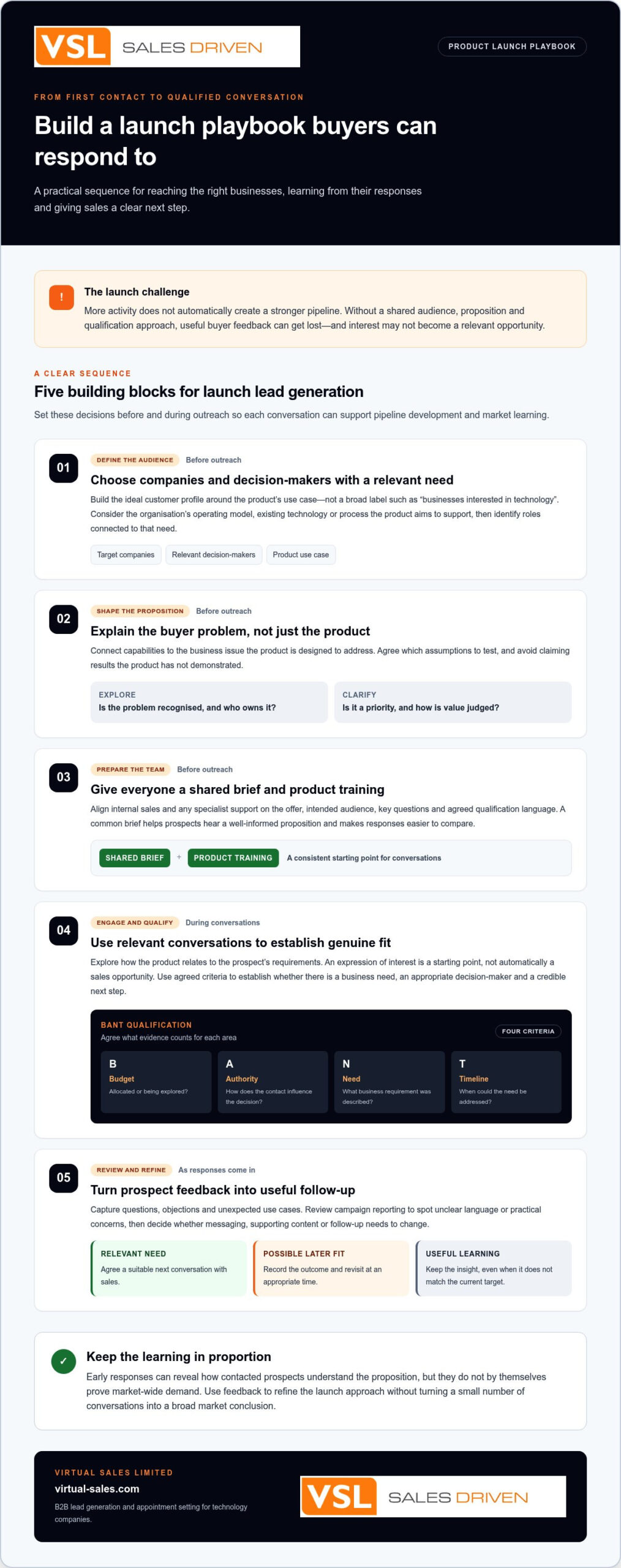
How to build and run a B2B lead generation launch playbook
Turn your launch objectives into a working campaign plan before outreach starts. Agree what the campaign needs to learn or achieve, then define the intended audience and the accounts that fit it. This keeps prospect selection connected to a clear purpose, such as testing a new use case or reaching buyers in a new vertical.
Before launch: define, prepare and align
Set the launch audience, proposition, relevant buying roles, campaign actions and timescales. Select target accounts against the agreed profile, then source company and contact data that includes the fields needed for sensible follow-up. Use a project set-up call to settle responsibilities and campaign processes, followed by training on the offer, its use cases and the boundaries of approved claims.
During launch: engage, qualify and improve
Use consultative, script-free conversations to explore prospects’ requirements. Capture agreed outcomes and useful context, including the contact’s role, stated business need and next action. Review the information with your team to decide which conversations warrant sales follow-up and which offer learning for later nurturing.
The VSL launch framework:
- Define: Set the campaign objective, ideal customer profile and target accounts.
- Prepare: Align the proposition, approved claims, buyer roles and handover process.
- Engage: Start relevant business conversations and capture prospect responses.
- Qualify: Apply the agreed criteria and record the evidence behind each outcome.
- Review: Assess campaign patterns and adjust targeting or messaging when the evidence supports a change.
Use campaign reporting and buyer feedback together. If the right accounts aren’t engaging, revisit your selection criteria. If prospects repeatedly misunderstand the same part of the proposition, work with your product and marketing colleagues to sharpen the explanation. Treat changes as informed tests, not guaranteed routes to a particular outcome.
When to use specialist B2B lead generation for a product launch
Specialist support may suit a launch when you’re entering a new market, targeting a different vertical or introducing a technology offer to buyers your team hasn’t engaged before. It can also help when internal sales capacity is focused on active opportunities and customer commitments, leaving little time for consistent prospecting.
Signals that your launch team may need additional outreach capacity
- Your team has a defined launch audience but struggles to make prospecting a regular part of its workload.
- You want to test whether a new type of organisation recognises the problem your product addresses.
- You need a clearer view of which account types and buyer roles engage, and what questions they raise.
Internal-only outreach offers direct ownership, but depends on your team having time and the right skills available. Specialist support can add focused campaign capacity and an external perspective, while your team retains control of product strategy, messaging approval and sales follow-up. The right choice depends on the proposition, target market, internal capacity and what you want the launch activity to establish.
Results, evidence and data to review
Judge a launch campaign by the quality and relevance of its outcomes, not activity totals in isolation. Review whether conversations involve accounts that match the intended audience, whether prospects describe a relevant need, and whether sales accepts the handovers for follow-up. Compare themes by account type and role before changing your targeting or proposition; isolated responses are useful context, not proof of wider demand.
Published client feedback can provide qualitative context about working with a provider, whilst campaign measures show what happened in a particular outreach programme. Consider both forms of evidence carefully. VSL’s published appointment-setting feedback on Clutch offers client perspectives; it should not be treated as a forecast of results for a different launch.
How VSL can support a technology product launch
VSL works as an extension of a technology company’s sales and marketing team, supporting prospect engagement and sharing campaign learning for your team to assess. This can be useful when you need structured outreach to explore a new audience while keeping product decisions and commercial priorities with your own people.
If you’re weighing up support for a launch, consider whether a focused conversation about your audience and campaign goals would help clarify the next step. VSL’s UK technology appointment-setting service is relevant to businesses planning that outreach.
Put your launch plan into action
Your next step is to turn the playbook into a focused campaign, with a clear audience, a proposition buyers can understand and agreed criteria for sales follow-up. Treat each conversation as a chance to develop pipeline and learn what prospective customers need, then use that learning to sharpen the next stage of your launch.
VSL has supported technology companies in the UK and USA since 2001. If you’re considering specialist support, a discovery call is an opportunity to discuss your launch audience, campaign goals and how outreach could fit alongside your sales and marketing team.
A considered approach to B2B lead generation for product launch gives your team a practical basis for action. Start with the buyers who matter, stay curious about their feedback and build from what you learn.
Frequently Asked Questions
What should a B2B product launch lead generation plan include?
It should include a campaign brief, agreed ownership and a route for handling questions the outreach team can’t answer. Set a process for escalating technical queries to product specialists, and decide who approves changes to messaging as the offer develops. Also agree what happens when sales receives a handover: who responds, where the next action is logged and how the launch team shares progress with marketing.
How do you identify the right B2B audience for a new product launch?
Start with the business problem the product addresses, then look for organisations where that problem is likely to arise. Use observable signals such as relevant technology, operating processes or a current business initiative to refine account selection. Map the people who experience the problem, assess solutions or approve action. For example, a user may describe workflow challenges, whilst a department leader owns the decision to address them.
How can a business qualify leads for a product launch?
Use consistent questions to understand whether the prospect has a relevant requirement and a credible next step. For example, if a prospect expresses interest but can’t explain the business issue or involve the relevant decision-maker, record that context rather than treating interest alone as sales readiness. Agree how to handle gaps in information, and pass useful notes to sales so the next conversation can build on what the buyer has already shared.
When should lead generation start before a B2B product launch?
Start planning when the team can explain the intended buyer, product use case and boundaries of the offer, even if launch details are still being refined. Outreach can begin once sales has enough approved information to hold accurate conversations and capture feedback. Work backwards from internal milestones, including product readiness, sales training and follow-up capacity. Avoid setting a start date that leaves no time to act on what early conversations reveal.
Can outsourced lead generation support a technical product launch?
Yes, specialist support can add focused prospecting capacity while your product team retains responsibility for technical accuracy and product decisions. For instance, an outreach partner can explore how a prospect handles a relevant business process, then route detailed architecture or security questions to your specialists. A clear escalation path helps keep conversations useful without asking callers to make claims beyond the approved product brief.
How should sales teams use feedback from product launch outreach?
Log feedback with enough context to interpret it: account type, contact role, use case and the question or objection raised. Then compare themes across similar prospects before changing the proposition. If buyers in one segment repeatedly misunderstand a feature, review the explanation for that audience. If feedback varies by role, consider whether each group needs different supporting information, rather than treating all responses as evidence of the same issue.
What is the difference between product launch marketing and B2B lead generation?
Product launch marketing builds awareness and communicates the offer across selected channels. B2B lead generation focuses on identifying and engaging prospective business customers, then establishing whether there is a relevant reason for sales to continue the conversation. The activities can support each other: marketing may introduce a use case, while sales outreach tests how specific organisations understand it and whether they have a requirement worth exploring.

Disclaimer
Disclaimer: Content is for general information only and does not constitute professional advice. Results may vary. Virtual Sales Limited accepts no liability for actions taken based on this content.
Tags: Appointment Setting, B2B Lead Generation, bant qualification, consultative outreach, Pipeline Growth, product launch, sales playbook, technology sales