B2B Lead Generation Agency: How to Choose the Right Partner for Your Technology Business
What if your next lead generation campaign delivered fewer names, but more conversations your sales team could use? For UK technology businesses, a busy internal team can struggle to maintain consistent prospect outreach, while a high lead count may hide a poor fit with your ideal customer profile. Choosing a partner like Virtual Sales Limited should be about more than activity. It should be about creating relevant opportunities your team can take forward.
You may already know that external support can add capacity. The harder question is whether an agency will understand your market, qualify prospects in a useful way and keep your team informed. Clear criteria and regular feedback help sales and marketing work from the same view of campaign progress.
Key Takeaways
- Distinguish B2B lead generation from appointment setting so your campaign is built around the outcomes your sales team needs.
- Assess a leadgenerationagency on ICP fit, conversation quality, qualification, campaign ownership and useful reporting, not activity volume alone.
- Set clear qualification criteria, including how Budget, Authority, Need and Timeline should inform a sales handover.
- Before starting outreach, clarify your proposition, target decision-makers and follow-up process to help turn prospect interest into pipeline activity.
- Look for a campaign process that keeps your team informed, uses prospect feedback and adjusts the approach as the campaign develops.
What a lead generation agency does for a B2B technology business
A lead generation agency provides external support to identify and engage prospective business customers. For a technology firm, that means focusing activity on organisations and decision-makers who may have a relevant business need, rather than simply supplying a larger list of names. A leadgenerationagency should help create useful opportunities for your sales team to assess and follow up.
The broad purpose of lead generation is to identify potential customers and encourage their interest in a product or service. In B2B technology sales, the value comes from connecting that activity to your ideal customer profile, proposition and sales process.
Lead generation and appointment setting serve different stages
B2B lead generation means identifying and engaging prospective business customers to create qualified opportunities. It can include building relevant prospect data, initiating conversations and learning whether a company’s needs align with your offer.
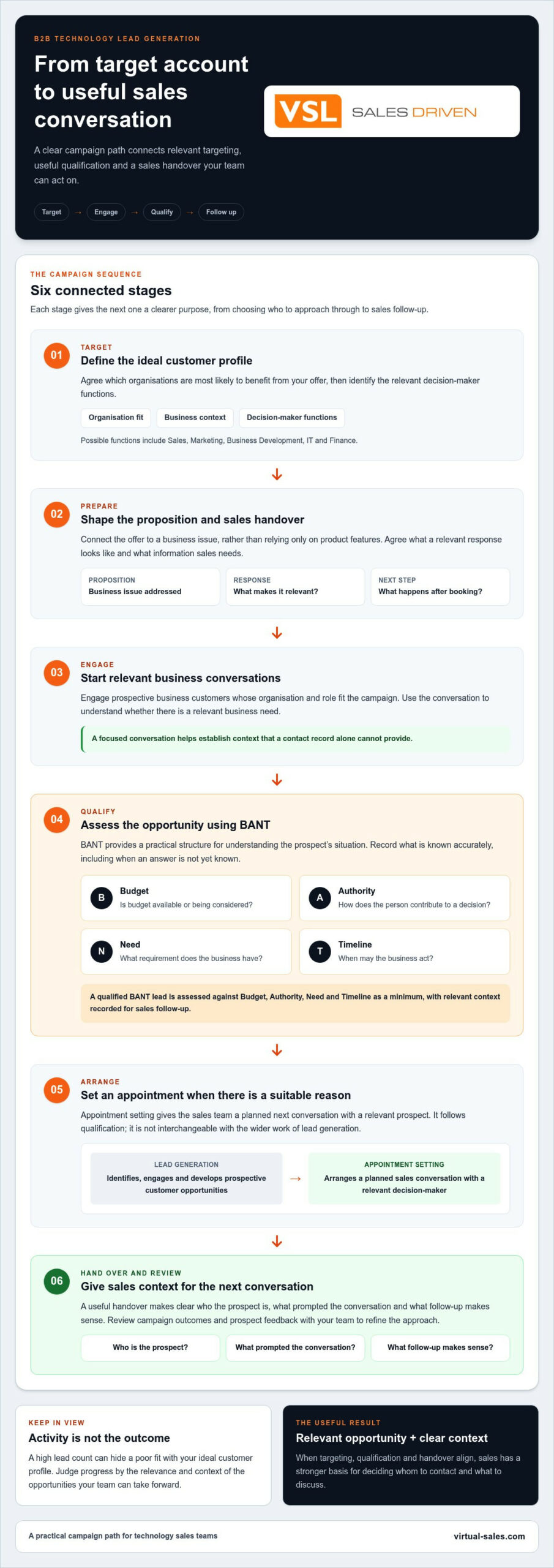
B2B appointment setting means engaging business decision-makers to generate qualified sales appointments. It gives the sales team a planned next conversation with a relevant prospect. The two activities can work together, but they aren’t interchangeable: lead generation develops and qualifies opportunities, whilst appointment setting arranges a sales meeting when there is a suitable reason to speak.
A practical handover should give your team more than a contact record. It should make clear who the prospect is, what prompted the conversation and what follow-up makes sense. That context helps a salesperson decide how to progress the opportunity through the sales pipeline.
A qualified BANT lead is a prospective business customer assessed, as a minimum, against Budget, Authority, Need and Timeline, with relevant information to support sales follow-up. An unqualified enquiry is an expression of interest that hasn’t yet been assessed against those criteria or lacks enough information to establish whether it merits direct sales engagement.
Why technology companies need relevant business conversations
Technology purchases often involve people with different responsibilities. A SaaS discussion might involve a department leader who needs a solution, an IT specialist who assesses technical fit and a budget holder who approves the spend. An IT services conversation may need to establish the scope of a business requirement before a useful next step can be agreed. Reaching one contact is not the same as understanding the opportunity.
That’s why technology firms need conversations that uncover practical context: the problem a prospect is trying to address, the role they play in a decision and the likely timing for action. More records alone won’t answer those questions. Clear qualification gives your sales team a stronger basis for deciding whom to contact and what to discuss.
Virtual Sales Limited’s technology lead generation for B2B companies uses consultative conversations to engage relevant business decision-makers and qualify opportunities to BANT criteria as a minimum. If your team also needs to understand where prospects stall between first contact and sales follow-up, reviewing ways to identify gaps in a B2B sales funnel can help clarify what the campaign should pass to sales.
How a lead generation agency qualifies opportunities and builds pipeline
A useful campaign follows a clear path from targeting to sales follow-up. A leadgenerationagency should first agree which organisations fit your ideal customer profile (ICP), then shape the proposition, engage relevant contacts, qualify what they learn and review the outcomes with your team. Each stage informs the next. If the target is too broad or the message misses a prospect’s business priorities, qualification will have little value.
Set the ideal customer profile before outreach
Define the types of organisations most likely to benefit from your offer. Consider sector, company fit and the business context that could create a need, such as a planned software change or a requirement for IT support. Then identify relevant decision-maker functions. Sales, Marketing, Business Development, IT and Finance may each contribute to a technology purchase in different ways.
A focused ICP helps the caller keep the conversation pertinent and gives your team a shared basis for reviewing campaign results. VSL’s practical guide to defining a useful ideal customer profile explores why precise targeting matters before outreach begins.
Next, prepare a proposition that connects your offer to a business issue, not just a list of product features. Agree what a relevant response looks like, which information sales needs at handover and what should happen after an appointment is booked. This gives campaign activity a clear purpose.
Use BANT to make qualification useful to sales
BANT means Budget, Authority, Need and Timeline. It provides a practical structure for understanding a prospect’s situation: whether budget is available or being considered, how the person contributes to a decision, what requirement the business has and when it may act. Responses should be recorded accurately, including when information is not yet known, rather than turned into assumptions.
A qualified BANT lead meets Budget, Authority, Need and Timeline criteria as a minimum, with relevant context recorded to support sales follow-up. A sales-qualified lead (SQL) is a qualified lead suitable for direct engagement by the sales team. Neither label guarantees a sale; each helps the team decide whether and how to progress the conversation.
Useful handover notes go beyond a meeting status. Record the prospect’s role, stated requirement, decision-making involvement, timing and agreed next step. This helps the salesperson prepare a relevant follow-up and reduces the chance that the prospect has to repeat information already shared.
Finally, review outcomes with sales and marketing. Look at which types of organisations engaged, what questions or objections came up, where qualification was incomplete and whether appointments matched the agreed criteria. Use that feedback to refine targeting or the proposition, not simply to increase activity. VSL’s Clutch appointment-setting reviews offer a useful view of how clients describe working with the team.
How to compare lead generation agency approaches for technology firms
A busy channel calendar can create plenty of activity without giving your sales team a clear view of opportunity quality. Compare a leadgenerationagency by how it defines the target market, handles conversations, qualifies responses and shares what it learns. This matters in technology sales, where a prospect’s role and the complexity of the proposition can shape what a useful next step looks like.
Channel choice describes how prospects are reached; qualification describes what sales receives. Email, social platforms or telephone outreach are methods of contact. They don’t, by themselves, show whether a prospect fits your ideal customer profile, has a relevant need or is ready for a sales conversation.
| Comparison area | What to assess |
|---|---|
| ICP fit | Are target company types and decision-maker roles clearly defined for your technology offer? |
| Conversation quality | Does outreach explore the prospect’s business context, or focus mainly on delivering a generic message? |
| Qualification | Are criteria such as BANT applied consistently, with unknown information recorded rather than assumed? |
| Campaign ownership | Is someone responsible for coordinating activity, acting on feedback and keeping the work connected to your sales process? |
| Reporting | Can your team see campaign outcomes and understand what they mean for follow-up and future targeting? |
Compare qualification and handover, not lead volume alone
Ask how the agency defines a qualified opportunity and how it will report against that definition. Useful handover context can include the contact’s role, the business need they described, their involvement in a decision, timing and the agreed next action. The aim is not to force every response into a sales stage. It’s to give your team a reliable account of what the prospect actually said.
Structured outcomes help sales decide what to do next and help campaign managers spot patterns. For example, if conversations repeatedly reveal that a particular role is not involved in the buying decision, the team can review its contact focus. If prospects understand the problem but not the proposition, the messaging may need refinement.
Assess reporting and team integration
Reporting should help you discuss progress, not just count completed activity. Look for visibility into prospect responses, qualification findings, appointments and recurring objections. A dedicated campaign manager can connect this feedback with your sales process, coordinate campaign changes and keep handovers clear. VSL provides weekly campaign reporting for clients to review activity and outcomes with their team.
Review where prospects drop out after initial engagement as well as what happens before a meeting. This can reveal follow-up gaps or unclear ownership. VSL’s guide to identifying gaps in a B2B sales funnel offers a useful lens for examining those handover points.
When a lead generation agency fits your sales plan, and what to prepare
External support can make sense when your sales team has a clear market to pursue but limited capacity for consistent prospecting. It may also help when you’re entering a new market, targeting a different ideal customer profile (ICP) or testing demand for a defined technology offer. The right time depends on your sales plan, not on a universal agency model.
Recognise the right time to add external support
Look for a specific gap. Perhaps internal sellers are spending more time managing active opportunities than opening new conversations. Perhaps outreach to a new sector has been intermittent, or your team needs market feedback before committing further internal resource. In each case, define what the campaign should learn or contribute to the sales pipeline.
Readiness also depends on what happens after a prospect engages. Decide who will respond to a handover, how quickly your team can follow up and how sales will share feedback. If internal capacity is already stretched, booked conversations may wait too long for attention. External outreach works best as a coordinated part of your sales activity, not a substitute for sales follow-up.
Prepare the brief and feedback loop
Give the campaign team enough detail to make conversations relevant. A practical brief can cover:
- Target accounts: sectors, company characteristics and the business context that makes an organisation a good fit.
- Decision-maker roles: the functions or seniority levels relevant to the purchase, including who influences or approves it.
- Proposition: the business problem your product or service addresses, explained in language a prospect can recognise.
- Exclusions: account types, roles or circumstances that should not be pursued.
- Qualification and follow-up: what counts as a relevant opportunity, what information to record and who takes the next step.
Be precise about what the campaign should not treat as a fit. For example, a software company may want to prioritise organisations with a particular operational need, while excluding businesses outside its delivery scope. Clear boundaries help keep outreach focused and make campaign feedback easier to interpret.
Agree a regular review between the agency, sales and marketing. Discuss prospect responses, handover quality and any objections or questions that recur. If feedback shows that a decision-maker is missing or the proposition is unclear, adjust the brief or approach. VSL’s guide to building a business case for outsourced sales can help structure the internal discussion around objectives, responsibilities and fit.
Before choosing a leadgenerationagency, check that your team can explain its target market, proposition and follow-up process in practical terms. If those decisions are still unresolved, clarify them first so campaign activity has a defined purpose.
How VSL runs lead generation campaigns as an extension of your team
VSL structures each campaign around your target market, proposition and sales follow-up process. The aim is to give your internal team consistent outreach support and useful information from prospect conversations, while keeping campaign activity connected to your commercial priorities.
The process starts with a subscription and briefing, where you share your ideal customer profile, target decision-makers, proposition and qualification requirements. A project set-up call then helps align the campaign plan and practical details. At kick-off, the caller receives proposition training so they can represent your offer accurately and understand the business context behind it.
Campaign management follows. Each campaign has a dedicated caller and campaign manager. Experienced UK-based callers hold consultative, script-free conversations with relevant business decision-makers. Opportunities are qualified to BANT criteria as a minimum, giving your sales team context for deciding what follow-up is appropriate. This supports a useful handover, without suggesting that qualification alone guarantees a sale.
What campaign management and reporting cover
The campaign manager oversees set-up, data sourcing, caller management and analysis of results. Weekly reports cover campaign metrics and outcomes, giving your sales and marketing teams a regular view of activity and prospect feedback. The manager can use those findings to make recommendations, such as refining the target profile or clarifying part of the proposition.
VSL uses a cloud-based CRM to manage campaign activity and can output campaign data for use with platforms such as HubSpot and Salesforce. This gives your team a way to work with campaign information in its wider sales process without implying a direct CRM integration.
How VSL works with technology sales teams
A dedicated caller and campaign manager work as an extension of your sales and marketing team. Your team provides the market knowledge and offer; campaign conversations bring back prospect responses that can inform follow-up and future activity. VSL was founded in March 2001, and its campaign managers have over 20 years telemarketing experience.
For a wider view of how external support can fit your commercial plan, VSL’s guide to outsourced lead generation services explores the role of campaign support. If you’re focused on technology prospects, the technology lead generation service explains how VSL supports outreach to relevant business decision-makers.
These steps give a leadgenerationagency campaign a clear operating rhythm: agree the brief, prepare the caller, engage prospects, qualify responses and review what the conversations reveal. Regular communication with your team helps keep that work aligned with sales priorities.
Put your next campaign decision into motion
Your next step is to turn the priorities in your sales plan into a clear campaign brief. Decide which market you want to learn about, what a useful sales conversation should establish and how your team will act on the resulting insight. These decisions give an agency relationship a practical purpose from the outset.
Choosing a leadgenerationagency is not just about adding outreach capacity. It’s a chance to build a repeatable way to test your proposition, hear how prospective buyers describe their needs and feed relevant intelligence back into sales and marketing. Keep the focus on what your team can learn and use, as well as the opportunities it wants to pursue.
If you’re ready to discuss how that approach could fit your technology sales plan, arrange a conversation with VSL.
A considered campaign starts with clear priorities. Take the next step when your team is ready to turn them into focused outreach.
Frequently Asked Questions
Can a lead generation agency target several decision-maker roles within one company?
Yes. A leadgenerationagency can engage different roles in the same target account when each has a relevant part in the buying process. For example, an IT leader may assess technical fit, whilst Finance considers budget and a business lead explains the operational need. Agree which roles matter and what each conversation should establish, so outreach reflects their responsibilities rather than repeating the same message to everyone.
How should an internal sales team follow up after receiving a qualified lead?
Review the handover before making contact, then tailor your first conversation to the prospect’s stated requirement and role. Confirm the agreed next step, avoid asking them to repeat information already shared and update your CRM with the outcome. If the prospect’s need involves several teams, identify who should join the next discussion. Share useful feedback with the campaign team so future handovers reflect what sales needs.
What information should a technology business prepare before a campaign begins?
Alongside target accounts and decision-maker roles, prepare concise product information, relevant customer examples you’re authorised to share, common prospect questions and known objections. Clarify which claims sales can make and which situations should be referred back to a subject-matter expert. Also name the internal owner for lead follow-up and agree how your team will report the outcome of each conversation. This helps keep campaign discussions accurate and actionable.
Can a lead generation agency support both SaaS and IT services companies?
Yes. The outreach can be shaped around the company’s offer and sales context. For a SaaS business, conversations may focus on the business need a platform addresses and who is involved in evaluating it. For an IT services firm, the discussion may centre on the prospect’s service requirements and relevant decision-makers. In both cases, agree the target profile and qualification criteria before outreach begins.
How can campaign data be used in HubSpot or Salesforce?
VSL uses a cloud-based CRM to manage campaign activity and can output campaign data for use with platforms such as HubSpot and Salesforce. Your team can then handle campaign information within its own CRM processes, according to how those systems are set up internally. Agree which fields and outcome details matter before the campaign starts, so the exported information is easier for sales to review and act on.

Disclaimer
Disclaimer: Content is for general information only and does not constitute professional advice. Results may vary. Virtual Sales Limited accepts no liability for actions taken based on this content.
Tags: Appointment Setting, B2B Lead Generation, bant qualification, consultative outreach, leadgenerationagency, Pipeline Growth, technology sales, uk tech