B2B Telemarketing and Sales: How to Turn Conversations into Qualified Meetings
What if telemarketing and sales worked as one disciplined process, with every conversation moving a relevant prospect closer to a qualified opportunity? For UK technology, SaaS and IT services teams, that’s the difference between activity that fills a report and outreach that gives sales a clearer route into the right accounts.
It’s frustrating when prospect lists are out of date, conversations don’t match your ideal customer profile, or leaders can’t see how outreach contributes to pipeline. Consultative telemarketing can help address those gaps by opening informed business conversations, testing fit and passing useful qualification insight to your sales team.
This guide explains how telemarketing supports B2B sales, what makes targeting and qualification more effective, and where specialist campaign support may fit your operation. You’ll also see how a practical campaign framework can connect prospect research, human-led conversations, BANT qualification and clear reporting, so your team can focus its time on opportunities with a stronger fit.
Key Takeaways
- Connect telemarketing and sales by focusing outreach on business decision-makers who fit your ideal customer profile.
- Keep B2B lead generation distinct from appointment setting, and define the outcome each activity should support.
- Use prospect conversations to capture needs and qualification details that help sales teams follow up with context.
- Apply a clear campaign process: define, prepare, engage, qualify and review.
- Consider specialist support when entering a market, launching an offer or targeting a new vertical.
Telemarketing and Sales in B2B Tech Businesses
For technology businesses, the first challenge is often not closing a sale. It’s starting a relevant conversation with the right decision-maker. B2B telemarketing means consultative telephone outreach to business decision-makers to generate qualified opportunities and appointments. It focuses on understanding whether there may be a business need, rather than pushing a product through a set pitch.
B2B telemarketing connects relevant business conversations with qualified sales opportunities. It can give a sales team a considered first point of contact, while leaving product demonstrations, proposals, negotiations and other later stages with the internal team. That division keeps the purpose of outreach clear: identify potential fit and make a useful handover, not promise a sale.
The term Telemarketing covers a broad history of telephone-based marketing. In a B2B technology campaign, the focus is narrower: informed conversations with relevant businesses and decision-makers. VSL’s B2B telemarketing support uses consultative, script-free conversations to support this early part of the sales process.
Where telemarketing fits in the B2B sales process
Outreach sits near the start of the sales pipeline. A campaign first identifies organisations and decision-makers that fit the ideal customer profile. The caller then opens a business conversation, explores the prospect’s context and records relevant qualification details. Where there is a suitable opportunity, the information can support a handover or meeting with the sales team.
For example, a software company targeting finance teams might use outreach to learn how prospective organisations currently manage a particular workflow. If a decision-maker describes a relevant requirement, the caller can capture that context so the sales team has a clearer starting point. The team remains responsible for assessing the opportunity, presenting the solution and progressing any potential sale.
How lead generation differs from appointment setting
B2B lead generation is the activity of identifying and engaging prospective business customers to generate qualified opportunities. It can include defining target accounts, reaching relevant contacts and learning whether a potential need exists. Appointment setting has a more specific purpose: engaging decision-makers to arrange qualified sales appointments for the client’s team.
The two activities can support different stages of pipeline development, but they aren’t interchangeable. A campaign may focus on finding and qualifying prospective accounts before prioritising meeting-ready contacts. Another may centre on arranging sales conversations with decision-makers who meet agreed criteria. In both cases, clear qualification and useful handover notes help internal salespeople decide what to do next.
For stronger alignment between telemarketing and sales, agree in advance what counts as a relevant opportunity, which decision-makers to target and what information the sales team needs at handover. That gives outreach a defined role and helps the team judge progress by opportunity quality, not simply by call activity.
Why telemarketing can strengthen B2B sales activity
Sales teams need more than a list of names. They need relevant conversations that clarify whether a prospect has a problem the business can address, who is involved in a decision and what a useful next step might be. That is where consultative outreach can add value: it gives sales and marketing teams direct feedback from the market while creating a more consistent way to engage target accounts.
For technology firms, B2B telemarketing services can support the early stages of business development. The commercial value lies in useful qualification and insight, not simply the number of calls made. Outreach can create potential opportunities, but it cannot guarantee that a prospect will buy or that a meeting will progress to revenue.
What sales teams gain from relevant prospect conversations
A focused conversation can help establish BANT: Budget, Authority, Need and Timeline. These criteria give the sales team a practical view of whether a prospect may be suitable for follow-up. They also help distinguish an active requirement from general interest, so salespeople can prioritise their time and tailor the next discussion.
Prospect feedback can inform more than individual follow-up. If contacts repeatedly misunderstand the offer, the proposition may need clearer wording. If the right organisations respond but the contact roles are consistently unsuitable, targeting may need refinement. Sales and marketing can use these observations to adjust messaging, account selection and the questions used to assess fit.
Look for relevance and learning, not activity in isolation. Conversations, qualified opportunities, appointments and follow-up outcomes are different measures. Tracking them separately helps leaders understand what outreach has produced and where prospects progress, without treating early activity as proof of revenue.
How reporting makes outreach more useful
Weekly reporting gives sales leaders a regular point to review campaign activity and outcomes. Useful measures may include contacts reached, conversations held, qualification status, appointments arranged and reasons prospects are not progressing. Read together, these details show whether the campaign is reaching the intended audience and whether its message is producing meaningful engagement.
Reporting becomes more valuable when it includes market feedback and recommendations, not just totals. A campaign manager can flag patterns such as a recurring objection, a missing decision-maker or a proposition that needs clarification. The team can then make a considered adjustment and assess what changes in subsequent reporting, rather than altering several elements without knowing what affected the results.
VSL does not record calls. Relevant outcomes and campaign feedback are entered in its cloud-based CRM, giving the client a written record for review and sales follow-up. Campaign data can also be output for use with platforms such as HubSpot and Salesforce; this does not mean a direct integration is in place.
That reporting discipline supports a shared view of progress between outreach and the internal sales team. If you want to understand how this approach works in practice, explore VSL’s appointment-setting reviews on Clutch.
Real insight: common telemarketing and sales mistakes to avoid
Outbound activity can look busy without creating useful opportunities. In telemarketing and sales, the difference often comes down to how well a campaign defines its target, adapts to prospect responses and records what the sales team needs for follow-up.
Mistakes that weaken sales-led outreach
A vague ideal customer profile (ICP) is a poor starting point. If a technology firm targets any organisation that might use its software, outreach can reach businesses with different needs, buying processes and levels of fit. Define the target company characteristics and relevant decision-maker roles first. This gives the caller a clearer basis for selecting prospects and assessing whether a conversation is worth progressing.
Consider an illustrative scenario, not a verified VSL client result. A software company wants to reach organisations that manage a particular business process. Before outreach begins, its team defines the types of organisations most likely to have that process, identifies relevant job functions and agrees what would indicate a genuine requirement. This makes the campaign’s purpose clearer than simply asking callers to contact as many businesses as possible.
During a conversation, the caller explores the prospect’s current approach and records relevant needs, decision-making responsibility, timing and agreed next steps. If the prospect has a potential fit, these notes help the sales team prepare a relevant follow-up. If there is no current need, recording that outcome can prevent the account from being treated as an immediate opportunity. The team can use patterns in prospect responses to refine its targeting or proposition.
Two other mistakes can undermine this process:
- Prioritising activity volume. Call totals alone don’t show whether the right decision-makers were reached or whether conversations produced qualified opportunities. Review activity alongside qualification and follow-up outcomes.
- Using generic or scripted messaging. A fixed pitch can make it harder to respond to a prospect’s specific context. Consultative conversations allow the caller to ask relevant questions and listen for information the sales team can use.
For a related perspective on prospect conversations, VSL’s B2B cold calling guidance for sales leaders covers the role of targeted outreach in business development.
Evidence, outcomes and responsible claims
Keep campaign evidence distinct from interpretation. Without approved, attributable VSL case-study or testimonial evidence, don’t present a scenario as a client result or attach invented figures to it. Instead, review measures such as target-account relevance, decision-makers reached, conversations held, qualification outcomes, appointments arranged and subsequent sales-team follow-up. These indicators help explain campaign performance; none alone proves revenue impact.
Use weekly reporting and prospect feedback to identify where targeting, qualification or follow-up may need attention. Any external research should be attributed to its source and checked before publication. To see VSL’s appointment-setting profile on Clutch, visit VSL’s Clutch profile.
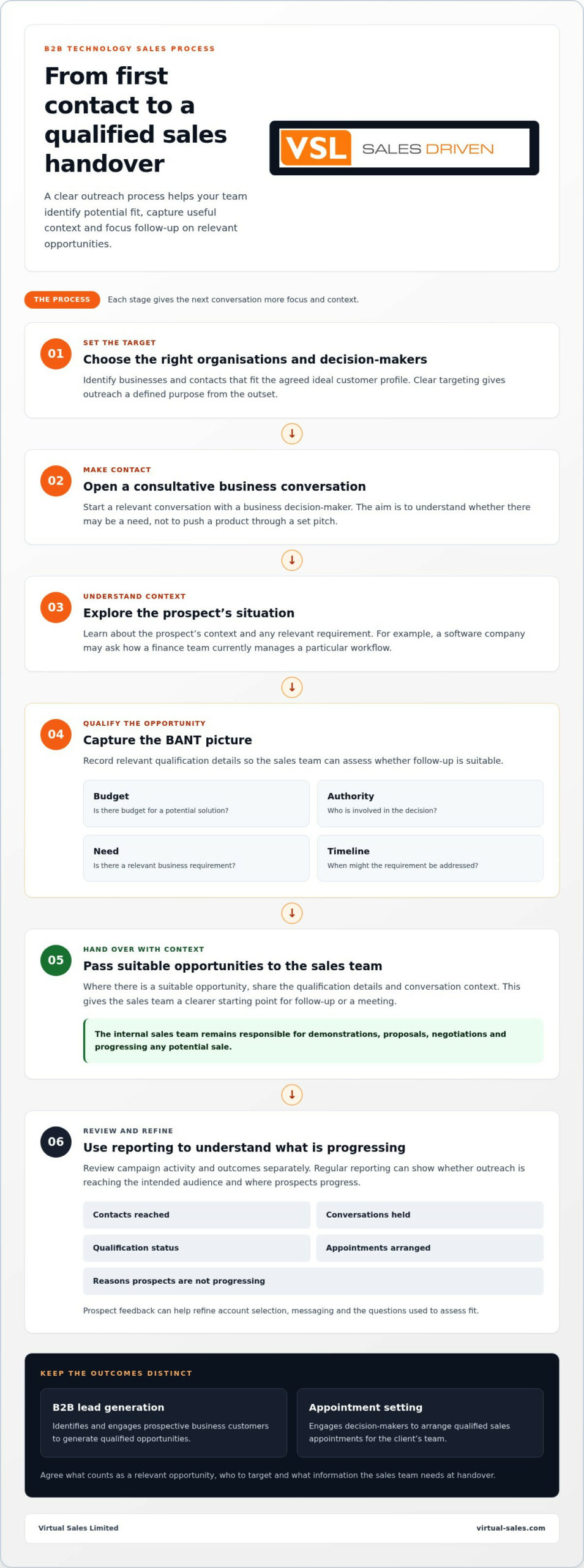
A practical VSL framework for connecting telemarketing with sales
Effective telemarketing and sales support needs a clear handover between campaign activity and the client’s sales process. VSL uses a five-step framework: define the target, prepare the campaign, engage prospects, qualify conversations and review outcomes. Each campaign has a dedicated caller and campaign manager, keeping campaign activity connected to the client’s objectives.
Define the target and prepare the campaign
Start with the ideal customer profile (ICP): agree which organisations are relevant, which decision-maker roles to reach and what business problem the campaign will explore. Clarify the proposition and decide what information the sales team needs before accepting a handover. A briefing document, project set-up call and proposition training help align the campaign with the client’s offer and priorities.
Campaign management also covers data sourcing and campaign set-up. Clear criteria help distinguish a suitable prospect from a company that matches only a broad sector description.
Engage, qualify and review prospect outcomes
Experienced UK-based callers use consultative, script-free conversations to understand a prospect’s context and explore potential fit. A qualified BANT lead is a prospect assessed against Budget, Authority, Need and Timeline criteria as a minimum. Recording relevant requirements and next steps gives the sales team useful context for follow-up.
Where a prospect is ready for a sales conversation, B2B appointment setting can connect qualification with a meeting for the client’s sales team. The sales team then owns later stages, including discovery, solution discussions and decisions about progressing the opportunity.
Weekly reporting, outcome analysis and recommendations give the client a basis for reviewing campaign activity and deciding whether targeting or the proposition needs adjustment. VSL’s cloud-based CRM manages campaign information, which can be output for use with platforms such as HubSpot and Salesforce.
As you consider whether this approach fits your sales operation, Virtual Sales Limited’s Clutch profile offers an external reference point for your evaluation.
25+ Years Helping Technology Companies Generate Qualified Sales Meetings
Every successful campaign starts with a conversation.
When should a technology business use telemarketing and sales support?
External campaign support may suit your business when prospecting is inconsistent, an internal team has limited capacity or a target database is underused. It can add focused outreach alongside your sales operation, while your team remains responsible for progressing suitable opportunities. A clear audience, a proposition to discuss and a plan for follow-up help establish whether this approach fits.
Signals that external campaign support may fit
Consider whether your business is:
- Entering a market and seeking direct feedback from relevant decision-makers.
- Launching a technology offer that needs a focused conversation with potential buyers.
- Targeting a new vertical but unsure which roles or needs deserve priority.
- Struggling to maintain prospecting activity alongside sales meetings and existing accounts.
- Holding a database that could benefit from renewed, targeted engagement.
For example, a software firm exploring a new sector might use a campaign to test how target decision-makers describe the problem its offer addresses. Prospect feedback can inform the next review of the proposition or audience. Campaign scope should be tailored to the business, target market and internal team’s capacity to follow up; outreach can provide insight, but it cannot guarantee commercial outcomes.
What working with VSL involves
VSL’s process begins with sign-up and a briefing document, followed by a project set-up discussion and proposition training. A dedicated caller and campaign manager support the campaign as an extension of the client’s sales and marketing team. Weekly reporting gives the client a regular opportunity to review activity and discuss next steps.
VSL uses a cloud-based CRM to manage campaign activity and can output campaign data for use with platforms such as HubSpot and Salesforce. This describes data output, not a direct integration. Teams can consider how campaign records fit their own follow-up and reporting workflows.
A flexible monthly subscription may suit businesses whose priorities change as they test a new proposition or target market. The campaign approach is tailored to the business and its objectives, rather than treated as a guaranteed source of leads or appointments. If you’re assessing whether support fits your sales operation, VSL’s B2B telemarketing service can form part of that evaluation.
Results, Evidence & Data
Assess campaign performance using evidence that is clearly defined and traceable. No specific VSL campaign results or verified client outcomes are presented in this section, so it makes no claims about appointment volumes, conversion rates or revenue contribution.
For your own review, compare campaign activity with outcomes such as relevant decision-makers reached, qualification status, appointments arranged and sales-team follow-up. These measures can help identify what to examine next, but they should not be treated as proof of revenue or a promise of future performance. Attribute any published client result to its verified source, and distinguish it clearly from general campaign observations.
Put your next campaign decision into action
Your next step is to decide what the sales team needs to learn or achieve. Are you testing a new proposition, reaching a different decision-maker or creating a steadier route to relevant conversations? A specific campaign objective gives outreach a clear purpose and gives your team a basis for reviewing what to do next.
VSL has supported technology businesses since its founding in March 2001. Its campaign managers bring over 20 years of telemarketing experience, helping clients shape outreach around their market and sales priorities. The aim is to make telemarketing and sales work together through informed prospect conversations and practical campaign learning, not to treat activity alone as a measure of success.
If you’re considering whether this approach fits your sales operation, a conversation can help you explore the right campaign focus for your objectives.
Set a clear objective, keep the next step focused and give your team room to build stronger B2B conversations.
Frequently Asked Questions
What is the difference between telemarketing and sales?
Telemarketing is one possible source of initial prospect engagement; sales covers the broader work of assessing an opportunity and progressing it. To make the handover practical, agree what information the sales team needs before it accepts a prospect, who owns the next action and how outcomes will be shared back with the campaign team. This helps prevent suitable contacts from stalling between outreach and follow-up.
Can telemarketing work for technology and SaaS companies?
Yes. It can be useful when a technology business needs to explore a defined audience, such as a particular type of organisation or decision-maker. Before starting, identify the business problem to discuss and what would count as a useful response. This gives the campaign a clear learning objective as well as a prospecting purpose, particularly when a company is preparing to test an offer with a new audience.
How does BANT qualification work in a telemarketing campaign?
Use BANT as a framework for gathering relevant information, not as a box-ticking exercise. A caller can record what the prospect has confirmed, what remains unclear and what should be explored in a sales conversation. For instance, don’t treat a contact’s interest as proof of available budget or decision-making authority. Clear notes help sales colleagues judge what to verify next without overstating the prospect’s readiness.
Are telemarketing calls recorded by Virtual Sales Limited?
No. VSL does not record calls. For effective follow-up, campaign notes should capture the business context, the prospect’s stated position and any agreed next action in clear, factual language. The sales team can then prepare for its next conversation from the written record. Avoid relying on memory or vague labels alone; precise notes make it easier to understand why a contact was assigned a particular status.
Can VSL campaign data be used with HubSpot or Salesforce?
Yes. VSL can output campaign data for use with HubSpot and Salesforce, rather than providing a confirmed direct integration. Before transferring records, decide which campaign fields matter to your team, how prospect statuses map to your CRM and who will review incoming data. A consistent field structure makes campaign information easier to interpret and helps prevent different teams from using the same status to mean different things.
Does VSL support technology companies outside the UK?
Yes. VSL works with technology companies in the UK and USA. Its multilingual callers speak French, German, Italian and Spanish, which may be relevant when a campaign targets business decision-makers who use those languages. Set the intended audience and language requirements during planning; language capability is applied according to the campaign, rather than assuming every language is used for every target market.

Disclaimer
Disclaimer: Content is for general information only and does not constitute professional advice. Results may vary. Virtual Sales Limited accepts no liability for actions taken based on this content.
Tags: B2B Appointment Setting, B2B Telemarketing, bant qualification, consultative outreach, SaaS Sales, Sales Pipeline, technology lead generation, telemarketing and sales