sales pitch examples: Everything You Need to Know
Your best cold-call pitch isn’t a polished monologue. It’s a relevant reason to speak, expressed in language that fits the person on the other end. The most useful cold calling pitch examples B2B teams can learn from are starting points, not lines to recite.
It’s frustrating when a generic opening fails to connect your technology proposition with a prospect’s priorities. But cramming in more detail isn’t the answer either. A strong pitch gives enough context to earn interest, then leaves room to listen and respond.
This guide shows you how to shape a clear, concise opening for B2B technology calls. You’ll find examples to adapt for different decision-makers and propositions, along with a practical structure for explaining why you’re calling, asking a relevant question and agreeing a suitable next step. Use the examples as preparation prompts, not a script: the aim is a genuine business conversation that can move a well-matched prospect towards a qualified follow-up.
Key Takeaways
- Use cold calling pitch examples B2B as prompts to prepare, then adapt your opening to the prospect’s role and business context.
- Connect your proposition to a relevant business issue and ask an open question to invite a genuine response.
- Shape your pitch around the ideal customer profile, target account and decision-maker, rather than relying on a memorised monologue.
- Listen to the prospect’s answer and adjust the conversation; their response can reveal whether a qualified next step makes sense.
- Assess campaign evidence carefully, separating verified results from illustrative scenarios and unsupported claims.
What makes a B2B cold calling pitch relevant to the prospect?
A B2B cold-call pitch is a concise, relevant reason to start a business conversation. It gives the prospect enough context to understand why you’re calling, without trying to explain every feature or secure a meeting before you’ve heard their view. The broader practice of cold calling starts a conversation with someone who hasn’t arranged to speak with you; a relevant pitch makes that interruption purposeful.
A cold-call pitch is the opening context that earns a response, not a complete sales presentation that explains and sells the entire proposition. It isn’t quite an elevator pitch, either. An elevator pitch is usually a compact summary of an offer or business. A cold-call opening must connect that summary to a particular prospect. Nor is it the whole appointment-setting conversation, which may include discovery, qualification and agreement on a suitable next step.
What should a B2B cold-call pitch achieve?
First, identify yourself and your company plainly. Then give a credible reason for calling that links one specific business issue to the prospect’s likely responsibilities. Avoid broad claims such as “we help businesses become more efficient” unless you can explain what kind of efficiency and why it may matter to this person.
For example, a caller discussing workflow software might explain that they’re speaking with operations leaders about how teams manage handovers between systems. That gives the prospect a clear point to respond to. An open question can then test whether the issue applies, rather than assuming it does.
The opening should create room for a conversation. If there’s a relevant need, the discussion can move towards a suitable next conversation. If not, the prospect’s answer gives you a reason to adjust or end the call professionally. The first 30 seconds of a B2B sales call can establish that context, but the aim is to connect, not rush through a fixed speech.
Why does a technology buyer need a relevant opening?
Technology propositions can affect different teams in different ways. A SaaS platform might relate to pipeline visibility for Sales, campaign measurement for Marketing, forecasting for Finance, system requirements for IT, or supplier processes for Procurement. HR may focus on staff workflows, adoption or administrative demands. The same product feature won’t carry equal weight for every role.
Use your ideal customer profile (ICP) to guide the opening: define the types of organisations, roles and business conditions that make a conversation relevant. Treat it as a focus for preparation, not proof that every target account has the same challenge. A Marketing Director may care about reporting, whilst an IT leader may want to understand how a proposition fits existing systems. Ask, listen and adapt.
That’s how cold calling pitch examples B2B teams prepare become useful: they provide adaptable prompts for explaining relevance, not wording to deliver verbatim. The caller’s judgement turns a prepared point into a genuine exchange.
Cold calling pitch examples B2B teams can adapt to real conversations
Use these illustrative scenarios as preparation prompts, not proven results or lines to repeat word for word. Each example starts with a business context, makes one relevant point and gives the prospect room to respond. A strong pitch makes one relevant point and earns dialogue, rather than trying to deliver the whole sales case at once.
Software efficiency: opening with a Sales leader
- Context: A Sales Director is responsible for how the team manages routine processes and sales activity.
- Opening point: “I’m calling from [company]. We work with sales teams looking at where manual steps affect their day-to-day processes. I wondered how your team is handling that at the moment.”
- Open question: “Which part of the process takes the most time for your team?”
This doesn’t assume the prospect has a problem. Keep product detail back until they confirm what matters. If the answer points to a relevant need, explore it; if not, adjust your understanding rather than pressing ahead with a feature list.
IT services risk: adapting the emphasis by role
- Context: A business is reviewing how it manages IT support or operational risk. Treat this as an illustrative scenario, not a claim about a named account.
- Opening point: “I’m calling from [company] about IT services. We speak with organisations reviewing how they manage support and reduce disruption. Is that something your team is considering?”
- Open question: “How do you currently assess whether your support arrangements meet the business’s needs?”
For an IT leader, ask about support requirements and operational priorities. With Finance or Procurement, focus on how the organisation evaluates the service and supplier decision. Don’t imply that risk will be removed or promise an outcome.
SaaS workflow improvement: speaking with an operational lead
- Context: An Operations Director oversees handovers between teams or systems.
- Opening point: “I’m calling from [company]. Our SaaS platform is designed to support teams reviewing how work moves between stages. I wanted to ask how you manage those handovers today.”
- Open question: “Where do delays or duplicated steps tend to arise, if at all?”
Keep the description brief. The prospect’s answer should guide whether to explain the platform, ask a follow-up question or leave the topic there.
If the prospect isn’t ready to engage
Acknowledge their response without pushing: “Of course. Would another time be more suitable, or would you prefer I leave it there?” Respect a clear refusal and follow your organisation’s approved contact preferences. Don’t create urgency that you can’t substantiate.
For more context on how VSL approaches business conversations, see its UK appointment-setting profile on Clutch.
Real insight: what weak B2B pitches miss and how to correct them
Illustrative technology campaign scenario: A team is introducing software intended to support project handovers. A weak opening lists dashboards, notifications and reporting features before finding out whether the prospect has a handover issue. A stronger approach starts with the prospect’s likely responsibilities, then listens for what is actually happening in their organisation.
| Opening style | Example | What it misses or achieves |
|---|---|---|
| Vague and product-led | “We offer a powerful platform with dashboards, automation and reporting. Can I book a meeting?” | It gives no clear reason this prospect should care and asks for commitment before establishing relevance. |
| Role-aware and open | “I’m calling because we speak with operations leaders reviewing project handovers. How does your team manage those between departments today?” | It connects the call to a possible responsibility, then gives the prospect room to confirm, correct or reject the assumption. |
Common pitch mistakes that reduce relevance
A long feature list makes the prospect work out the business value for themselves. A job title isn’t proof of ownership either: an IT Director might influence a technology decision without controlling the budget, whilst a Finance or Procurement colleague may shape the buying process. Generic claims and unverified personalisation can undermine trust. So can closed questions that invite only “yes” or “no”, leaving little to learn.
Prepare a relevant opening, not a verdict about the prospect. For more context on choosing the right audience and approach, see this B2B cold calling companies guide.
How prospect responses can improve the next conversation
In the illustrative scenario, the operations leader says handovers aren’t the issue; keeping project status consistent across teams is. A fixed pitch would continue describing handover features. A responsive caller instead asks how status is shared, who needs visibility and whether the issue is a current priority. The answer can clarify whether there’s a business need, who else is involved and whether a suitable next conversation makes sense.
Record outcomes in useful categories, such as relevant need identified, further qualification required, future follow-up requested or no current fit. A warmer contact has engaged with a relevant issue; a future opportunity may need a later review or another stakeholder. Neither should be treated as a qualified opportunity until the agreed criteria are met. Reviewing these outcomes helps teams refine their audience and opening, rather than judging a pitch by activity alone.
The opening sets the tone, but the prospect’s response should shape what follows. Explore the first 30 seconds of a B2B sales call for more on making that initial exchange relevant.
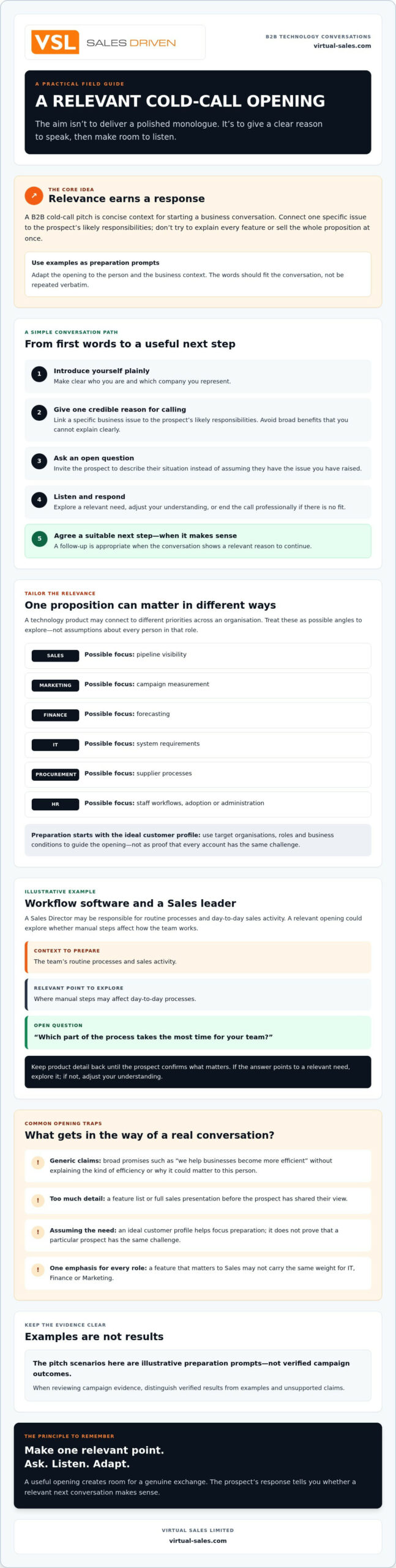
A practical framework for shaping a consultative B2B cold-call pitch
Use this framework to prepare your thinking, not to memorise a sequence of lines. The aim is to arrive with a clear reason for calling, then let the prospect’s answers guide the conversation. That’s what makes cold calling pitch examples B2B teams prepare useful: they help shape judgement, rather than dictate wording.
Prepare the proposition before making the call
- Define the fit. Set out your ideal customer profile, the target account and the decision-maker you want to reach. A job title can help identify a likely contact, but it doesn’t confirm that person owns the need or budget.
- Choose one relevant point. Connect a business issue to the proposition in plain language. For example, if you’re speaking with an IT leader about IT services, focus on a relevant support or operational consideration, not a catalogue of services.
- Check your basis. Use accurate company and prospect information. Avoid presenting an assumption as a known fact. Prepare an open question that can test whether the issue matters to this organisation.
Keep the first explanation concise. You can add detail if the prospect confirms relevance or asks for it. Preparation should make it easier to respond naturally, not pull the conversation back to a pre-written monologue.
Adapt the conversation and qualify the opportunity
Listen before you move on. If the prospect raises a different priority, explore it with a relevant follow-up. Don’t force the original proposition into the discussion if their answer shows it isn’t a fit.
Where appropriate, qualify against BANT: Budget, Authority, Need and Timeline. Treat this as a way to understand whether a potential opportunity fits, not a checklist to run through regardless of context. Ask about the prospect’s need first; then establish who is involved, whether budget is available or being considered, and when the organisation may act.
Agree a next step only when the conversation supports one. That might be a follow-up with the relevant decision-maker or a sales meeting to explore the stated requirement. Be specific about its purpose and who should take part. If there’s no current fit, record that accurately rather than treating politeness as buying intent.
Review outcomes and refine the approach
Review prospect feedback and call outcomes with the campaign manager. Weekly reporting can help identify recurring questions, objections and points of relevance, then inform practical adjustments to the campaign. VSL uses a cloud-based CRM to manage activity and can output campaign data for use with platforms such as HubSpot and Salesforce; this doesn’t imply a direct integration.
For more on B2B cold calling services for technology companies, see how a campaign can support qualified conversations with relevant decision-makers.
Evidence, best-fit situations and next steps for B2B cold calling
A useful pitch is a starting point, not proof that a campaign will produce a particular result. Judge the approach by the relevance of the conversations, the quality of qualification and whether agreed next steps contribute to your sales pipeline. The cold calling pitch examples B2B teams prepare can help shape those conversations, but they can’t guarantee an outcome.
What evidence can support a cold-call pitch approach?
VSL facts: Virtual Sales Limited was founded in March 2001 and works with technology companies in the UK and USA. Campaigns have a dedicated caller and campaign manager, with weekly reporting. VSL qualifies leads to BANT criteria as a minimum: Budget, Authority, Need and Timeline. These details describe VSL’s experience and process, not a guaranteed level of campaign performance.
Published client reviews and case studies can offer further evidence, but check the original Clutch material before quoting a result or testimonial. Attribute any client outcome to that specific engagement. Don’t present one organisation’s experience as a typical result for every campaign.
The same standard applies to external research. Name the original source, retain the context of its findings and explain what was measured. If a figure or claim can’t be verified, leave it out. Campaign outcomes can vary with the brief, target market, proposition, data quality and campaign complexity.
When may a technology business benefit from this approach?
Consultative cold calling may suit a technology firm that is entering a market, testing an ideal customer profile or building qualified pipeline without relying only on existing inbound demand. It can also help an internal sales team focus more time on relevant conversations with business decision-makers.
Consider whether the team has a clear target account profile, a proposition worth testing and a practical way to review feedback. Dedicated callers and campaign management can support activity as an extension of your team, whilst weekly reporting gives you a regular basis for reviewing outcomes and considering adjustments. It won’t remove the need for sales and marketing to agree what counts as a suitable opportunity or next step.
Take a practical next step
Prepare one credible point of relevance, then let the prospect’s answers shape the discussion. That keeps the pitch concise and makes qualification and any follow-up more purposeful.
25+ Years Helping Technology Companies Generate Qualified Sales Meetings
Every successful campaign starts with a conversation.
#OneStepCloser 🚀
UK technology appointment setting
Frequently Asked Questions
What is a B2B cold calling pitch?
A B2B cold calling pitch is a concise, relevant reason to start a business conversation with a prospect who hasn’t arranged to speak with you. It identifies who’s calling, explains why the contact may matter to that person and invites a response. The best cold calling pitch examples B2B teams use are adaptable prompts, not complete sales presentations or fixed speeches.
How do you start a B2B cold call?
Start by introducing yourself and your company, then explain your reason for calling in terms relevant to the prospect’s role or organisation. For example, you might say you’re speaking with IT leaders about how teams manage a particular support requirement, then ask how they approach it. Keep the opening grounded in what you know. Don’t present an assumption about the prospect as a confirmed fact.
What should a cold calling pitch include?
A cold-call pitch should include your name and company, a credible reason for contacting the prospect, one relevant business point and an open question. Keep product detail brief until you know the issue matters to them. For instance, rather than listing software features, ask how the prospect currently manages a related workflow. Their answer can guide whether to explore a need or end the conversation.
How long should a B2B cold-call pitch be?
There’s no fixed duration that suits every call. Keep the opening brief enough to introduce yourself, establish relevance and invite a response without dominating the conversation. The pitch is only the start, not a timed product presentation. If the prospect shows interest, ask a relevant follow-up and add context as needed. If they’re busy or uninterested, respond respectfully rather than rushing through more detail.
How can I adapt a cold calling pitch for SaaS or IT services?
Adapt it by connecting the proposition to a business issue that may matter to the specific role. For a SaaS product, an operations leader might care about workflow, whilst an IT decision-maker may want to discuss service requirements. Treat these as possibilities, not assumptions. Prepare a relevant question, listen to the answer and adjust the discussion. Avoid promising outcomes or presenting unverified company research as fact.
How do you qualify a B2B prospect during a cold call?
Qualify by exploring whether there’s a relevant need, who is involved in the decision, whether budget is available or being considered, and the likely timeline. BANT stands for Budget, Authority, Need and Timeline. Use it as a framework for a natural discussion, not a checklist to force into every call. Agree a next step when the prospect’s answers support one, and record the outcome accurately.
Should sales teams use a cold calling script or pitch examples?
Use examples to prepare your thinking, not to dictate every word. A fixed script can make it harder to respond when a prospect raises a different priority or corrects an assumption. Prepare the key points instead: who you’re contacting, why the proposition may be relevant and what you need to learn. VSL’s callers use consultative, script-free conversations, adapting their approach to the prospect’s responses.

Disclaimer
Disclaimer: Content is for general information only and does not constitute professional advice. Results may vary. Virtual Sales Limited accepts no liability for actions taken based on this content.
Tags: B2B Appointment Setting, B2B sales outreach, bant qualification, cold calling pitch examples B2B, consultative outreach, SaaS lead generation, sales pitch examples, technology lead generation