How to Improve B2B Appointment Setting Results for Technology Companies
More calls do not necessarily create more sales pipeline. For UK technology, SaaS and IT services teams, b2b telemarketing yield should show whether outreach is producing qualified opportunities and moving them towards sales, not just how many calls have been made.
Call totals alone cannot tell you whether the right decision-makers are engaging, whether sales accepts the leads or what happens after hand-off. If marketing and sales use different definitions of a qualified opportunity, campaign performance is difficult to assess consistently.
This guide explains how to define useful yield measures, assess lead quality and track progression through the sales pipeline. It covers how qualification criteria, data quality and sales feedback affect your interpretation of results, and how to use campaign evidence to decide what to refine. The goal is a clearer view of which conversations have commercial potential and why.
Key Takeaways
- Define campaign yield around agreed outcomes, not call totals alone.
- Report conversations, qualified BANT leads, appointments and pipeline progression separately.
- Use a consistent measurement framework to assess b2b telemarketing yield across campaigns.
- Review ICP fit, contact data, proposition and timing to understand what may affect outcomes.
- Combine campaign reporting with sales feedback to decide what to refine and when specialist support may help.
What does B2B telemarketing yield mean for a technology sales team?
For a technology sales team, b2b telemarketing yield means the useful, qualified outcomes generated in relation to agreed campaign activity or inputs. The right measure depends on the campaign’s purpose. A market test might aim to find out whether a defined group of businesses has a relevant need. An appointment-setting campaign might focus on qualified meetings with suitable decision-makers.
These outcomes occur at different stages. A connection is not necessarily a substantive conversation. A conversation may reveal a potential need, but that alone does not make someone a qualified BANT lead. An appointment is a scheduled sales discussion that meets agreed criteria. Pipeline progression comes later, when the sales team assesses the opportunity and records what happens next.
This distinction makes performance easier to discuss than activity totals alone. A high call count can show that outreach took place, but it cannot confirm prospect fit, qualification or commercial value. For a neutral overview of the wider term, see What is telemarketing? VSL’s B2B telemarketing service focuses on consultative conversations and qualified sales opportunities, with outcomes assessed against the agreed campaign objective.
How is B2B telemarketing yield different from call volume?
Activity measures can include calls, connections and conversations, where tracked. Outcome measures show what those interactions produce, such as qualified BANT leads or appointments that meet the campaign’s agreed criteria. Both views are useful, but they answer different questions: activity shows the work completed, while outcomes show whether it is creating relevant opportunities. Call volume alone cannot establish lead quality or confirm that a campaign is contributing to the sales pipeline.
What counts as a qualified outcome?
BANT assesses Budget, Authority, Need and Timeline. A qualified BANT lead meets those criteria as a minimum, while qualification should also reflect the ideal customer profile and the information the sales team needs at hand-off. Agree what makes an appointment suitable, too. If marketing, campaign management and sales classify outcomes differently, the reporting becomes difficult to interpret. Shared definitions help teams review results consistently without treating every conversation as a sales opportunity.
Assess yield against the campaign’s aim, qualification rules and agreed inputs, not a universal benchmark. Appointment numbers are not guaranteed, as results depend on the campaign and the prospects reached. Set clear definitions first, then measure progress through each stage.
How can you measure B2B telemarketing yield without misleading benchmarks?
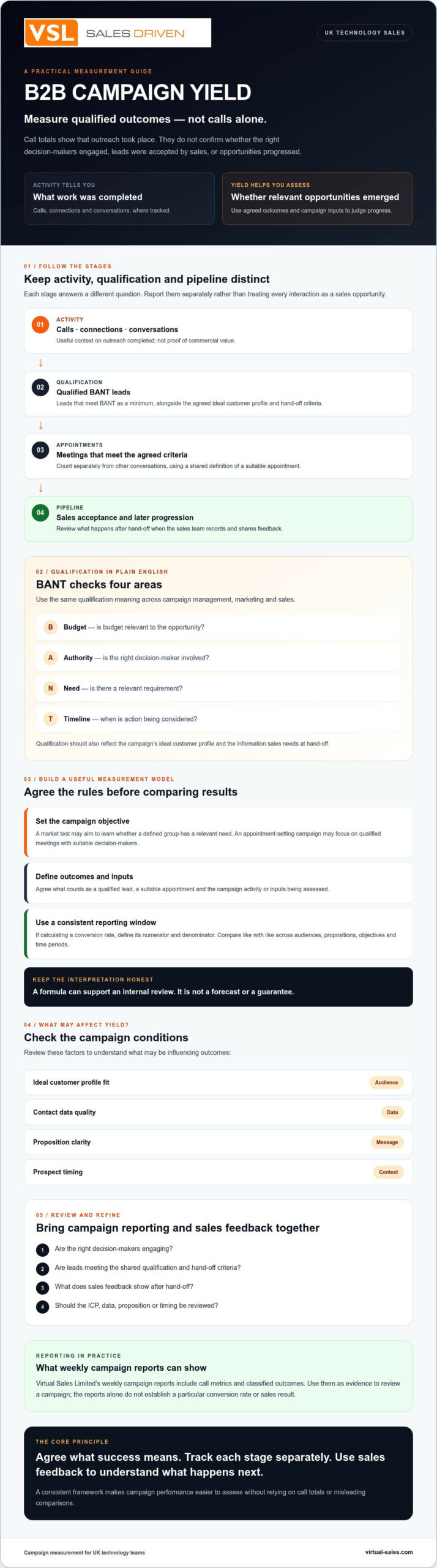
Build a measurement model around the campaign objective, then report each stage separately. This shows how activity relates to contact, qualification, appointments and any later pipeline progression. Before launch, agree the definitions, reporting period and data sources. Without that groundwork, differences in classification can look like changes in performance.
Use a consistent sequence:
- Activity: Calls, connections and conversations, where tracked. These explain outreach activity, but do not establish commercial value.
- Qualification: Qualified BANT leads that meet the agreed ICP and hand-off criteria.
- Appointments: Meetings that meet the campaign’s agreed definition, counted separately from other conversations.
- Pipeline: Sales acceptance and later progression, where the sales team records and shares feedback.
Which measures show progress through the campaign?
Read the measures together. Activity provides context; qualified leads and agreed appointments show whether the campaign is achieving its immediate objective. Sales feedback can indicate what happens after hand-off. If you calculate a conversion rate, define the numerator and denominator clearly, and use the same reporting window when comparing results. A formula can support internal review, but it is not a forecast or guarantee.
How should sales and marketing interpret the numbers?
Compare segments only when their audiences, propositions, objectives and time periods are comparable. VSL’s weekly campaign reports include call metrics and classified outcomes, giving teams information to review. Those reports do not, by themselves, establish a particular conversion rate or sales result. Assess campaign performance using the verified reporting for that campaign rather than assuming a benchmark applies.
Results, Evidence & Data
Keep client reporting distinct from external guidance. IBM’s overview of sales metrics offers context for selecting and interpreting measures, but it is not evidence of telemarketing performance or a benchmark for your campaign. For practical guidance on choosing relevant measures, see VSL’s guide to sales development metrics.
There is no universal benchmark for every technology campaign. Assess b2b telemarketing yield against agreed definitions and comparable campaign evidence, rather than call volume alone.
What changes B2B telemarketing yield in a real campaign?
Campaign performance depends on how well the target companies, contact data, proposition and timing fit together. Qualification rules matter as well, because they determine which outcomes count as useful yield. Higher call activity or outsourced support alone cannot guarantee more appointments. Review the campaign conditions before drawing conclusions about performance.
Real Insight: an illustrative campaign scenario
This example is illustrative, not a VSL client result. Imagine a software company testing demand for a service aimed at organisations with a particular IT requirement. Early conversations suggest that some contacts understand the issue but are not involved in the relevant decision. This gives the team a practical question to investigate: does the ICP identify the right decision-making roles, and does the proposition explain the service’s relevance to those prospects?
If the team changes its targeting, it should record the change and review outcomes against the updated audience. Otherwise, it may compare unlike segments and mistake a shift in audience for a change in the proposition’s effectiveness. Apply the same discipline to b2b telemarketing yield: interpret results in the context of what the campaign actually tested.
Why can two campaigns produce different yield?
Start by comparing target-account definitions, decision-maker roles and contact-data accuracy. Then consider whether each proposition addresses a recognisable business need and whether the timing suits the prospect. A campaign aimed at IT leaders in a defined market is not directly comparable with one reaching a broader mix of roles. Sales follow-up also affects later progression. Without timely feedback from the client team, it is harder to see what happened after hand-off.
How can prospect feedback improve campaign decisions?
Use agreed classifications such as Call Back, Warmer Contact and Warm Lead to review outcomes consistently. Not Interested and Future Opp can prompt questions about audience fit, proposition and timing. For example, a cluster of future opportunities may justify discussing follow-up timing, while repeated objections in one segment may warrant a closer look at the message or targeting.
Treat these patterns as signals to investigate, not proof of cause. Discuss them with campaign management and sales, agree a focused adjustment, then assess the next results in context. Outsourcing does not remove the need for shared review. It provides a structured basis for learning and refining campaign decisions.
How should a technology business review and improve telemarketing yield?
Improving yield takes a repeatable review process, not a reaction to one headline figure. Agree what the campaign is intended to achieve, inspect the reported outcomes, gather feedback from the people involved, make a focused adjustment and reassess against the same criteria. This helps your team distinguish verified campaign facts from assumptions or illustrative examples.
What should a weekly campaign review cover?
Start with the campaign objective and compare it with reported activity and classified outcomes. If the aim is to generate qualified sales appointments, call activity is useful context, but the review should also check whether opportunities met the agreed qualification criteria. Bring together observations from callers, campaign management and your sales team. A prospect’s response may help explain a pattern in the data, while sales feedback can show whether the hand-off included enough relevant information.
VSL’s weekly reporting includes call metrics and classified outcomes. Use that information to agree a practical next step rather than changing several campaign elements at once. For example, if the team spots a possible mismatch between target roles and the decision-makers engaging, record a targeting adjustment and review its effect in the next reporting period. Keep a simple record of what changed, why it changed and what the subsequent data shows.
This approach helps teams avoid treating a plausible explanation as a proven cause. A rise or fall in qualified outcomes may coincide with a change to the data or proposition, but that alone does not establish why performance shifted. Review the evidence alongside campaign context and sales feedback. VSL’s guide to common B2B lead-generation mistakes offers further prompts for reviewing campaign decisions.
How should campaign data reach the wider sales team?
Agree who needs each outcome and what they need to do with it. Sales should be able to see the qualification information, appointment context and agreed follow-up action, then share feedback on acceptance and progression. That closes the loop between campaign reporting and the wider sales pipeline.
VSL uses a telemarketing-focused CRM to manage campaign activity. It supports CSV and Excel import and export, as well as Salesforce integration. Agree the required fields and data-handling process with the campaign team and your CRM owner before launch, so reporting can support a consistent hand-off.
Keep the improvement cycle disciplined: agree measures, inspect outcomes, gather feedback, adjust and reassess. Over time, this gives your team a clearer evidence base for decisions about b2b telemarketing yield.
When is a VSL approach to B2B telemarketing yield worth considering?
VSL may be worth considering when your technology business is entering a market, testing an ideal customer profile (ICP) or seeking more qualified conversations without expanding its internal sales team. Fit depends on having a proposition to test, relevant decision-makers to reach and a sales team able to follow up. External support can add campaign capacity and structured feedback, but cannot guarantee a particular volume of appointments or pipeline.
What signs suggest external campaign support may fit?
Consider support if outreach is inconsistent because your sales team is focused on other priorities, or if you want to learn how a defined group of prospects responds to your proposition. VSL works as an extension of a client’s sales and marketing team, with a dedicated caller and campaign manager. Its experienced UK-based callers use consultative conversations without scripts, and leads are qualified to BANT criteria as a minimum.
A practical VSL framework for reviewing fit is:
- Define: Agree the ICP, campaign aim and decision-makers to reach.
- Engage: Use consultative conversations to explore the prospect’s requirements.
- Qualify: Assess opportunities against BANT criteria and agreed hand-off expectations.
- Review: Use weekly reporting and sales feedback to consider what to refine.
What should a prospective client clarify before starting?
Set the foundations together. Define the ICP, proposition, BANT criteria and what qualifies as an appointment. Agree how the team will share campaign feedback, what reporting it needs and who will follow up with prospects. These decisions give both sides a common basis for assessing results and discussing changes.
VSL offers flexible monthly subscriptions, with no long-term commitment and the option to cancel at any time. To understand the service and discuss whether it fits your campaign objectives, explore VSL’s B2B telemarketing services.
Turn campaign evidence into better decisions
Useful b2b telemarketing yield measures more than call activity. Define outcomes before a campaign starts, then distinguish qualified BANT leads and agreed appointments from later sales pipeline progression. Review comparable audiences and campaign periods, and use feedback from sales to understand what happens after hand-off.
Yield can vary with ICP fit, contact data, proposition, timing and qualification standards. Regular reviews help your team identify patterns, test focused adjustments and separate confirmed results from assumptions. No single benchmark can account for every campaign.
VSL has supported technology companies since March 2001. Its campaign managers have over 20 years of telemarketing experience, and its approach combines dedicated campaign management with consultative conversations and weekly reporting. These are practical foundations for working together, not a promise of a set number of appointments or outcomes.
If you are considering whether a campaign could support your sales priorities, start by clarifying your audience, objectives and qualification criteria.
Frequently Asked Questions
What does B2B telemarketing yield mean?
B2B telemarketing yield is the qualified campaign outcomes achieved in relation to agreed activity or inputs. It can include qualified BANT leads and suitable appointments, with sales pipeline progression assessed later when feedback is available. Calls and conversations help explain campaign activity, but do not prove commercial success by themselves. Choose measures that fit the campaign objective, ideal customer profile and agreed definition of a useful outcome.
How do you measure B2B telemarketing yield?
Agree what counts as a qualified lead, appointment and sales-accepted opportunity before outreach begins. Then review activity alongside qualified BANT leads, appointments and available sales feedback. Compare like with like, using equivalent campaign segments and reporting periods rather than unrelated audiences. A formula can help organise performance data, but it is a management aid, not a promise of results. VSL-specific metrics should come from verified campaign reporting.
Which KPIs matter most in a B2B telemarketing campaign?
The right KPIs depend on the campaign aim. Measures may include relevant conversations, qualified BANT leads, appointments that meet agreed criteria and sales-team feedback after hand-off. Track calls and connections as context, not as the final measure of yield. Before launch, have sales and marketing agree how each outcome is defined and classified. Avoid adopting industry targets unless a reliable source supports them and the comparison is relevant.
Can B2B telemarketing generate qualified BANT leads?
Yes. BANT assesses Budget, Authority, Need and Timeline. A qualified BANT lead meets those criteria as a minimum, while the campaign brief also defines fit and the information sales needs at hand-off. VSL qualifies leads to BANT criteria as a minimum. Agree the qualification standard with the sales team before launch, so both teams understand what makes a lead suitable for follow-up.
Does higher call volume always mean better telemarketing yield?
No. Call volume shows activity, but it does not establish whether the right prospects were reached, whether they fit the target profile or whether opportunities progressed. Activity figures remain useful because they help teams interpret how much outreach took place and assess contact outcomes. Review them alongside data quality, proposition, qualified outcomes and sales follow-up for a more balanced view of campaign performance.
How often should a business review telemarketing campaign results?
Agree the review rhythm when setting up the campaign, then use regular reporting to assess activity, outcome classifications and sales feedback. VSL provides weekly campaign reporting, including call metrics and classified outcomes. This offers a regular point for discussion, but the right decision process depends on the campaign objective and evidence available. Avoid making changes based on a single result without considering its context.
When should a technology company consider outsourced B2B telemarketing?
Consider external campaign support if you are entering a market, testing an ideal customer profile, seeking more qualified conversations or adding outreach capacity without expanding your internal sales team. Fit depends on a clear proposition, relevant decision-makers, agreed qualification criteria and a plan for sales follow-up. VSL works with technology companies as an extension of their sales and marketing teams, but campaign outcomes depend on the circumstances and are not guaranteed.

Disclaimer
Disclaimer: Content is for general information only and does not constitute professional advice. Results may vary. Virtual Sales Limited accepts no liability for actions taken based on this content.
Tags: B2B Appointment Setting, b2b telemarketing yield, consultative outreach, qualified BANT leads, sales pipeline development, technology lead generation, UK tech sales