UK B2B Cold Calling Laws: A Practical Guide for Sales Teams in 2026
A business number isn’t automatically a safe number to call. The legal requirements for B2B cold calling in the UK depend on both whether a number can be called under PECR and how personal data is handled under UK GDPR. A limited company contact and a sole trader may have different protections, so screening against only one do-not-call register can leave gaps.
If you’re unsure how TPS and CTPS apply, what to do when someone objects, or whether an external appointment-setting partner takes compliance responsibility off your hands, you’re not alone. Live B2B marketing calls can be made without prior consent in many cases, but that doesn’t remove the need for proper checks, clear caller identification, a lawful basis for using personal data and reliable suppression records.
This guide sets out the main checks to make before a campaign, explains how to manage objections and records, and shows how to assign responsibilities when working with a specialist. You’ll also see how appointment setting can support relevant business conversations while keeping compliance processes firmly in view.
Key Takeaways
- Understand how PECR call rules and UK GDPR data obligations work together in a B2B campaign.
- Apply the legal requirements for B2B cold calling in the UK by checking contact type and screening against the relevant preference registers.
- Set clear ownership for campaign checks, suppression requests and records, including when an external partner makes calls.
- Use a practical workflow to prepare the campaign, make calls transparently and review outcomes.
- See when specialist appointment setting can support technology-sector outreach while your organisation retains responsibility for its compliance processes.
What do UK legal requirements for B2B cold calling cover?
Sales teams need conversations with prospective customers, but a business number isn’t automatically suitable for every campaign. The legal requirements for B2B cold calling in the UK depend on the type of call, the number being dialled and whether the campaign uses information about an identifiable person.
B2B cold calling means unsolicited, live direct marketing calls to prospective business contacts. That could mean calling a company switchboard or contacting a named IT director about a relevant service. The distinction matters: “B2B” describes the commercial context, but it doesn’t remove data-protection responsibilities if a person’s name, job title or direct number is collected or used. The general meaning of a cold call is outlined in Cold Calling – Wikipedia; UK campaign decisions should instead be grounded in current legislation and regulator guidance.
Is B2B cold calling illegal in the UK?
No. Live marketing calls aren’t automatically prohibited, but permission to make a call depends on applicable conditions and exceptions. A team shouldn’t assume that every number associated with a business can be called. The contact’s status, screening results and any previous objection can affect whether outreach is appropriate. Automated calls are a separate category and have different consent requirements from live calls.
Which rules and organisations should sales teams recognise?
Three parts of the UK framework are relevant. PECR sets rules for electronic marketing, including live telephone marketing. The UK GDPR governs how organisations process personal data, such as a named contact’s work number. The Data Protection Act 2018 sits alongside the UK GDPR as part of the UK’s data-protection framework.
The Information Commissioner’s Office (ICO) regulates these areas and publishes guidance for organisations. Its guidance can help teams understand how the rules apply, but campaign decisions still need to reflect the organisation’s own data, purpose and processes. Check the ICO’s current guidance for organisations before launching or changing a campaign.
In practice, separate the questions rather than treating compliance as one box to tick:
- Can this number be called? Assess the call against PECR and the relevant screening and objection rules.
- Can this contact’s data be used? Consider the personal information involved and the applicable UK GDPR requirements.
- Can the team explain its decision? Keep the campaign purpose and relevant checks clear enough for responsible review.
This section is practical information, not legal advice. Legislation and ICO guidance can change, so have a qualified UK privacy professional review legal interpretations and campaign procedures. Before publication, check the current wording of PECR, the UK GDPR and the Data Protection Act 2018, alongside the ICO’s latest live direct-marketing guidance. That gives sales teams a sound starting point without mistaking a general explainer for a campaign-specific legal assessment.
How PECR, UK GDPR and TPS screening shape live marketing calls
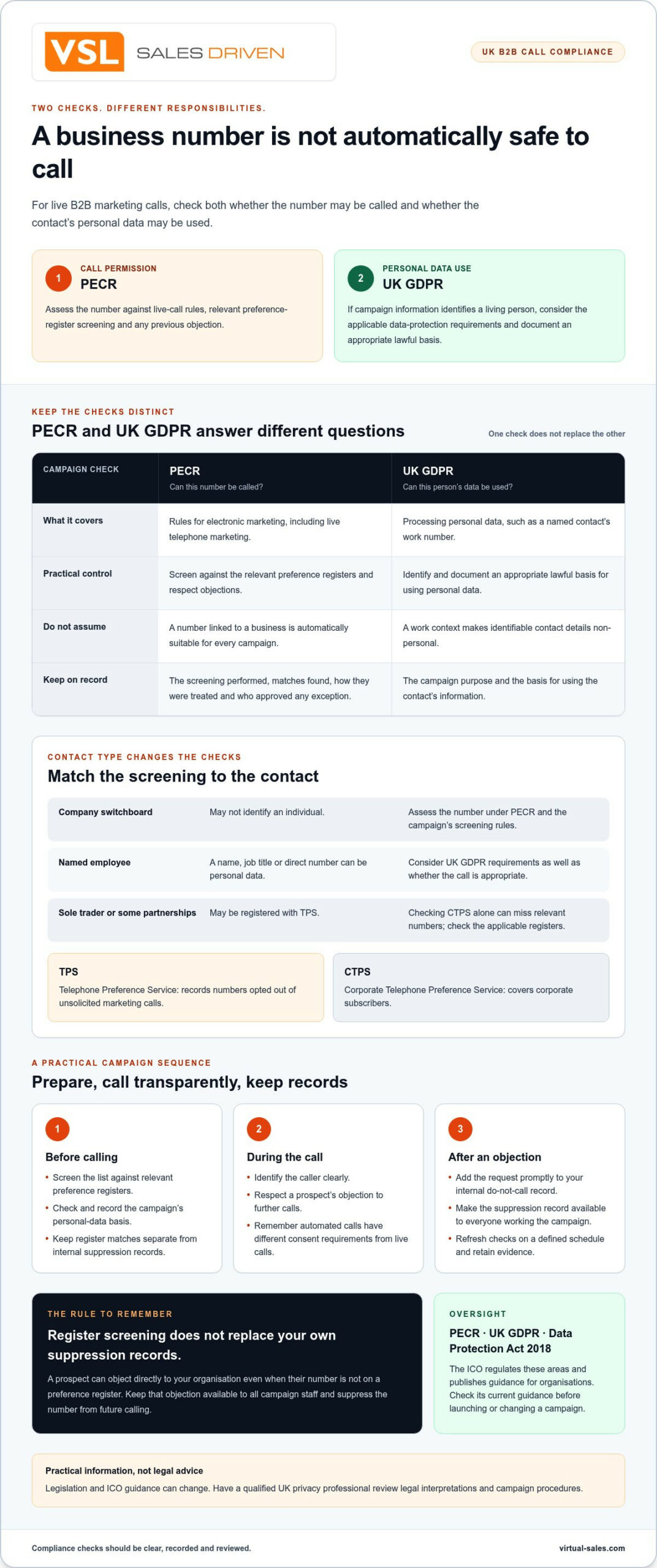
For a live marketing call, separate two questions: may you call this number? and may you use this person’s data for the campaign? PECR governs key rules for live direct marketing calls, including screening against preference registers and respecting objections. UK GDPR applies where campaign information identifies or relates to a living person. Passing one check doesn’t settle the other.
That distinction is a practical control, not just a legal technicality. A company switchboard number may not identify an individual, while a named employee’s direct line usually links contact details to a person. Keep the call-permission decision and personal-data assessment distinct in campaign records.
What TPS and CTPS checks should a campaign plan include?
The Telephone Preference Service (TPS) records numbers opted out of unsolicited marketing calls. The Corporate Telephone Preference Service (CTPS) covers corporate subscribers. Sole traders and some partnerships may be registered with TPS, so checking CTPS alone can miss relevant numbers. The Official Telephone Preference Service (TPS) Website provides access to TPS information and links to CTPS resources.
Build register screening into data preparation, not as an informal check made by callers. Document when the list was screened, which registers were checked, how matches were treated and who approved any exception. Verify current register requirements and exceptions against the ICO’s latest guidance before a campaign begins.
Keep register matches separate from your own suppression records. A prospect may object directly to your organisation even if their number isn’t on a preference register. Add that objection to an internal do-not-call record promptly, make it available to anyone working the campaign and suppress the number from future calling. Refresh the register checks and suppression data on a defined schedule, and retain enough information to show that checks took place.
When does UK GDPR apply to business contact data?
A work context doesn’t make identifiable contact details non-personal. A named employee’s name, job title, business email address or direct telephone number can be personal data. Before using it, identify and document an appropriate lawful basis. For direct marketing calls, organisations often consider legitimate interests, but that requires assessing the purpose, necessity and impact on the individual rather than assuming it applies.
Then make the data handling understandable and proportionate:
- Transparency: explain relevant information about the organisation’s use of contact data in line with applicable privacy-notice requirements.
- Data minimisation: collect and use only details needed for the campaign’s stated purpose.
- Retention: set and follow a retention approach, including how records are reviewed or removed.
- Individual rights: provide a route for people to exercise applicable rights and ensure requests reach the responsible team.
For technology businesses, this means the campaign brief, data source, register screening and objection handling should align. If specialist appointment-setting support is part of your plan, VSL’s published appointment-setting profile can help you understand its service experience. It isn’t evidence of legal compliance, which remains a matter for the organisations responsible for the campaign.
How B2B cold-calling rules differ by contact and campaign
A prospect’s job title doesn’t tell you who subscribes to the telephone number. Nor does it settle whether the campaign is processing personal data. Use the comparison below to identify what needs checking, then verify the classification and current PECR requirements against ICO guidance. The campaign’s purpose, contact data and circumstances of the call all affect the assessment.
| Contact type | Subscriber status to assess | Personal-data relevance | Campaign checks |
|---|---|---|---|
| Corporate contact, such as a company switchboard | Establish whether the organisation is the subscriber. Don’t infer this from the number alone. | A generic switchboard number may not identify a person. Notes or linked contact details may do so. | Check applicable preference registers and your organisation’s suppression and objection records. |
| Named employee, such as an IT director | The employee’s name doesn’t establish subscriber status. Check whether the number is held by a corporate or individual subscriber. | A name linked to a role or direct number may identify a living person, even in a work context. | Assess subscriber status, applicable register checks and internal suppression records. Consider the personal-data processing separately. |
| Sole trader, individual or partnership contact | Determine the actual subscriber. Some sole traders and partnerships may have individual-subscriber status, but don’t assume every partnership is treated alike. | Contact details identifying the trader or individual may be personal data. | Check the applicable registers, internal suppressions and objections. Resolve uncertain status before calling. |
What changes when a prospect is a named employee or sole trader?
A business purpose doesn’t remove the need to consider personal data. For instance, a software provider may call an IT director about a work-related service, but the person’s name and direct number can still identify them. Treat the subscriber-status check and data-protection assessment as separate questions. If the contact is a sole trader or partnership, verify the specific circumstances rather than relying on a broad category label.
How should teams handle objections and special categories?
Respect a clear objection to marketing calls, stop contact and record the request so it informs future suppression. Apply that instruction across the campaign, including when lists or callers change. Claims-management and pension-related calls can have specific restrictions, so check current legislation and ICO guidance before undertaking them. Those special-case rules shouldn’t be generalised to ordinary technology-sector prospecting.
Illustrative example, not legal advice: A software business plans outreach to technology decision-makers. Its list contains company switchboards, named employees and a sole-trader consultant. Before calling, the team checks who subscribes to each number, reviews the relevant register and internal records, and assesses named contact data separately. Any unclear classification is held for review rather than treated as permission to call.
A practical compliance framework for UK B2B calling campaigns
A compliance process needs more than a pre-campaign checklist. Give every decision an owner, set clear hand-offs and make sure the calling team can act on objections without delay. Outsourcing calls doesn’t remove your organisation’s responsibility for its campaign arrangements or lawful processes.
Use this VSL-aligned framework to connect campaign delivery with compliance oversight. It supports clear operations; it isn’t legal advice or a guarantee that a campaign meets the law.
What should happen before the first call?
Set up the campaign around five control points. Assign an owner to each one, including where a specialist partner carries out agreed campaign tasks.
- Purpose: Define the campaign objective, target businesses and relevant job roles. Keep the intended outreach specific enough for the team to recognise an out-of-scope contact.
- Data ownership: Record who provides the contact list, who assesses its use and who maintains updates. Agree how the team will handle uncertain records before they reach callers.
- Call readiness: Assign responsibility for register screening and internal suppression checks. Record the list version and check status, and hold any records that need review.
- Caller briefing: Give callers clear guidance on the campaign purpose, how to identify the organisation and where to direct requests or objections.
- Outcome review: Agree who checks call outcomes, complaints, data concerns and process changes, and how actions are fed back into campaign planning.
What should callers and campaign managers do during and after calls?
During outreach, callers should follow the approved briefing, identify themselves and their organisation, and use the agreed route for handling questions. If a person objects, the caller should stop marketing contact and pass the request promptly to the person responsible for suppression updates. Make the escalation route clear before activity starts, not after the first objection.
After calls, review outcomes and record relevant decisions in campaign records. Focus on whether the right contacts were reached, whether any data appeared inaccurate and whether objections or complaints were actioned. Keep records that show the process and follow-up, rather than relying on informal messages between teams.
Illustrative scenario, not a VSL result or legal advice: A software company commissions outreach to IT decision-makers. Before launch, it assigns responsibility for list checks, internal suppression updates and caller guidance. During the campaign, callers know where to pass objections. At review, the company checks outcomes and unresolved data issues, then updates the next campaign list and briefing before further calls.
Have a qualified UK privacy professional review legal interpretations and check current ICO guidance. VSL can work alongside your sales and marketing team on campaign delivery, while your organisation retains ownership of its legal decisions and processes.
When to use specialist support for compliant B2B cold calling
Specialist support may suit your business when you’re preparing to enter the UK market, testing a new ideal customer profile or seeking a steadier rhythm of technology-sector outreach. It can give your team added campaign capacity and help turn market feedback into practical adjustments to targeting and messaging.
External support doesn’t transfer your organisation’s legal responsibilities. Keep ownership clear: your team should define campaign objectives, approve the data process and decide how objections and compliance questions are handled. A specialist can support delivery, but isn’t your legal adviser and can’t guarantee compliance.
What should a technology company expect from an experienced campaign team?
Expect a campaign briefing that aligns the proposition, target roles, contact-data process and desired outcomes. This gives the caller and campaign manager a shared operating plan, while leaving legal decisions with your organisation. VSL works as an extension of your sales and marketing team, with campaign reviews focused on progress, prospect feedback and agreed next steps.
If you’re weighing up external support, the B2B appointment-setting service explains how campaign delivery can fit your sales activity. For a wider view of the operating model, compare it with this guide to outsourced appointment setting services and guide to lead generation and appointment setting.
How can a business take the next step?
Before briefing a team, clarify the campaign purpose, contact-data source, register checks, objection process and ownership of each task. Ask a qualified UK privacy professional to review legal interpretations and current guidance. Once your internal process is clear, a campaign discussion can focus on fit, target audience and how outreach would work alongside your existing sales activity.
Build compliance into your next growth phase
As your UK prospecting plans grow, make compliance part of campaign design rather than a last-minute check. The legal requirements for B2B cold calling in the UK should inform how your team defines its target market, manages contact data and assigns responsibility for decisions. Keep legal interpretation with a qualified privacy professional, then make sure the operational process is clear to everyone involved.
For technology businesses that want added outreach capacity, VSL works alongside sales and marketing teams. Its campaign approach pairs experienced UK-based callers and consultative, script-free conversations with BANT qualification as a minimum, dedicated campaign management and weekly reporting. These practices support visibility into campaign activity; they aren’t legal advice or a compliance guarantee.
Choose a next step that fits your team’s priorities. A focused conversation can help you consider how specialist appointment setting might support your prospect outreach.
With clear ownership and the right expertise around the campaign, your team can pursue relevant business conversations with greater confidence.
Frequently Asked Questions
Is B2B cold calling legal in the UK?
Yes, live B2B marketing calls can be lawful, provided the campaign meets the relevant rules and no restriction or objection prevents the call. Don’t assume that a number is callable simply because it appears on a business website. Before outreach, establish who the subscriber is, check applicable registers and consider whether the call involves personal data. Automated marketing calls are treated differently and require specific prior consent.
Do UK businesses need to check the TPS before B2B cold calls?
Yes, campaign teams should consider TPS screening alongside CTPS checks, since sole traders and some partnerships may use TPS-registered numbers. Don’t rely on a previous campaign’s screening without confirming that the list and checks remain suitable. Keep a record of the screening date, register results and numbers suppressed, then follow current ICO guidance on requirements and exceptions before calls are made.
Does UK GDPR apply when calling a business contact?
It can. A named employee’s direct dial or work email may identify a living person, even when the call relates to their professional role. For example, a SaaS supplier using a named finance director’s contact details should consider the lawful basis for processing them and how the person is informed. The legal requirements for B2B cold calling in the UK therefore include data-handling considerations as well as call checks.
Can a company outsource B2B cold calling and transfer its legal responsibility?
No. Hiring an external caller doesn’t automatically remove the commissioning organisation’s responsibilities or make the provider solely responsible. The parties should agree who supplies and checks contact data, manages suppression requests, handles complaints and keeps campaign records. Their legal roles depend on how the activity and data processing are arranged, so document responsibilities and ask a qualified UK privacy professional to review the allocation.
What should a caller do if a business contact objects to marketing calls?
Stop the marketing call and make sure the objection is recorded for future suppression. Pass the request promptly into the campaign’s agreed process so another caller or a later list upload doesn’t restart contact by mistake. Keep only the information needed to respect the objection and make the suppression record available to teams working on the campaign. Don’t treat a new product or campaign as permission to call again.
What information should a live B2B marketing caller provide?
The caller should clearly identify themselves and their organisation, and must not hide or disguise the calling line identity. If asked, they should provide a valid callback number and the contact details required under current guidance, such as a contact address or freephone number. Brief callers on how to answer these requests accurately. Check the latest ICO guidance before setting caller instructions, as information requirements can change.
Are the rules different for sole traders and limited companies?
They can be. A limited company will commonly be a corporate subscriber, while a sole trader may be an individual subscriber with different PECR protections. Don’t classify a contact by job title or trading name alone: check who subscribes to the number. Some partnerships may also have individual-subscriber status. Separately, a named contact’s details can be personal data whether they work for a limited company or run a sole-trader business.

Disclaimer
Disclaimer: Content is for general information only and does not constitute professional advice. Results may vary. Virtual Sales Limited accepts no liability for actions taken based on this content.
Tags: B2B Appointment Setting, B2B cold calling, B2B Telemarketing, cold calling compliance, CTPS screening, data hygiene, PECR, UK GDPR