Human-Led Telephone Outreach vs AI Sales Messages: What Works?
What if the value of AI prospecting depends less on how many messages it creates and more on how it helps you prepare for a prospect’s response? Why AI-assisted research and telephone outreach can work together comes down to relevance and interaction. AI can help organise research. A human conversation can explore a buyer’s priorities, timing, and fit in real time.
It’s understandable to look to AI to make prospecting faster and more consistent. But speed alone doesn’t make an approach persuasive, and a message that could apply to any company is easy to ignore. The value comes from using technology to inform outreach, then giving prospects a relevant reason to engage.
This article explains how AI-assisted research, tailored messages and telephone conversations can shape sales conversion. You’ll see where generic outreach loses relevance, how human-led conversations reveal useful qualification detail, and how to combine AI and personalisation without treating automation as a substitute for understanding the buyer.
Key Takeaways
- Use AI to organise prospect and company information, then tailor outreach to a focused audience and a clear business context.
- Keep human oversight in the process so sales conversations can respond to a prospect’s needs rather than follow an automated sequence alone.
- Assess outreach by looking beyond opens and replies to whether conversations progress into relevant sales meetings.
- Use BANT to guide qualification and follow-up, giving your sales team a clearer view of fit, priorities and timing.
How should I use AI for personalised sales outreach?
Start with a focused prospect list built around your ideal customer profile, not a broad export. Use AI-assisted research to organise company details, role changes and relevant public activity, then check that the information is current. For example, a software firm expanding its engineering team may have a different priority from one recruiting a new finance director. Use that context to shape a message around a plausible business need, not merely to insert a prospect’s name. Relevant B2B outreach connects the company’s circumstances with a specific reason to talk.
Use behaviour and company data to decide what happens next. A prospect visiting a product page, replying to an email or engaging on LinkedIn may warrant timely human follow-up. Treat each signal as a prompt to review, not proof of buying intent. AI can summarise research and suggest a first draft; a person should check the context, correct errors and choose the next action. Reserve manual prospecting for complex accounts where several stakeholders or a specialised use case call for closer judgement.
To assess costs and ROI, compare the resources spent on research, data enrichment and outreach with the quality of replies, qualified meetings and pipeline progression. AI may reduce repetitive preparation; telephone conversations take human time but can reveal priorities that messages miss. Track outbound activity in your CRM, including its source, the response and the agreed next step. This gives sales leaders a practical basis for allocating effort, rather than judging performance by message volume alone.
Human conversations versus AI-only sales sequences
AI-only sequences can send consistent follow-ups across a prospect list. They can suit routine updates or sharing material with people who have already shown interest. But a platform may miss the meaning behind a pause, objection or change in context. Human judgement lets a caller ask a follow-up question and adapt the conversation. This allows a caller to respond thoughtfully when a prospect’s answer calls for further discussion, though it does not establish that telephone outreach outperforms AI messages.
AI messages can work well for straightforward, timely communication based on accurate information. An automated confirmation can acknowledge a webinar registration; a phone conversation can explore how its subject relates to a prospect’s priorities. Have a person review AI-generated content for accuracy, relevance and tone. Clear governance should also define approved data, access and review processes.
UK B2B telephone marketing must comply with applicable PECR and UK GDPR requirements. Live marketing calls are generally governed by PECR Regulation 21, including requirements to respect objections and screen against relevant TPS and CTPS registers. Automated marketing calls delivering recorded messages are subject to stricter consent requirements under Regulation 19. Businesses must also handle personal data lawfully and respect individuals’ rights.
ICO guidance on telephone marketing
Scale human-led outreach by using AI for research and preparation, while people handle account decisions and conversations. Review replies and prospect feedback to refine targeting, rather than increasing message volume by default. For technology firms building a sales pipeline, UK technology appointment setting can support relevant business conversations.
Does AI prospecting improve conversion rates?
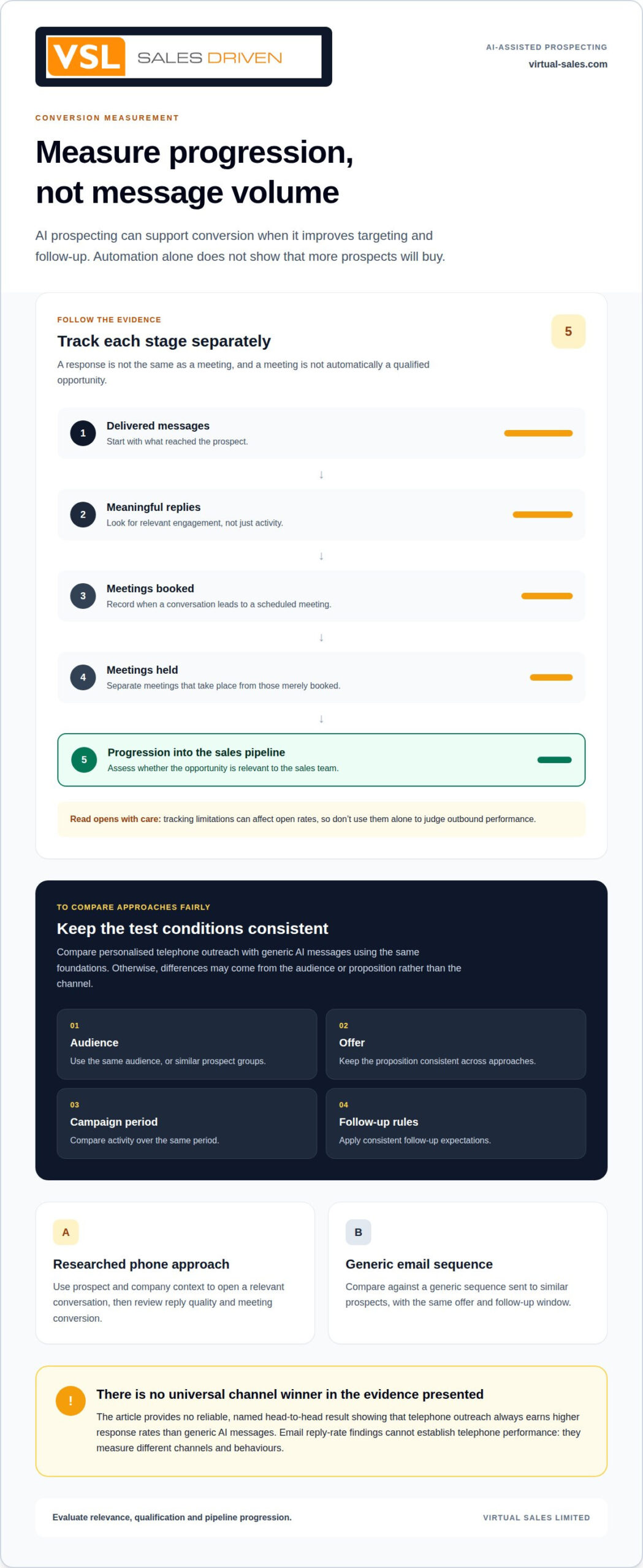
AI prospecting can support conversion when it improves targeting and follow-up, but automation alone doesn’t show that more prospects will buy. To compare personalised telephone outreach with generic AI messages, use the same audience, offer, campaign period and follow-up rules. Without those controls, results may reflect differences in the list or proposition rather than the channel.
Campaign performance depends on targeting, proposition, data quality and execution. Businesses should evaluate outreach through meaningful conversations, qualified appointments and sales pipeline progression rather than relying solely on email response rates or message volumes.
Track each stage separately. An email open is not a reply; a reply is not a booked meeting; and a booked meeting is not necessarily a qualified opportunity. Tracking limitations can also affect open rates, so don’t use them alone to judge outbound performance. Record delivered messages, meaningful replies, meetings booked, meetings held and progression into the sales pipeline.
For example, compare a researched phone approach with a generic email sequence sent to similar prospect groups. Keep the offer and follow-up window consistent, then review reply quality and meeting conversion alongside volume. AI may help identify patterns and organise follow-ups, while sales teams assess whether conversations reveal relevant needs and decision-makers. This offers a more useful view of conversion than an isolated reply-rate figure and shows where targeting, messaging or follow-up needs adjustment.
Personalised versus generic B2B sales outreach
Generic automated messages often rely on broad claims that could fit any software firm. A tailored message connects company context to a relevant business issue. For example, a LinkedIn update about expansion into a new market gives a caller a reason to ask how that move affects the prospect’s priorities. It creates a specific opening without assuming the prospect has a need. Personalised telephone outreach gives experienced callers the opportunity to respond to what a prospect actually says, explore relevant business challenges and adapt the conversation accordingly
On a call, refer to a prospect’s role or stated priority, then invite them to explain their situation. They can correct an assumption or add context. Trust comes from accuracy and listening, not just using someone’s name.
LinkedIn and automated messages can support recognition between conversations, but repeated generic follow-ups may feel intrusive. Give each channel a defined purpose, such as sharing a relevant insight or arranging a discussion. Keep messages consistent with the offer, and change direction if a prospect says it isn’t relevant.
Connect outreach with pipeline development by recording the context, response and agreed next step. A reply that raises a business need calls for different follow-up from a polite decline. Review response rates alongside conversation quality, not message volume alone. Limiting excessive sales automation keeps human judgement involved. The takeaway: personalise around a credible business reason, then let the conversation establish fit.
How BANT can guide human-led outreach
BANT is a qualification framework that assesses Budget, Authority, Need and Timeline. In a human-led conversation, it helps turn initial interest into a clearer view of fit without replacing active listening. Capture what the prospect confirms and what still needs clarification. Use the framework to guide useful questions, not as a checklist to rush through.
For a software company, start with Need: what operational issue is the prospect trying to address? Explore Authority by asking who else will shape the decision. Discuss Budget tactfully to establish whether resources are available or approval is required. Timeline helps distinguish early research from an active evaluation.
These details shape relevant follow-up. A prospect with a recognised need but no immediate project may prefer a later conversation tied to a stated milestone. A decision-maker assessing options now may benefit from a sales meeting. If budget or timing remains unclear, record that accurately and don’t treat an assumption as qualification.
AI can organise notes under the framework, but a caller should interpret nuance and capture the prospect’s own words. Before hand-off, sales teams can review confirmed details, outstanding questions and agreed next steps. This makes BANT a shared decision aid for prioritising follow-up, while allowing for the buyer’s circumstances to change. Use the information to tailor the next conversation rather than sending the same follow-up to every prospect.
How Virtual Sales Limited can support your outreach
Virtual Sales Limited helps technology companies put relevant human conversations at the centre of outbound activity. Its B2B appointment setting and B2B lead generation support teams that need to engage suitable business decision-makers, build qualified opportunities and give salespeople useful context for follow-up.
This support can be useful when generic messaging gets attention without generating meaningful conversations, or when internal teams lack capacity for consistent prospect engagement. Virtual Sales Limited’s experienced UK-based callers use consultative conversations to understand a prospect’s requirements, without relying on scripts. Each campaign has a dedicated caller and campaign manager to keep activity aligned with your objectives.
For technology businesses, outreach needs to reflect the product, target market and buying process. Virtual Sales Limited uses BANT to assess Budget, Authority, Need and Timeline, recording what is confirmed and what remains unknown. This gives your sales team a clearer basis for deciding which conversations merit follow-up and what needs further discussion.
VSL works as an extension of your sales and marketing team, with weekly campaign reporting to help you review activity and prospect feedback. You can explore its approach to B2B appointment setting as part of a wider plan for human-led outreach and pipeline development.
Founded in 2001, Virtual Sales Limited brings more than 25 years of experience to B2B prospect engagement. Its UK-based callers each have at least five years of relevant experience and use a consultative, script-free approach. VSL supports software vendors, SaaS providers, IT consultancies and managed service providers that need meaningful conversations with relevant decision-makers.
VSL offers flexible monthly appointment-setting subscriptions starting from £2,495, with no setup fees or commission charges. Clients benefit from dedicated UK-based callers, experienced campaign management and transparent weekly reporting. Subscriptions can be adjusted to reflect changing business requirements, with no long-term commitment beyond the initial month.
If you’re considering how to make your technology outreach more relevant, contact Virtual Sales Limited to discuss your priorities.
Make your next outreach decision count
Choose a clear audience and business outcome for your next outreach activity. Decide what would make a conversation useful to your sales team, then use prospect feedback to refine targeting and follow-up. This keeps measurement focused on opportunity quality, not message volume alone.
The value of personalised telephone outreach lies in its ability to support meaningful, two-way conversations. AI can make research and preparation more efficient, while experienced callers can explore a prospect’s requirements, respond to questions and establish whether a relevant sales opportunity exists.
If you’re looking to build a more qualified sales pipeline, Virtual Sales Limited can help. Our experienced UK-based callers work as an extension of your team, combining research, consultative conversations and structured qualification to engage relevant technology decision-makers.
With a clear focus and useful feedback, your next campaign can start from a stronger position.
Frequently Asked Questions
What are typical conversion rates for personalised sales calls versus AI-generated messages?
There isn’t one reliable conversion rate that compares these approaches across B2B campaigns. Results depend on the target audience, offer, data quality and how each team defines conversion. A call connection rate, an email reply rate and a meeting rate measure different stages. Treat any comparison carefully unless its method and denominator are clear.
How can sales teams personalise telephone outreach using customer data?
Use accurate business information to prepare a relevant opening, not to make assumptions about an individual. For a software prospect, a salesperson might mention the company’s product category, then ask whether a related operational issue is a current priority. If the prospect corrects the context, adapt the conversation. Record useful preferences and agreed next steps for future contact.
How can businesses measure and compare the performance of phone outreach and AI sales campaigns?
Set a shared outcome, then compare similar prospect groups receiving each approach. Track each channel separately, using relevant measures such as successful conversations, meaningful replies, meetings held and qualified opportunities. Note the audience, offer and follow-up approach alongside the results. This helps show whether differences relate to channel, targeting or execution, rather than relying on one headline rate.

Ready for a pipeline that AI alone can’t build?
See how our lead generation powered by AI combines intelligent automation with experienced SDRs based in the UK. You can also explore our appointment setting and lead generation services.
Get me more leadsDisclaimer
Disclaimer: Content is for general information only and does not constitute professional advice. Results may vary. Virtual Sales Limited accepts no liability for actions taken based on this content.
Tags: AI prospecting, B2B Sales, bant qualification, consultative outreach, Lead generation, sales personalisation, telephone outreach