AI vs Human SDRs in 2026: Future of B2B Lead Generation
The most expensive SDR on your payroll might not be the one drawing a salary. Across B2B sales floors in 2026, technology companies are discovering that poorly deployed AI outreach tools are quietly torching brand reputation, flooding pipelines with unqualified contacts, and driving response rates into the floor. The debate around AI vs Human SDRs in 2026 isn’t simply about cost per contact. It’s about what actually moves a high-ticket prospect from cold awareness to a booked meeting with genuine intent.
You already know the pressure. Buying committees are growing more complex, inboxes are saturated with automated sequences that smell like automation from the opening line, and the SDR turnover cycle is an expensive, demoralising treadmill. The instinct to automate everything is understandable. The consequences of getting it wrong are not.
This article cuts through the noise. You’ll gain a clear, practical framework for understanding where AI genuinely accelerates your pipeline, where human-led consultative intelligence remains non-negotiable, and how the most effective technology businesses in 2026 are combining both to build scalable, revenue-generating lead generation strategies that protect their brand whilst consistently delivering BANT-qualified appointments.
Key Takeaways
- The debate around AI vs Human SDRs in 2026 is not a binary choice — the highest-performing B2B sales teams are combining both to build scalable, brand-safe pipelines that consistently deliver BANT-qualified appointments.
- Buyer fatigue is a measurable commercial threat in 2026; understanding where AI-generated outreach is damaging your brand reputation is the first step to protecting your pipeline’s long-term health.
- AI excels at data enrichment and top-of-funnel sorting, but emotional intelligence and unscripted consultative conversation remain non-negotiable when pursuing high-ticket IT and SaaS deals with complex buying committees.
- A structured hybrid framework — where technology handles scale and human SDRs handle nuance — dramatically reduces cost-per-qualified-meeting whilst increasing executive-level trust and conversion rates.
- Discover how VSL’s flexible, pilot-campaign approach allows ambitious technology businesses to test and optimise their outreach strategy with minimal risk before committing to full-scale deployment.
The Evolution of Outreach: Defining the SDR Role in 2026
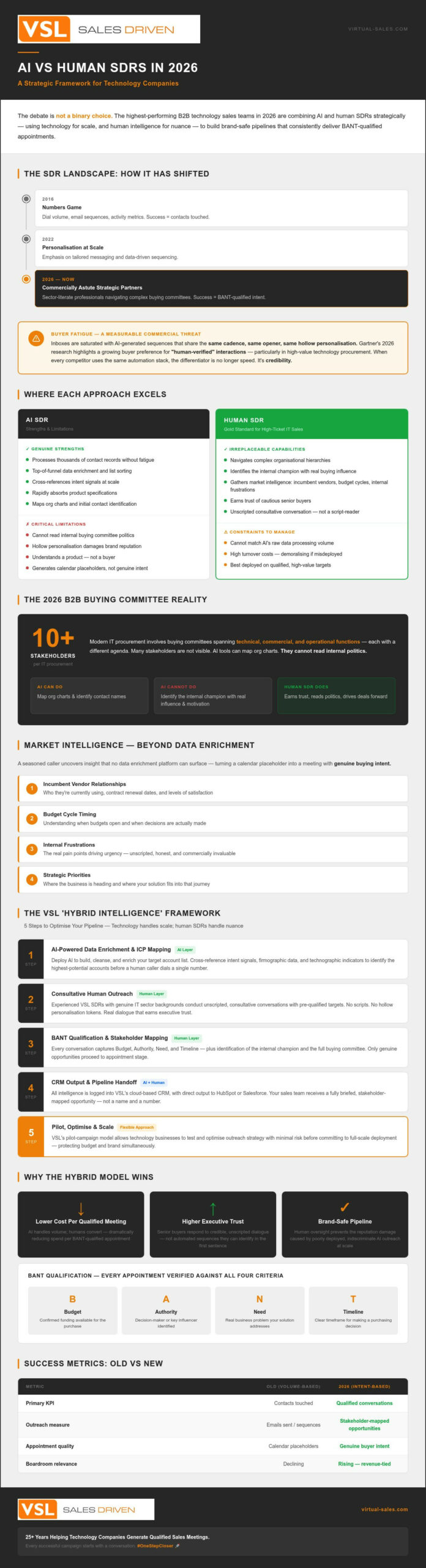
The Sales Development Representative (SDR) has always been a role defined by its moment. In 2016, it was a numbers game: dial volume, email sequences, and activity metrics. By 2022, the emphasis shifted towards personalisation at scale. In 2026, the role has transformed again, this time into something fundamentally more demanding. The SDR who survives and thrives in this environment isn’t a script-reader. They’re a commercially astute, sector-literate professional capable of navigating complex organisational hierarchies and earning the trust of cautious senior buyers.
What’s driving this transformation? Buyer fatigue. Not the abstract kind referenced in marketing decks, but a measurable, commercially damaging phenomenon. Inboxes across every B2B vertical are saturated with AI-generated sequences that share the same cadence, the same opener, and the same hollow personalisation token. Gartner’s 2026 research highlights a growing buyer preference for what it terms "human-verified" interactions, particularly in high-value technology procurement. When every competitor is deploying the same automation stack, the differentiator is no longer speed. It’s credibility.
This context reframes the entire debate around AI vs Human SDRs in 2026. Quantity-based metrics, contacts touched, emails sent, sequences completed, are losing their boardroom relevance. What’s replacing them is intent-based performance: qualified conversations, stakeholder-mapped opportunities, and appointments where the prospect has genuine buying authority and a real business problem your solution can address.
The 2026 B2B Buying Committee
From Script-Readers to Strategic Partners
High-growth technology firms have largely abandoned the model of hiring junior SDRs to work through scripted call guides. The cost of mis-qualified pipeline is simply too high. VSL has operated on a different philosophy from the outset: experienced professionals with genuine IT sector backgrounds, conducting unscripted, consultative conversations that generate BANT-qualified leads rather than superficial contact records.
That distinction matters more in 2026 than it ever has. The Market Intelligence gathered by a seasoned caller, understanding a prospect’s incumbent vendor relationships, budget cycle timing, internal frustrations, and strategic priorities, goes far beyond what any data enrichment platform can surface. It’s this layer of human-gathered insight that separates a booked meeting with genuine intent from a calendar placeholder that quietly becomes a no-show.
Competitors in this space frequently cite AI’s ability to absorb product specifications rapidly. What that argument misses is that understanding a product is not the same as understanding a buyer. The AI vs Human SDRs in 2026 conversation only becomes strategically useful when you separate what each approach actually does well, and build your pipeline architecture accordingly.
The Rise of the AI SDR: Perfect Knowledge vs. Real-World Nuance
AI-powered outreach tools have genuine, undeniable strengths. They don’t sleep. They don’t have bad Tuesdays. They can process thousands of contact records, cross-reference intent signals, and fire personalised sequences at a scale no human team can match. For top-of-funnel data enrichment, initial list sorting, and identifying accounts that are showing early buying signals, AI is a legitimate accelerant. That’s not a controversial position. It’s simply where the technology performs well.
The problem begins when organisations mistake product knowledge for commercial intelligence, and scale for strategy.
The Product Knowledge Paradox
An AI SDR can absorb a full product manual in seconds. It can recite feature sets, compliance certifications, and integration capabilities with flawless accuracy. What it cannot do is translate those capabilities into the specific business outcome a CFO cares about in a budget-constrained quarter, or understand why a Head of IT is privately frustrated with their current vendor. Technical accuracy and strategic relevance are not the same thing. In 2026, senior buyers have become acutely sensitive to this gap. Research from Gartner consistently highlights that C-suite buyers increasingly disengage from outreach that feels transactional rather than consultative. When a message leads with features rather than outcomes, it signals immediately that no genuine discovery has taken place. Most experienced technology buyers can identify an AI-generated interaction within the first thirty seconds of a call or the first paragraph of an email. The cadence is too clean. The personalisation is too shallow. The questions don’t follow the conversation; they follow a script.
Scalability vs. Sustainability
Here’s the calculation that rarely appears in AI vendor pitch decks. Subscription software costs are real and relatively modest. But the cost of burning through your Total Addressable Market with robotic, impersonal outreach is far more expensive, and far harder to reverse. A C-suite prospect who receives three poorly timed, AI-generated sequences from your brand doesn’t just ignore them. They form an opinion. That opinion travels into procurement meetings, peer networks, and LinkedIn threads.
In the debate around AI vs Human SDRs in 2026, this is the variable most cost-benefit analyses ignore: the brand tax. Every misaligned, automated touchpoint erodes the trust equity your marketing team has spent months building. Volume without precision doesn’t fill a pipeline. It empties a reputation.
VSL’s appointment setting services are built on a fundamentally different philosophy. Rather than maximising contact volume, the focus is on protecting market reputation whilst delivering qualified conversations with genuine buying intent. Balancing the reach of intelligent prospecting with the precision of human-led B2B telemarketing isn’t a compromise. It’s the architecture of a pipeline that compounds over time rather than cannibalises itself.
If you want to understand how that model performs in practice, the verified client outcomes on Clutch provide a more honest benchmark than any vendor’s internal projections.
Why Human SDRs Remain the Gold Standard for High-Ticket IT Sales
Emotional intelligence isn’t a soft skill. In high-ticket IT sales, it’s a commercial asset. The ability to read hesitation in a prospect’s voice, to recognise when a stated objection masks a deeper political concern, or to know instinctively when to push and when to listen — none of that exists in an automated sequence. It exists in a seasoned professional who’s navigated enough complex procurement cycles to understand that the words a buyer uses rarely tell the whole story.
Consider a realistic scenario. A human SDR is three minutes into a call with a Head of IT at a mid-market financial services firm. The prospect says they’re "happy with their current provider." An AI-driven tool logs the objection, triggers a pre-built rebuttal, and moves on. The human SDR notices something different: a slight pause before the word "happy," a shift in tone that signals frustration rather than satisfaction. They ask a single, well-placed question. Within ninety seconds, the prospect is describing a support escalation that’s been unresolved for four months. That’s not a closed door. That’s a live opportunity. An AI would have closed it.
Senior decision-makers in Finance, HR, and Operations are particularly resistant to transactional outreach. These are professionals whose time is genuinely scarce and whose trust is hard-won. They respond to peer-level conversation, not pitch sequences. In the broader debate around AI vs Human SDRs in 2026, this distinction carries real commercial weight. A booked meeting secured through genuine dialogue converts at a fundamentally different rate than one extracted through automated persistence.
Consultative Calling: Beyond the BANT Framework
VSL’s callers bring genuine IT sector backgrounds into every conversation. That means they’re not reading from a discovery script; they’re engaging as informed peers. BANT qualification matters, but it’s a floor, not a ceiling. The real intelligence gathered during a consultative call includes incumbent vendor relationships, renewal timelines, internal political dynamics, and the prospect’s actual priorities versus their stated ones. Identifying intent through tone, cadence, and what a prospect doesn’t say is a skill built over years, not months. It’s also why VSL operates with zero ramp-up time on campaigns; the professionals are already calibrated.
There’s also a distinction worth drawing between a "qualified sales appointment" and a genuine conversation with buying intent. Volume-chasing approaches book the former. Consultative calling builds the latter. The difference shows up clearly in show rates, conversion ratios, and ultimately, closed revenue.
The Transparency and Accountability Advantage
Human-led outreach demands accountability in a way automated tools rarely do. VSL’s model is built around weekly reporting, 360-degree feedback loops, and full integration with cloud-based CRMs including Salesforce and HubSpot. Every contact, every conversation outcome, and every qualified opportunity is visible in real time. There’s no black box.
The commercial logic of operating without long-term contracts reinforces this discipline. When an agency can’t rely on a twelve-month retainer to absorb underperformance, every month has to deliver. That structure keeps standards high and aligns incentives directly with client outcomes. For technology businesses evaluating their B2B lead generation strategy, that level of transparency isn’t a nice-to-have. It’s the baseline for a partnership worth committing to.
Explore VSL’s client case studies to see how this consultative, accountable model translates into measurable pipeline results across the IT and SaaS sectors.
The VSL ‘Hybrid Intelligence’ Framework: 5 Steps to Optimise Your Pipeline
Most approaches to the AI vs Human SDRs in 2026 debate present a false choice. Deploy automation and sacrifice quality. Hire human SDRs and sacrifice scale. VSL’s Hybrid Intelligence Framework rejects that binary entirely. It’s a structured, five-step methodology that sequences technology and human expertise in the precise order each performs best, building a pipeline that’s simultaneously scalable and commercially credible.
Step 1 and 2: Building the Foundation
Every campaign begins with data. VSL uses LinkedIn add-ons and specialist profiling tools to construct prospect profiles that consistently deliver around 40% better contact accuracy than standard list purchases. That means fewer bounced calls, fewer wasted touches, and more conversations with people who actually hold purchasing authority.
Existing customers are excluded from the outset. Every call is a fresh opportunity, not a redundant touchpoint that risks damaging a live commercial relationship. Intent mapping then identifies which accounts are exhibiting genuine buying signals before any human caller picks up the phone. BANT criteria are applied as a filter at this stage, not retrospectively. If an account doesn’t meet the threshold for Budget, Authority, Need, and Timing, it doesn’t enter the human outreach queue. That discipline protects your team’s time and keeps your pipeline clean.
Step 3 and 4: The Human Element in Action
This is where the framework separates itself from anything a purely automated stack can replicate. VSL’s callers are paid a high fixed rate with no commission structure. That’s a deliberate commercial decision. Commission-driven SDRs are incentivised to book meetings; fixed-rate professionals are incentivised to book the right meetings. The quality of a booked appointment, its show rate, its conversion potential, reflects directly in the data, and that accountability is built into the model from day one.
VSL’s Project Managers operate as an extension of your marketing team, not as a remote supplier managing a contract. They absorb your messaging, your competitive positioning, and your ideal customer profile, then translate that intelligence into live conversations. The impact of this approach on ROI is documented clearly through professional lead generation for technology companies, where consultative outreach consistently outperforms volume-based automation on qualified pipeline metrics.
CRM synchronisation runs in parallel. Every contact record, conversation outcome, and qualified opportunity flows directly into your existing systems, whether that’s Salesforce, HubSpot, or your preferred platform. There’s no manual reconciliation. No data lag. Your internal sales team receives intelligence in real time, allowing them to follow up with context rather than cold-calling their own pipeline.
Step 5: Continuous Optimisation
Weekly reviews refine the Key Message based on live call data. What’s resonating? What’s triggering early disengagement? Which objections are appearing consistently? These aren’t abstract questions answered by a monthly report. They’re addressed in structured review sessions that adjust the outreach strategy whilst the campaign is still running. That feedback loop is what separates a campaign that compounds over time from one that plateaus after week three.
The AI vs Human SDRs in 2026 question is ultimately answered by outcomes, not theory. This framework delivers both the reach that technology enables and the trust that only human expertise builds.
Choosing Your Strategy: Scaling Sustainable Revenue with VSL
The most important conclusion to draw from the AI vs Human SDRs in 2026 debate isn’t which approach wins. It’s that framing it as a competition misses the point entirely. The highest-performing technology businesses aren’t choosing between automation and human expertise. They’re sequencing both, deploying each where it genuinely excels, and building a pipeline architecture that compounds in value rather than degrades over time.
That architecture requires a starting point. For many sales leaders, the honest answer is that they don’t yet know where their current outreach is losing ground. Before committing to a full-scale strategy shift, the most commercially sensible move is a structured audit of your existing sequences. Ask the hard questions: Do your email openers read like they were written by a human who knows your prospect’s world? Do your call scripts allow for genuine discovery, or do they funnel every conversation towards a predetermined close? If the answer is uncomfortable, that discomfort is useful data.
VSL’s pilot-campaign model is designed precisely for this moment of strategic recalibration. Rather than locking technology businesses into lengthy contracts before outcomes are proven, the VSL subscription model allows you to test the market with a defined scope, measure real results against your ideal customer profile, and scale with confidence. The risk profile is low. The intelligence gathered is immediately actionable.
Building a B2B sales pipeline grounded in trust isn’t a slow strategy. It’s a durable one. Relationships built through consultative, human-led outreach don’t evaporate when a competitor drops their price. They persist because the foundation isn’t a sequence; it’s credibility.
The VSL Guarantee: Qualified Meetings, Not Just Leads
VSL doesn’t arrange coffee meetings that consume your senior team’s diary without commercial justification. Every appointment delivered meets BANT criteria, and every booked meeting is accompanied by a detailed post-appointment PDF brief. Your sales team walks into each conversation with full context: the prospect’s stated priorities, their incumbent vendor situation, their budget cycle, and the specific business problem they’ve acknowledged. That’s not a lead. That’s a live opportunity with a documented foundation.
Getting started is straightforward. Explore the VSL subscription options to find the engagement model that fits your current pipeline goals, or review the VSL client case studies to see how this approach translates into measurable revenue outcomes across IT and SaaS sectors.
Final Strategic Recommendation
Focus your internal closing team on what they do best: converting qualified opportunities into signed contracts. The complex, time-intensive work of identifying the right prospects, navigating organisational hierarchies, and earning the trust of senior buyers is where VSL operates as a genuine extension of your commercial function.
- Protect your top 20% of high-value target accounts with human-led, consultative outreach that reflects the seniority of the buyers you’re pursuing.
- Use technology to sort and enrich your broader addressable market, but never let automation be the first voice a C-suite prospect associates with your brand.
- Audit your current outreach immediately for robotic patterns: templated openers, feature-led messaging, and sequences that don’t adapt to the conversation.
The businesses scaling sustainable revenue in 2026 aren’t the ones who automated fastest. They’re the ones who understood where human intelligence remains irreplaceable, and built their pipeline strategy accordingly. Start that conversation with VSL today.
25+ Years Helping Technology Companies Generate Qualified Sales Meetings. Every successful campaign starts with a conversation. #OneStepCloser 🚀
Build the Pipeline That Compounds, Not the One That Collapses
The AI vs Human SDRs in 2026 debate doesn’t end with a winner. It ends with a decision. Businesses that scale sustainable revenue aren’t choosing automation over expertise; they’re sequencing both intelligently, protecting their brand reputation whilst consistently delivering BANT-qualified conversations to their closing teams.
Three things remain clear. Buyer fatigue is real and commercially damaging. Human consultative intelligence is irreplaceable at the senior level. And the hybrid model, built on structured data enrichment followed by experienced human outreach, outperforms either approach in isolation.
VSL brings 25+ years of IT sector experience, a BANT-qualified lead guarantee, and a flexible month-to-month subscription model that removes the risk from your first step. No long-term contracts. No pipeline guesswork. Just qualified meetings with genuine buying intent.
See what that looks like in practice.
Every successful campaign starts with a conversation. Yours could begin today.
Frequently Asked Questions: AI vs Human SDRs in 2026
Can AI SDRs handle technical objections as well as humans in 2026?
No, not reliably. AI tools can retrieve pre-loaded rebuttals quickly, but technical objections in IT and SaaS sales rarely follow a predictable pattern. A prospect might raise a concern rooted in a previous vendor failure, an internal compliance constraint, or a political dynamic within their procurement team. Responding to that effectively requires contextual judgement and active listening, not pattern-matching against a database of stock responses.
VSL’s callers bring genuine IT sector backgrounds into these moments. They don’t retrieve an objection-handling script; they engage with the substance of the concern, ask the right follow-up questions, and use that intelligence to qualify or disqualify the opportunity accurately.
What is the typical cost difference between an AI SDR tool and a human agency in £?
We won’t quote specific figures here, as pricing varies significantly based on scope, platform, and engagement model. What’s important to understand is that the headline subscription cost of an AI tool rarely reflects its true commercial cost. Factor in the management time required to build and maintain sequences, the list purchasing overhead, and the brand erosion caused by poorly targeted automated outreach, and the gap narrows considerably.
VSL’s month-to-month subscription model is designed to remove the financial risk from your first step. Rather than committing to a long-term contract before results are proven, you test with a defined scope and scale based on real outcomes.
How does VSL ensure their human callers understand our specific software product?
VSL’s Project Managers run a structured onboarding process before any campaign goes live. This covers your product’s core value proposition, your ideal customer profile, your competitive positioning, and the specific business outcomes your solution delivers for different buyer personas. Because VSL’s callers already hold IT sector backgrounds, the learning curve is significantly compressed compared to a generalist agency.
Critically, this knowledge is applied in unscripted conversation, not recited from a briefing document. Callers understand your product well enough to discuss it naturally with a technically literate Head of IT or a commercially focused CFO, adapting their language to the buyer in front of them.
Is it possible to integrate AI tools with VSL’s human-led telemarketing?
Yes, and this is precisely the architecture that delivers the strongest results in the context of AI vs Human SDRs in 2026. AI-powered data enrichment and intent-signal monitoring work well at the top of the funnel, identifying accounts worth pursuing and surfacing early buying signals. VSL’s human callers then engage those pre-qualified accounts with the consultative depth that converts interest into genuine pipeline.
VSL’s cloud-based CRM sits at the centre of this workflow, ensuring that intelligence gathered during human-led conversations flows back into your broader data environment in real time, with direct output to Salesforce and HubSpot.
What happens if a human SDR doesn’t book enough meetings in a month?
VSL’s model is built around accountability, not excuses. Weekly reporting sessions surface performance data whilst a campaign is still running, not after the month has closed. If call-to-conversation ratios or booking rates are underperforming against targets, the Key Message is refined, the targeting criteria are reviewed, and adjustments are made in real time rather than retrospectively.
The absence of long-term contracts reinforces this discipline directly. VSL can’t rely on a twelve-month retainer to absorb a poor month, so every campaign is managed with the urgency that short-term accountability demands. That structure keeps quality high and aligns VSL’s incentives directly with your commercial outcomes.
Does VSL use scripts for their B2B appointment setting calls?
No. VSL operates without call scripts by design. Scripts produce conversations that sound scripted, and senior B2B buyers recognise that immediately. Instead, VSL’s callers are briefed thoroughly on your proposition, your buyer personas, and your competitive landscape, then trusted to conduct genuine, unscripted dialogue that adapts to wherever the conversation leads.
This approach is only viable because VSL employs experienced professionals rather than entry-level callers who need a script to stay on track. The result is a conversation that feels peer-level to the prospect, which is precisely why it earns trust where automated sequences don’t.
How does VSL handle data security and CRM integration for UK tech firms?
VSL’s cloud-based CRM is the operational backbone of every campaign, providing full visibility of contact records, conversation outcomes, and qualified opportunities throughout the engagement. Data outputs integrate directly with Salesforce and HubSpot, eliminating manual reconciliation and ensuring your internal team receives clean, real-time intelligence.
For UK technology firms with specific data governance requirements, VSL’s transparent reporting structure means there’s no black box in how prospect data is handled or stored. Every touchpoint is logged and accessible, giving your compliance and sales operations teams the oversight they need without disrupting campaign momentum.
Can VSL support multilingual outreach for our European expansion?
VSL’s core expertise and established track record is in English-language, UK-focused B2B outreach for IT and SaaS businesses. If European multilingual coverage is a requirement for your expansion strategy, it’s worth raising directly with VSL during an initial conversation so they can advise honestly on what’s within scope for your specific campaign objectives.
What VSL can confirm is that the consultative methodology, the BANT qualification framework, and the CRM integration infrastructure translate directly to European market campaigns where English is the primary outreach language, including senior-level engagement across UK, Irish, and international English-speaking technology buyers.
🚀 Want to discover how AI-powered insight combined with experienced UK appointment setters can generate more qualified B2B sales opportunities?
Learn more:
#AI #B2BLeadGeneration #AppointmentSetting #SalesOutsourcing #SaaS #VirtualSalesLimited

Ready for a pipeline that AI alone can’t build?
See how our AI sales development combines intelligent automation with experienced SDRs based in the UK. You can also explore our appointment setting and lead generation services.
Get me more leadsDisclaimer
Disclaimer: Content is for general information only and does not constitute professional advice. Results may vary. Virtual Sales Limited accepts no liability for actions taken based on this content.
Tags: AI outreach, AI vs Human SDRs, B2B Lead Generation, B2B Sales Strategy, bant qualification, consultative selling, Pipeline Generation, sales development representatives, SDR automation, technology companies