How AI Is Changing How B2B Buyers Choose Suppliers
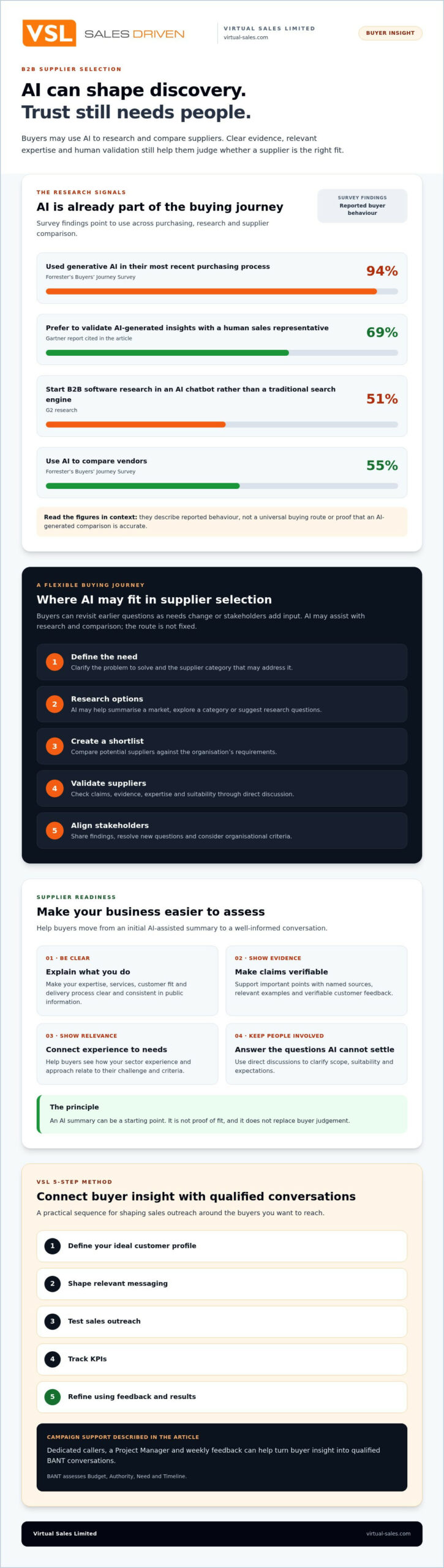
94% of B2B buyers used generative AI during their most recent purchasing process, according to Forrester’s 2026 Buyers’ Journey Survey. AI Is Changing How B2B Buyers Choose Suppliers, but it isn’t making trust or fit less important.
If you’re concerned your business could be missed during AI-assisted research, it’s worth paying attention. Buyers can use AI to research products and compare suppliers before speaking to sales. But discovery is only part of the decision: Gartner reports that 69% of B2B buyers prefer to validate AI-generated insights with a human sales representative.
This guide explains how AI may influence supplier discovery, comparison and validation, and what you can do to make your business easier to assess. You’ll find practical ways to present clear, credible evidence, connect buyer insight to relevant conversations and support those discussions with experienced sales professionals. The aim is to help you stay visible during research and turn informed interest into qualified opportunities.
Key Takeaways
- Identify where AI may shape supplier discovery and evaluation, while recognising that buyers follow different research paths.
- Use consistent criteria to compare suppliers, then check important claims against named sources and verifiable evidence.
- AI Is Changing How B2B Buyers Choose Suppliers, so make your expertise, relevance and process easy to assess.
- Use the VSL 5-Step Method to define your ideal customer profile, shape messaging, test sales outreach and refine it using KPIs.
- See how dedicated callers, a Project Manager and weekly feedback can help turn buyer insight into qualified BANT conversations.
How AI Is Changing B2B Supplier Discovery and Buyer Expectations
AI can change where supplier research begins, but it doesn’t make every buying journey the same. Some buyers may ask a chatbot to explain a market or suggest suppliers. Others may start with a search engine, industry contacts or existing relationships. AI-generated summaries and recommendations are another potential early source of information.
AI-assisted B2B supplier research is the use of AI tools to summarise, compare or identify potential suppliers as part of a buyer’s research. It can inform discovery, but it cannot establish whether a supplier meets an organisation’s requirements.
What AI changes in the early stages of supplier research
A buyer exploring a new software category, for example, might ask an AI tool to explain common capabilities, compare vendors or suggest questions for a procurement discussion. G2’s March 2026 research reports that 51% of B2B software buyers start their research in an AI chatbot rather than a traditional search engine. This finding points to a shift in some buyers’ behaviour, not a universal route to market.
AI summaries may influence which sources a buyer consults first. While agencies like Bullseye Marketing Consultants help organisations adapt their web presence for search and answer engine optimisation, suppliers must also make their expertise, services, customer fit and delivery process clear and consistent across all public information. If key details are vague or conflict between sources, buyers may find it harder to understand what you offer. Even a recommendation won’t automatically earn a place on the shortlist. Buyers still need to check whether you meet their specific requirements.
The familiar stages of identifying needs, comparing options and selecting a supplier remain useful context. See the traditional supplier selection process for an overview. AI can support parts of that work, while organisations adapt the steps to their own decision-making.
Why buyers still need evidence beyond an AI summary
A generated summary is a starting point, not proof. Buyers need to check claims against named sources, relevant examples and verifiable customer feedback. They also need to assess whether a supplier has experience that matches their sector, challenge and decision criteria.
Forrester’s January 2026 Buyers’ Journey Survey reports that 55% of B2B buyers use AI to compare vendors. That figure describes reported use, not the accuracy of any comparison. A summary may omit context or fail to answer a buyer’s specific question. Direct discussions help clarify scope, suitability and expectations, while internal stakeholders apply their own priorities and judgement.
That’s why AI Is Changing How B2B Buyers Choose Suppliers, but credible evidence and human judgement still matter. Make your information easy to verify, and be ready to explain how your experience relates to a buyer’s needs.
How AI Fits Into the B2B Supplier Selection Journey
Supplier selection often moves through five practical stages: define the need, research options, create a shortlist, validate suppliers and align stakeholders. AI can assist with research and comparison, but this isn’t a fixed route or a decision made by technology alone. A new requirement, an unanswered question or input from another stakeholder can send a buying group back to an earlier stage.
Some buyers may use AI to organise initial research or generate a list of potential suppliers before having a direct conversation. MarketScale discusses AI as a gatekeeper in procurement, but buyers still need to confirm whether a suggested supplier fits their organisation’s actual needs.
From need recognition to an initial supplier shortlist
Buyers first clarify the problem they need to solve, then consider which supplier categories might address it. An AI tool could help summarise the issue or suggest research questions, such as which integrations a software provider should support. For suppliers, a clear ideal customer profile and precise positioning help prospective buyers assess relevance, rather than relying on a broad offer that could apply to almost anyone.
From supplier comparison to internal approval
Once buyers have options, they may compare expertise, suitability, delivery approach and supporting evidence. They can then share their findings with finance, procurement, operational teams and other decision-makers. Each stakeholder may raise new questions, prompting the group to revisit its shortlist or requirements. Final approval may also involve checks, discussions and organisational criteria that an AI-generated summary cannot resolve.
The table outlines one way to think about AI’s possible role at each stage. Use it as a guide, not as a universal buying process.
| Buyer stage | Possible AI use | Supplier evidence to check |
|---|---|---|
| Define the need | Organise the problem and generate questions | Clear explanation of the challenge addressed |
| Research options | Summarise supplier categories and available information | Accurate service descriptions and relevant expertise |
| Build a shortlist | Group or compare potential suppliers | Evidence of fit with the buyer’s sector and requirements |
| Validate suppliers | Summarise claims or identify points to investigate | Named sources, specific examples and verifiable feedback |
| Align internally | Help organise findings and questions for stakeholders | Transparent processes and answers to stakeholder concerns |
AI Is Changing How B2B Buyers Choose Suppliers by adding another tool to the research process, not removing the need for human judgement. If you’re assessing how supplier conversations can support buyer evaluation, you can review VSL’s appointment-setting feedback as one source of information.
What B2B Buyers Should Check Before Choosing an AI-Recommended Supplier
An AI tool may bring a supplier into view, but appearing in a summary or recommendation doesn’t confirm its capability, suitability or results. Discoverability shows that a supplier can be found; demonstrated fit shows that it can meet your requirements. Keep that distinction in mind when assessing each option.
Use the same criteria for every supplier. A consistent comparison makes it easier for your buying group to focus on evidence rather than the confidence of an AI-generated summary.
| Check | What to assess | Evidence to request or verify |
|---|---|---|
| Expertise | Does the supplier understand your sector, challenge and required capabilities? | Relevant experience, named sources and specific examples |
| Relevance | Does its work match your organisation’s needs and context? | Examples with comparable scope, customer type or problem |
| Evidence | Can you substantiate performance and customer claims? | Case studies with context, measurable outcomes or verifiable feedback |
| Process transparency | Are responsibilities, delivery steps and reporting clear? | A clear description of who does what, when and how progress is reviewed |
| Communication | Can the supplier explain its approach and respond to questions? | Direct answers, agreed contact points and a clear feedback process |
How to verify supplier expertise, evidence and relevance
Match examples to your situation. A case study from a different sector or with a very different scope may offer limited insight into your likely experience. Ask how reported outcomes were measured, what work was included and whether the source can be checked independently. Read testimonials for detail about the service and context, not just positive wording.
Trace important claims back to named sources, specific examples or verifiable customer feedback. If a supplier’s public information differs from its explanation, ask what accounts for the difference.
Questions to ask before committing to a supplier
Clarify delivery before making a decision. Ask who will do the work, how responsibilities are managed and what reporting you’ll receive. Agree how feedback will be handled, what qualification criteria apply and which measures will define progress. These questions help you compare the proposed process with your organisation’s requirements.
Also ask how the supplier handles data and whether its processes are GDPR-compliant. Make sure the answers address your organisation’s needs and can be reviewed by the relevant stakeholders.
AI Is Changing How B2B Buyers Choose Suppliers, but careful due diligence still rests on evidence, fit and clear communication. Use AI to guide your questions, then verify the answers before choosing a supplier.
How Suppliers Can Respond to AI-Informed B2B Buyer Behaviour
AI-supported research can give your team clues about the questions buyers are asking. The next step is to turn those clues into focused sales outreach, then check what prospects actually tell you. The VSL 5-Step Method is a practical way to organise that work, not a universal industry standard.
The VSL 5-Step Method for acting on buyer insight
- 1. Define your ideal customer profile. Set clear criteria for the organisations you can serve, then identify relevant decision-maker roles before building a prospect list.
- 2. Build messaging. Agree how to explain your offer and its relevance. Prepare questions that help establish whether a prospect’s situation is a fit.
- 3. Test outreach. Start conversations with a focused group of suitable prospects. Record activity and responses in the agreed CRM.
- 4. Track KPIs. Measure qualified conversations, meetings booked and campaign outcomes using definitions agreed with your team.
- 5. Optimise weekly. Review feedback and results, then adjust targeting or messaging when the evidence supports a change.
Begin with the audience, not the tool. This guide to market and competitor research for sales can help inform your targeting decisions.
Use results to test whether the approach is working
Illustrative scenario: A technology supplier sees buyer questions about a particular operational challenge in its research. The team checks whether the organisations asking about it match its ideal customer profile, agrees a message that addresses the challenge, then tests that message in conversations. Call feedback highlights recurring questions and areas where prospects need more detail. The team uses those findings to refine its approach.
This example shows how research insight could guide outreach. It isn’t a claim about a specific campaign or result. A signal from an AI tool doesn’t confirm a prospect’s intent. Use direct conversations to establish whether there’s a relevant need, who is involved and whether the opportunity meets your agreed BANT criteria.
Before activity begins, agree what counts as a qualified conversation, a meeting booked and a campaign outcome. Keep those definitions consistent in your reporting so your team can assess progress. When using third-party research, check the original source, report title, date and figures. Include Clutch outcomes or campaign evidence only when the details have been verified and approved. Avoid attributing results to AI unless the evidence supports that conclusion.
VSL pairs dedicated callers with a Project Manager and uses weekly reporting and feedback to review campaign responses with client teams. This keeps the work aligned with agreed targeting and qualification criteria.
How VSL Connects AI Insight With Qualified B2B Conversations
AI can help buyers organise their research, but a recommendation alone doesn’t confirm that a prospect has a relevant need or is ready to speak with a supplier. Virtual Sales Limited (VSL) provides B2B appointment setting and lead generation, not a standalone AI product. Where AI-supported insight informs your targeting, experienced callers can help test relevance through direct, consultative conversations.
Where experienced appointment setters complement AI-informed research
A buyer’s online research may suggest a likely challenge, but a conversation can establish whether that issue matters to the organisation and who is involved in the decision. VSL callers use agreed messaging and qualification criteria, including BANT, to understand Budget, Authority, Need and Timeline. Suitable opportunities can then be passed to your sales team against the criteria you’ve agreed.
For IT and technology businesses, VSL’s callers have IT backgrounds as well as sales and marketing experience. A dedicated caller or callers work alongside a Project Manager, helping the campaign operate as an extension of your sales and marketing team. The purpose is not to treat an AI signal as proof of intent, but to ask relevant questions and record what prospects actually say.
What a transparent appointment-setting partnership includes
Agree the ideal customer profile, messaging, qualification criteria and responsibilities at the outset. Dedicated callers make conversational calls, while the Project Manager coordinates the campaign. Weekly reporting and feedback give both teams a regular opportunity to review responses, clarify what counts as a qualified conversation and adjust the approach based on evidence.
VSL uses a cloud-based CRM and can work with client CRM systems, including Salesforce. Its CRM supports CSV and Excel import and export. Confirm how campaign information will be recorded and shared, and make sure the reporting fields match your existing sales process. This helps your team review conversations and assess opportunities without relying on an AI-generated summary alone.
AI Is Changing How B2B Buyers Choose Suppliers, but a credible supplier relationship still depends on clear responsibilities, relevant conversations and agreed measures. Review VSL’s B2B appointment setting services to consider how this approach could fit your sales process.
Turn Buyer Insight Into More Relevant Conversations
AI Is Changing How B2B Buyers Choose Suppliers, but appearing in research is only the beginning. Clear supplier information helps buyers assess relevance, while verifiable evidence supports trust. For your business, the next step is to connect those signals to focused targeting, agreed qualification criteria and conversations that explore a prospect’s actual needs.
VSL provides B2B appointment setting and lead generation, pairing a dedicated caller and Project Manager with your campaign. Weekly reporting and feedback help your teams review progress, while qualified BANT leads provide a shared standard for assessing suitable opportunities. The service is designed to work alongside your sales and marketing team, not replace its knowledge of your customers.
Keep improving your approach by reviewing what prospects ask, checking whether conversations match your ideal customer profile and refining messaging against agreed measures. You don’t need to treat AI recommendations as certainty. Use them as a prompt for informed, human follow-up.
With clear evidence and relevant conversations, you can help the right buyers move forward with confidence. Each useful discussion can help your team build a stronger sales pipeline.
Frequently Asked Questions
How is AI changing the way B2B buyers choose suppliers?
AI Is Changing How B2B Buyers Choose Suppliers by adding summaries and recommendations to the research process. Buyers may use these tools to understand a category, compare options or prepare questions before contacting providers. The tools can help organise information, but they don’t confirm whether a supplier meets a company’s requirements. Buyers still need to check evidence, assess suitability and consider their organisation’s priorities.
Can AI recommend which B2B suppliers a company should shortlist?
AI can suggest suppliers based on the information available to it and the prompt a buyer provides. Treat those suggestions as research leads, not a definitive shortlist: recommendations may miss context or fail to reflect specific requirements. Compare each suggested supplier against your criteria, such as relevant expertise, delivery approach and verifiable evidence. Then involve the people who will assess, approve or use the service.
What do B2B buyers use AI for when researching suppliers?
Buyers may ask AI tools to explain unfamiliar categories, summarise supplier information, compare stated capabilities or draft questions for a sales discussion. For example, a team researching software might use a tool to organise its requirements before reviewing provider websites. The exact process varies between organisations and buying groups. AI can help with early research, but buyers should verify important claims against supplier materials and other reliable sources.
How can a supplier appear in AI-assisted buyer research?
There’s no guaranteed way to appear in an AI-generated answer. Make your public information clear, accurate and consistent: explain what you offer, who it suits, the problems you address and how your process works. Support claims with named sources, relevant examples and verifiable customer feedback. This helps buyers assess your fit if they encounter your information through an AI summary, a search engine or another research route.
Does AI replace human judgement when businesses select suppliers?
No. AI can support research and comparison, but it can’t make the full decision for an organisation’s stakeholders. People still need to judge whether a supplier fits their needs, review evidence, clarify responsibilities and consider internal priorities. A direct conversation can also resolve questions a summary may leave open. Use AI as one input, then validate its output and apply your team’s own selection criteria.
How should suppliers prove their credibility to AI-informed buyers?
Make claims easy to check. Provide specific examples that show the work involved, the customer context and how any outcomes were assessed. Use relevant testimonials or case studies, and make responsibilities and delivery processes clear. Avoid relying on broad promises or treating appearance in AI-generated answers as proof of capability. Buyers need evidence they can verify and relate to their own requirements before placing confidence in a supplier.
How can appointment setting support buyers who have researched suppliers using AI?
Appointment setting can give buyers a human conversation to test whether a supplier’s offer matches their actual needs. VSL uses dedicated callers and a Project Manager, with agreed qualification criteria such as BANT to identify suitable opportunities for the client’s sales team. Weekly reporting and feedback help keep the campaign aligned. The conversation can clarify interest and fit, rather than treating an AI-generated recommendation as proof of intent.

Ready for a pipeline that AI alone can’t build?
See how our AI lead generation services combines intelligent automation with experienced SDRs based in the UK. You can also explore our appointment setting and lead generation services.
Get me more leadsDisclaimer
Disclaimer: Content is for general information only and does not constitute professional advice. Results may vary. Virtual Sales Limited accepts no liability for actions taken based on this content.
Tags: AI in Sales, Appointment Setting, B2B buyer behaviour, B2B Sales, Lead generation, sales qualification, supplier selection