Financial Model for Outsourced Lead Generation: The 2026 ROI Guide for B2B Leaders
Approximately 79% of B2B leads never convert into sales because of fragmented qualification and inconsistent nurturing. If you’re managing an internal SDR team, you’re likely battling high overheads and a lead flow that feels more like a gamble than a strategy. It’s difficult to justify spend when you can’t pin down the exact cost per qualified appointment. Developing a sophisticated financial model for outsourced lead generation is the only way to replace this uncertainty with a clinical, results-oriented framework for 2026.
We agree that your sales pipeline should be a predictable engine, not a source of financial stress. This article provides the blueprint to build a robust model that justifies your investment and forecasts scalable growth. You’ll learn how to lower your Customer Acquisition Cost (CAC) while integrating high-performing external expertise directly into your HubSpot or Salesforce workflows. By shifting your focus from raw volume to clinical precision, you can finally secure the sustainable pipeline growth your business demands.
Key Takeaways
- Uncover the hidden costs of in-house SDR teams and learn how a financial model for outsourced lead generation provides a transparent view of your true ROI.
- Define the critical relationship between Customer Acquisition Cost and Lifetime Value to justify long-term investment in your sales pipeline.
- Compare retainer-based telemarketing against project fees to identify which structure offers the best financial stability for your 2026 growth strategy.
- Apply the VSL Framework to set accurate baseline metrics and establish strict financial definitions for what constitutes a truly qualified lead.
- Benchmark your results against top-tier performance data, including typical ranges of 10–20 high-quality meetings per month for dedicated campaigns.
Why In-House Lead Generation Often Fails the Financial Stress Test in 2026
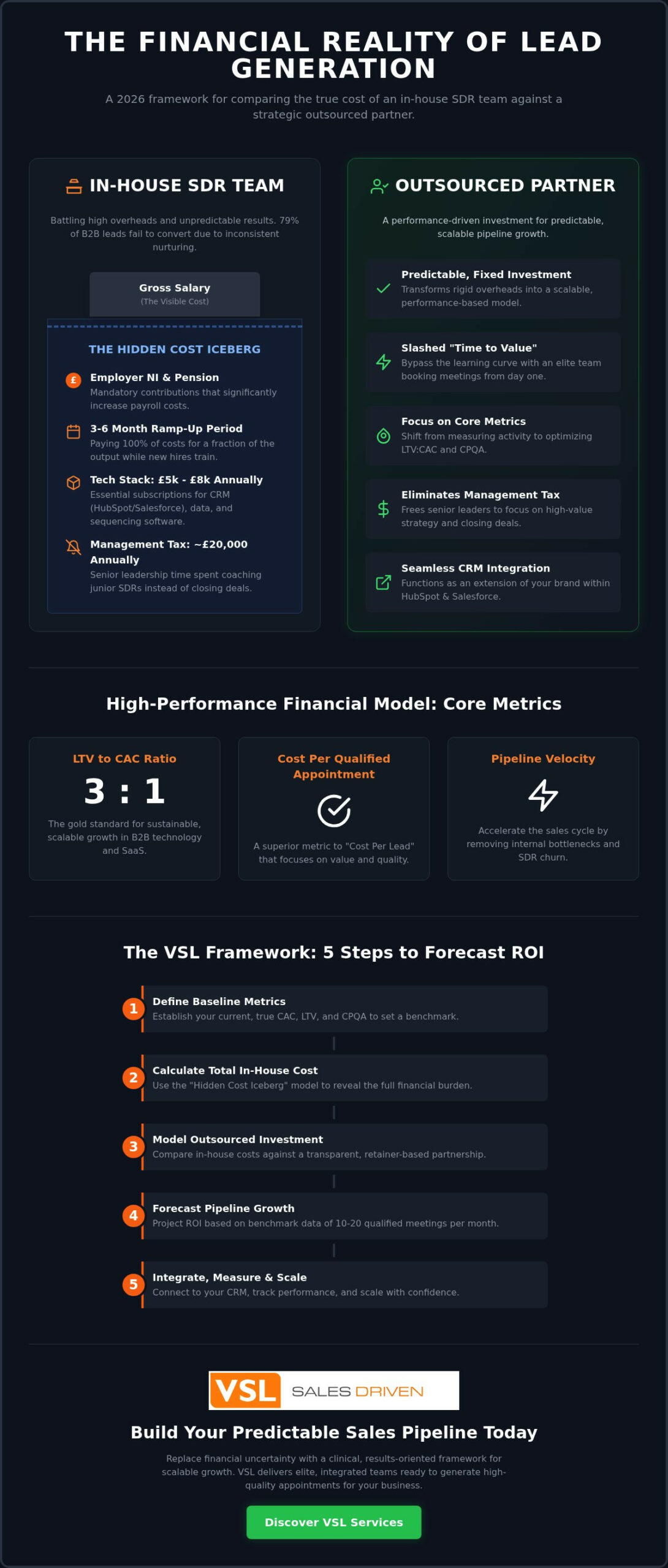
A financial model for outsourced lead generation is more than a budget tracker. It is a clinical, strategic instrument designed to forecast ROI with surgical precision. Many B2B leaders find that their internal teams fail the financial stress test because they only account for gross salaries. They ignore the “Hidden Cost Iceberg” that sits beneath the surface. In 2026, the demand for budget predictability is at an all-time high. Fixed overheads are the enemy of agility. By shifting to an outsourced model, you transform these rigid expenses into scalable, performance-driven investments that align directly with your revenue targets.
Understanding what lead generation is in a modern context requires looking past the activity and focusing on the economics. An internal team often carries a “management tax” that erodes the efficiency of your sales operation. When you factor in recruitment fees, training cycles, and the inevitable churn of junior staff, the cost-per-appointment for an in-house team often doubles compared to a professional, integrated partner. Outsourcing mitigates these risks by providing an elite, ready-to-scale workforce that functions as a natural extension of your own brand.
The True Cost of a UK-Based Internal SDR
Gross salary is merely the entry fee for an internal Sales Development Representative (SDR). To build an accurate financial model, you must calculate the total cost to the business (£). This includes employer National Insurance contributions, pension requirements, and the essential tech stack. A high-performing SDR requires access to cloud-based CRMs like HubSpot or Salesforce, premium data tools, and sequencing software. These subscriptions can easily add £5,000 to £8,000 per head annually.
The most significant financial drain is the ramp-up period. It typically takes three to six months for a new hire to become fully productive. During this window, you are paying 100% of the costs for a fraction of the output. When you choose an expert partner for B2B lead generation, this “Time to Value” (TTV) is slashed. You bypass the learning curve and gain immediate access to proven methodologies and mature professionals who are ready to book meetings from day one.
Opportunity Cost and Management Tax
Management tax is the quantifiable time senior leaders spend recruiting, onboarding, and coaching junior SDRs instead of closing high-value deals. If a Sales Director earns £100,000 and spends 20% of their week managing a struggling lead gen team, that is a £20,000 annual hit to your bottom line. This “tax” is rarely reflected in internal financial models, yet it significantly increases your Customer Acquisition Cost (CAC).
Strategic outsourcing removes this burden. It allows your leadership team to focus on conversion and strategy while the partner handles the tactical execution of building a B2B sales pipeline. This shift ensures that every pound spent is directed toward revenue-generating activities rather than administrative maintenance.
Core Components of a High-Performance Outsourced Financial Model
A high-performance financial model for outsourced lead generation requires a shift from measuring activity to measuring value. You must track Customer Acquisition Cost (CAC) with clinical accuracy. This includes every penny spent on the campaign divided by the number of new customers acquired. However, CAC is a hollow metric without the context of Lifetime Value (LTV). Your model should look beyond the initial invoice to understand the total revenue a client generates over their tenure. In B2B SaaS and technology sectors, aiming for a 3:1 LTV-to-CAC ratio is the gold standard for sustainable scaling.
Outsourcing also fundamentally improves pipeline velocity. This metric measures how quickly leads move through your sales funnel to become closed-won revenue. By deploying an elite, integrated team, you remove the bottlenecks associated with internal SDR churn and inconsistent outreach. This acceleration reduces the time your capital is tied up in the sales cycle, which significantly improves overall cash flow and allows for more aggressive reinvestment in growth.
Calculating Cost Per Qualified Appointment (CPQA)
Focusing on “Cost Per Lead” is a common trap that leads to inflated forecasts and poor lead quality. CPQA is a far more reliable metric because it only counts meetings that meet your specific qualification criteria, such as BANT (Budget, Authority, Need, Timeline) or CHAMP (Challenges, Authority, Money, Prioritisation). CPQA is defined as the total campaign cost divided by the number of sales-ready meetings. By setting strict financial parameters for what constitutes a “qualified” lead, your model remains grounded in reality. You can see how we deliver these results by reviewing our verified UK appointment setting performance.
Integrating CRM Data for Accurate Attribution
Your financial model is only as good as the data feeding it. Cloud-based CRMs like HubSpot and Salesforce are essential for tracking the journey from the first touchpoint to the final signature. VSL integrates directly with your existing systems to provide transparent, real-time reporting on campaign performance. This integration ensures that every booked appointment is attributed correctly, allowing for precise ROI calculations.
We prioritise rigorous data cleansing to prevent the “garbage in, garbage out” syndrome that often plagues internal financial modeling. This technical accuracy ensures your forecasts are built on a foundation of verified, actionable intelligence. When your CRM data is clean and integrated, you don’t have to guess about your lead generation ROI; you can prove it with surgical precision.
Real Insight: Comparing Retainer-Based Models vs. Project Fees
Selecting the right commercial structure is a pivotal step in building a financial model for outsourced lead generation. Most B2B leaders find themselves choosing between monthly retainers and fixed project fees. Retainer-based telemarketing provides the financial stability required for long-term pipeline health. It allows your integrated partner to refine messaging, build data depth, and maintain a consistent presence in the market. Project-based fees are useful for short-term “burst” campaigns, such as a localized product launch, but they often lack the momentum needed for sustainable revenue growth.
We purposefully avoid “pay-per-lead” models to protect your financial integrity. While pay-per-lead sounds attractive on paper, it incentivizes volume over quality. This often results in a calendar full of unvetted meetings that your sales team cannot close. A high-performance model prioritizes the “Revenue-per-Appointment” rather than the lowest possible lead price. By focusing on quality, you ensure that every pound spent on outreach has a direct, measurable path to a signed contract.
Scenario: The £100k Revenue Target
Consider a mid-sized software firm aiming for £100,000 in new business revenue. If your average deal size is £10,000, you need 10 closed-won deals. With a conservative 10% conversion rate from meeting to close, your campaign must generate 100 high-quality appointments. Modeling this over a 12-month period shows that a dedicated retainer offers a significantly lower cost-per-acquisition than sporadic project bursts. This consistency prevents the “feast or famine” cycle that plagues internal teams. Our VSL subscription models are designed to provide this exact financial predictability, ensuring your sales team has a steady stream of opportunities to hit their targets.
The Risk of the Pay-Per-Lead Trap
The “cheap” lead is often the most expensive one in your financial model. When an agency operates on a pay-per-lead basis, they are forced to cut corners on qualification to maintain their own margins. This creates a massive financial fallout for your business. Your senior sales professionals end up spending hours on calls with prospects who have no budget or authority. This wasted time is a significant component of your “management tax” and drives your total CAC upward.
Rigorous B2B appointment setting acts as a filter for your sales resources. It ensures that your team only engages with prospects who have been vetted against strict financial parameters. By investing in a quality-first model, you reduce the total number of touches required to close a deal, which ultimately improves your pipeline velocity and overall ROI.
The VSL Framework: 5 Steps to Building Your Lead Gen ROI Forecast
Constructing a reliable financial model for outsourced lead generation requires a structured, step-by-step approach. We’ve developed a clinical framework that eliminates guesswork and aligns your spend with measurable outcomes. This 5-step method ensures your forecast is grounded in real-world data and resilient to market shifts. It transforms your lead generation from a cost center into a predictable revenue driver by focusing on the economics of the entire sales cycle.
Step 1 & 2: Setting the Foundation
First, establish your baseline. You can’t predict the future without auditing your current sales cycle to identify the leaky parts of your funnel. Document your current conversion rates from meeting to opportunity and your average deal value in pounds (£). Next, define what qualified actually means for your business. Set strict financial and firmographic parameters to ensure your model only accounts for high-value prospects. Utilizing B2B data cleansing is essential during this phase. It ensures your model is based on accurate market size rather than outdated or duplicate records. This foundation allows you to align your lead generation with proven IT services sales strategies that prioritize high-intent accounts.
Step 3 involves mapping the volume. Calculate the exact outreach activity required to hit your meeting targets based on historical contact rates. Don’t underestimate the human element in Step 4. Your model must account for the expertise of professional, UK-based sales staff. Mature professionals navigate complex B2B hierarchies far more effectively than low-cost, automated alternatives. This human-led expertise is the primary differentiator that ensures your cost per qualified appointment remains low while lead quality remains high.
Step 5: Sensitivity Analysis for 2026
Finally, stress test your model. The 2026 business environment demands a sensitivity analysis that accounts for economic volatility and industry-specific shifts. Apply low, base, and high-performance scenarios to your ROI forecast. For instance, a Fintech campaign might face different regulatory hurdles than a Manufacturing campaign. These factors affect lead times and conversion velocity. An agile financial model for outsourced lead generation allows you to pivot resources quickly. By maintaining a flexible partnership, you can scale activity up or down based on these stress tests without the friction of internal hiring or layoffs. Review our verified appointment setting track record to see how we maintain performance across diverse market conditions.
Results and Data: Benchmarking Success in Outsourced Sales
Integrating a financial model for outsourced lead generation requires validation from real-world performance. You cannot build a forecast on hope; you need hard data. Gartner research highlights a significant shift toward outsourced sales development for agile firms looking to maintain competitive advantages. This trend is driven by the need for precision and the high cost of maintaining internal infrastructure. For dedicated campaigns, VSL typically delivers between 10 and 20 high-quality meetings per month. These aren’t just names on a list. Our conversion rate from “Appointment Set” to “Opportunity Created” typically sits between 70% and 80%. This high fidelity ensures your sales team spends their time closing rather than qualifying. You can find external validation of these metrics in our Clutch reviews, where clients document the tangible impact on their revenue and pipeline health.
Metrics That Matter: Beyond the Spreadsheet
A robust financial model must also account for “soft ROI.” Every outreach attempt gathers valuable market intelligence and builds brand awareness within your target accounts. Even when a prospect isn’t ready to buy immediately, the financial value of a clean, nurtured database for future marketing efforts is immense. Gartner predicts 60% of B2B sales organisations will transition to data-driven selling by 2026. This shift necessitates a partner who can provide the granular data required to fuel that transition. By capturing detailed feedback from every conversation, we provide a strategic asset that pays dividends long after the initial campaign concludes.
The VSL Advantage in Your Financial Model
Offshoring often carries a “reputation risk” cost that is difficult to quantify but easy to feel. Low-cost alternatives often damage brand equity through robotic or culturally mismatched outreach. Our mature, UK-based staff mitigates this risk by acting as an elite, integrated part of your workforce. This proactive insider approach ensures that every interaction reflects your brand’s professional standards and technical maturity. By reducing the management tax and providing a predictable revenue engine, VSL allows you to focus on high-level growth strategy while we handle the tactical execution of your B2B appointment setting. This partnership doesn’t just fill your calendar; it builds a sustainable foundation for your 2026 commercial goals.
Secure Your 2026 Revenue Pipeline
Building a clinical financial model for outsourced lead generation allows you to replace unpredictable overheads with a scalable growth engine. By focusing on metrics like Cost Per Qualified Appointment and Lifetime Value, you ensure every pound invested drives measurable returns. This strategic shift from volume to precision eliminates the management tax associated with internal teams while significantly accelerating your pipeline velocity. You’ve seen how a structured approach transforms lead generation from a variable cost into a predictable revenue driver.
VSL brings 20+ years of B2B expertise to your business, acting as specialists in IT and software lead generation. As a top-rated UK agency on Clutch, we integrate directly with your CRM to provide transparent, data-driven results that justify every investment. It’s time to move past the uncertainty of unvetted leads and start building a predictable sales engine. Calculate your potential ROI with VSL’s outsourced sales solutions and take the first step toward sustainable growth today.
Frequently Asked Questions
How much does it cost to outsource B2B lead generation in the UK?
Outsourcing costs in the UK typically follow a monthly retainer structure rather than a pay-per-lead model. This approach ensures you’re investing in a dedicated, high-standard resource focused on quality over raw volume. While industry averages vary based on campaign complexity, your budget should account for the professional maturity of the staff and the technical tools required. A retainer provides the financial predictability needed for consistent, long-term pipeline development.
Is it cheaper to hire an in-house SDR or use a lead generation agency?
Using an agency is almost always more cost-effective than hiring an in-house Sales Development Representative (SDR). When you calculate the total cost to the business, you must include National Insurance, pension contributions, and a tech stack that often costs over £5,000 per head. Agencies also bypass the three to six month ramp-up period. You gain an elite, integrated workforce for a fraction of the total internal overhead.
What is a good ROI for an outsourced lead generation campaign?
A high-performing campaign should target a 3:1 ratio of Lifetime Value (LTV) to Customer Acquisition Cost (CAC). This benchmark is the gold standard for B2B SaaS and technology companies looking to scale. Achieving this ratio within your financial model for outsourced lead generation proves the long-term viability of your outreach. It ensures that the revenue generated by new clients significantly outweighs the costs of securing them.
How do you calculate the cost per lead vs. cost per appointment?
Calculate cost per lead by dividing your total campaign spend by the number of raw contacts generated. To find the cost per qualified appointment (CPQA), divide that same spend by the number of meetings that meet your strict BANT or CHAMP criteria. CPQA is the superior metric. It measures the true price of a sales-ready opportunity rather than just a potential interest, providing a more clinical view of your ROI.
What financial metrics should I track when outsourcing sales?
Track Customer Acquisition Cost, Lifetime Value, and Pipeline Velocity to measure the efficiency of your sales engine. You should also monitor the conversion rate from appointment set to opportunity created, which typically ranges from 70% to 80% for high-performing partners. These metrics move beyond surface-level activity. They provide a data-driven view of how effectively your partner moves prospects through the buying cycle toward closed-won revenue.
How long does it take for an outsourced lead generation model to show a profit?
Profitability typically emerges within three to six months, depending on your specific sales cycle. With the average B2B buying cycle now lasting 10.1 months, your financial model for outsourced lead generation must be built for long-term momentum. Early indicators of success include a steady increase in pipeline value and a reduction in your internal management tax. This allows for more aggressive reinvestment in growth as the campaign matures.
Can I integrate an outsourced lead gen model with my existing Salesforce or HubSpot CRM?
Integration with cloud-based CRMs like Salesforce and HubSpot is a standard requirement for professional agencies. This setup allows for seamless lead handoffs and real-time attribution of won deals without manual data entry. It eliminates the risk of data silos. By working directly within your existing systems, an outsourced partner functions as a natural, integrated component of your internal sales team, ensuring full transparency.
What are the hidden costs of lead generation outsourcing I should watch for?
Be wary of undisclosed data procurement fees, setup costs, and the management tax of poor communication. You should also watch for the reputation risk associated with low-cost, automated outreach. Top-tier UK partners provide transparent reporting and high-standard, human-led expertise to mitigate these risks. This ensures your financial model remains accurate and free from unexpected operational drains that could erode your total ROI.

Disclaimer
Disclaimer: Content is for general information only and does not constitute professional advice. Results may vary. Virtual Sales Limited accepts no liability for actions taken based on this content.
Tags: B2B Lead Generation, B2B Sales, Customer Acquisition Cost, Financial Modelling, Outsourced Sales, roi calculation, Sales Pipeline, SDR