Sales Pipeline Review Meeting Template: The 2026 Strategic Guide for B2B Leaders
Why are your forecast calls still treated like interrogations when median B2B pipeline accuracy has climbed to 71% this year? If your team spends more time defending their CRM data than discussing strategy, you’re likely losing ground to more clinical competitors. Most B2B leaders agree that poor data quality and deals stuck in mid-funnel limbo make accurate forecasting feel like a guessing game. You need a system that shifts the focus from backward-looking reporting to forward-looking execution and proactive problem-solving.
This guide provides a professional sales pipeline review meeting template built for the 2026 commercial landscape. You’ll learn how to master your forecast, eliminate friction, and drive the deal velocity required to scale your B2B operation effectively. We’ll preview the VSL framework for unblocking complex deals involving an average of 11.2 stakeholders and demonstrate how to turn every review into a tactical hunt for revenue opportunity. By the end of this article, you’ll have the tools to build a culture of accountability that delivers predictable, measurable growth.
Key Takeaways
- Learn how to eliminate CRM data decay with a hygiene check that ensures every prospect has a defined close date and next step.
- Implement our professional sales pipeline review meeting template to shift your team culture from defensive reporting to proactive strategy.
- Discover the financial impact of deal delays by calculating the £ value of pipeline velocity across your mid-market and enterprise cycles.
- Master the VSL 5-Step Framework to unblock deals and improve your MQL to closed-won conversion rates for a more predictable 2026 forecast.
- Understand how integrating specialized SDR expertise with your Salesforce or HubSpot instance can accelerate your B2B lead generation results.
Why Most Sales Pipeline Review Meetings Fail in 2026
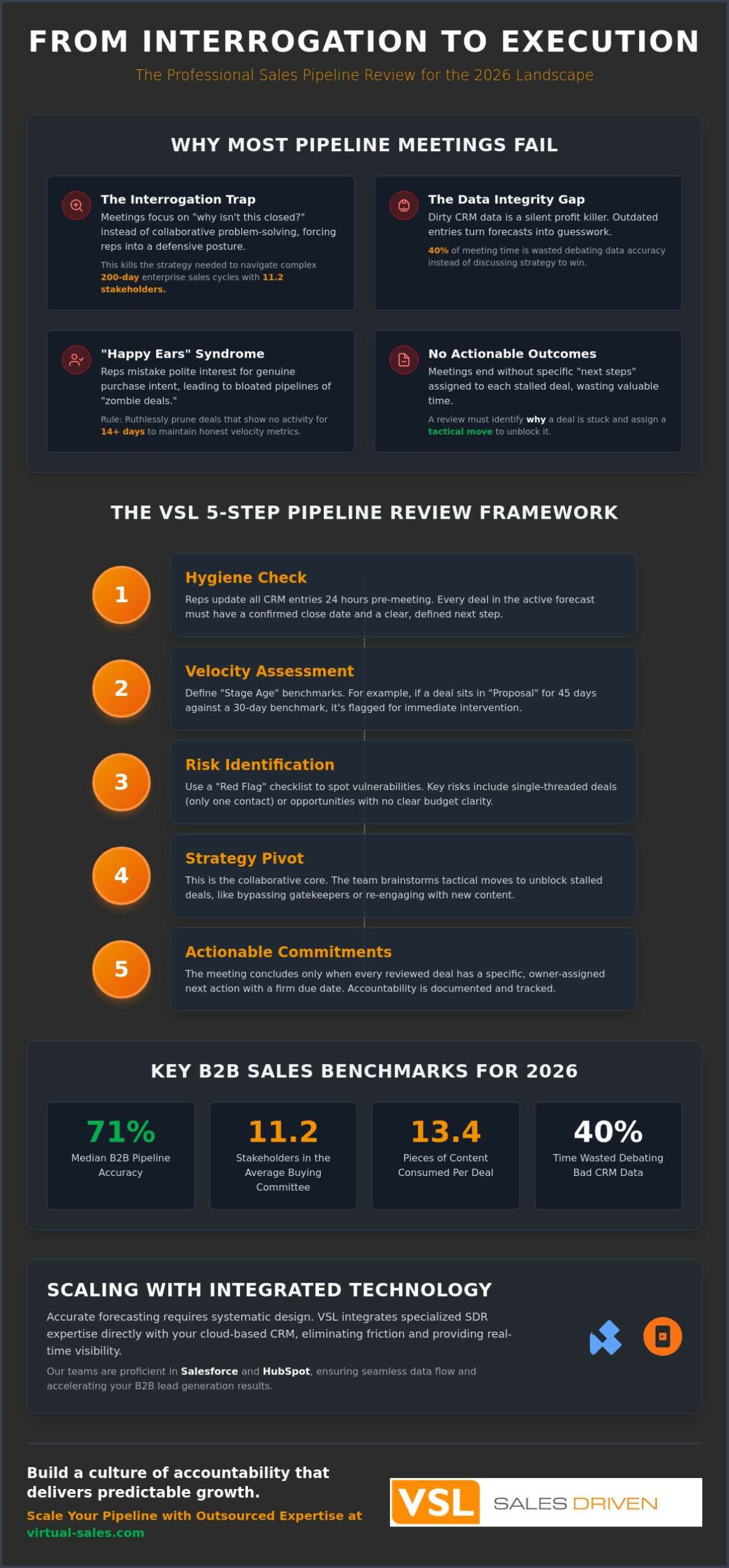
Most pipeline reviews function as autopsies of dead deals rather than tactical strategy sessions. In 2026, where the average B2B buying committee has expanded to 11.2 stakeholders, a surface-level status update is no longer sufficient. Many leaders fall into the “Interrogation Trap,” where reps feel pressured to present a polished version of reality. This fear-based culture encourages reps to hide bad news, leading to a massive disconnect between the forecast and actual bank deposits. When a manager focuses solely on “why isn’t this closed yet?”, the rep retreats into a defensive posture. This kills the collaborative problem-solving needed to navigate complex 200-day enterprise sales cycles.
The Data Integrity Gap in Modern CRMs
Dirty data is a silent profit killer. Outdated CRM entries cost UK businesses thousands in lost productivity every year. When your sales pipeline review meeting template relies on manual entry, you aren’t looking at reality; you’re looking at a sales rep’s best guess from three weeks ago. Accurate 2026 forecasting requires the systematic design of sales processes that integrate cloud-based platforms like HubSpot and Salesforce. Real-time visibility is the only way to eliminate the friction that stalls deal velocity. Without automated data capture, your team spends 40% of the meeting debating the accuracy of a close date rather than discussing how to win the account.
Misaligned Intent vs. Sales Velocity
“Happy Ears” syndrome remains a primary reason for pipeline bloat. Reps often mistake polite professional interest for genuine purchase intent. This leads to a funnel filled with “zombie deals” that consume resources without any clear path to closure. Distinguishing between a qualified lead and a sales-ready opportunity is critical for maintaining high B2B lead generation standards. Over-inflated pipelines don’t just mess up your numbers; they crush team morale by creating a false sense of security that inevitably leads to a missed quarter. You must ruthlessly prune deals that haven’t shown activity in 14 days to keep your velocity metrics honest.
Finally, meetings fail when they lack actionable outcomes. If a session ends without a specific “next step” for every stalled deal, you’ve wasted your time. A strategic review must identify why a deal is stuck and assign a tactical move to unblock it. Effective leaders use these sessions to coach, not just to audit. They ask about the specific stakeholders identified and whether the current content assets match the buyer’s stage in the 13.4-piece content consumption journey. Without this level of granularity, your pipeline is just a list of names, not a revenue engine.
The VSL 5-Step Pipeline Review Framework
Execution starts with visibility. A professional sales pipeline review meeting template must move beyond simple status updates to foster a culture of tactical accountability. We’ve developed a five-step framework designed to eliminate the “interrogation” feel and replace it with clinical, results-oriented strategy. This method ensures that every minute spent in the meeting translates directly into increased deal velocity and accurate forecasting for the 2026 fiscal year.
Steps 1 & 2: Establishing the Baseline
Step 1 is the Hygiene Check. Reps must update CRM entries at least 24 hours before the session. If a deal lacks a confirmed close date or a clear next step, it doesn’t belong in the active forecast. We recommend using b2b data cleansing to ensure contact accuracy, as reaching the wrong stakeholder in a committee of 11.2 people is a waste of resources. A visual representation of the sales process only provides value if the underlying data is pristine.
Step 2 involves the Velocity Assessment. You need to define industry-specific “Stage Age” benchmarks. If a mid-market deal typically spends 30 days in the “Proposal” stage but a specific opportunity has sat there for 45, it’s a red flag. Identifying these outliers early allows you to intervene before the deal goes cold. You aren’t just looking at the total £ value; you’re looking at the speed of movement through each gate.
Steps 3 to 5: Tactical Execution
Step 3 is Risk Identification. We use a “Red Flag” checklist to spot single-threaded deals or opportunities with no clear budget clarity. If your rep is only talking to one person, the deal is at high risk. Step 4 is the Strategy Pivot. This is where the team brainstorms tactical moves to bypass gatekeepers or re-engage stalled prospects. You might decide that setting appointments with a different stakeholder, such as a technical lead or a financial controller, is the necessary pivot to move the needle.
Step 5 is Resource Allocation. High-value enterprise deals often require senior leadership or technical support to close. Use this final step to decide exactly where to deploy your “big guns.” Every next move must have a specific owner and a deadline. If you’re struggling to maintain this operational rhythm, partnering with top-rated UK appointment setting experts can provide the consistency your internal team needs to focus on closing. This structured approach ensures your pipeline remains a lean, revenue-generating engine rather than a bloated list of “maybe” opportunities.
Results and Data: Benchmarking Pipeline Performance
Data-driven leadership isn’t a luxury; it’s a requirement for 2026. Median B2B pipeline forecasting accuracy has climbed to 71%, up from 54% just two years ago. Reaching these levels requires a sales pipeline review meeting template that moves beyond gut feelings and into verified performance benchmarks. If your forecast accuracy sits below this threshold, your review process is likely failing to identify the risks hidden within your CRM data.
Quantitative KPIs for 2026
Targeting a 20–30% win rate from qualified pipeline opportunities provides a realistic baseline for high-performing teams. This starts with top-of-funnel volume, where consistent b2b appointment setting ensures a steady stream of prospects enters the funnel. You should track the following metrics during every review session:
- MQL to Closed-Won Rate: The current industry median is 2.4%.
- Average Sales Cycle: Expect 121 days for mid-market and 218 days for enterprise deals.
- Pipeline Forecasting Accuracy: High-growth firms aim for 70% or higher.
The £ value of pipeline velocity is often underestimated. For an enterprise deal valued at £50,000, a 10-day delay in the 218-day cycle isn’t just a scheduling issue; it’s a drag on your net revenue retention, which should ideally sit between 95–105%. Every day a deal sits idle increases the cost per closed deal, which typically consumes 20–30% of the total deal value in industry averages.
Qualitative Signals of Deal Health
Numbers tell half the story. Qualitative signals are the leading indicators of whether a deal will actually cross the finish line. Effective leaders use their review sessions to interrogate the depth of engagement within an account. Multi-threaded engagement is the primary success metric here. Since the average B2B buying committee now includes 11.2 stakeholders for deals over £40,000, being “single-threaded” with one contact is a critical failure point.
Research shows that 67% of the buyer’s journey is self-directed, with prospects consuming 13.4 pieces of content before ever speaking to a rep. Your review process must verify if these interactions are actually happening. Expertly managing a sales pipeline means identifying when a decision-maker is inaccessible and pivoting your strategy before the deal stalls. Measuring the ROI of these meetings is simple: look at your quota attainment. Teams that use structured interactions and documented prospect data close deals 15–20% faster than those that don’t.
The Ultimate Sales Pipeline Review Meeting Template
Efficiency is the cornerstone of high-performing sales operations. A successful sales pipeline review meeting template isn’t an exhaustive list of every prospect; it’s a surgical strike on the deals that matter. Start with a 15-minute manager-led data audit before the call to ensure CRM hygiene. This prevents the meeting from devolving into a spreadsheet correction session and keeps the focus on strategy. High-velocity teams don’t have time to debate whether a close date is accurate during the call.
Open with a five-minute high-level overview comparing the current forecast against monthly £ targets. This sets the stakes immediately. Move into a 20-minute “Deep Dive” focused exclusively on the top three and bottom three deals. This polarization highlights your biggest wins and your most significant risks. Follow this with 10 minutes of “Obstacle Removal” where you identify resource needs, such as technical support or senior executive involvement. Close with a five-minute summary of action items and hard CRM update deadlines. This 45-minute structure respects your team’s time while driving measurable progress.
Agenda Structure for Maximum Impact
Don’t waste time on “sure things” or “lost causes.” Focus your energy on “Swing Deals,” those opportunities that could go either way this month depending on your tactical execution. A structured approach ensures you aren’t just reporting numbers; you’re actively moving them. We also recommend a “Post-Mortem light” segment to briefly discuss one lost deal. This isn’t about assigning blame. It’s about identifying patterns to prevent recurrence in future enterprise cycles that typically span 218 days.
Real Insight: The SaaS Pipeline Turnaround
Consider a UK software firm we partnered with that had a £500,000 pipeline but zero deal velocity. Their internal team was stuck in an interrogation loop, unable to identify the hidden gatekeepers stalling their progress. By implementing the VSL framework, we mapped the 11.2 stakeholders involved and identified key technical blockers that the reps had overlooked. This shift from reporting to problem-solving changed the entire team dynamic.
We deployed a targeted strategy that combined our expertise in lead generation with their internal sales efforts. The result was three high-value meetings booked with C-suite stakeholders within 14 days. This external perspective re-energised their internal team and turned a stagnant pipeline into a live revenue stream. If your current reviews feel stagnant, it might be time to see how top-rated UK appointment setting experts can provide the tactical support needed to unblock your funnel.
Scaling Your Pipeline with Outsourced Expertise
A professional sales pipeline review meeting template is only as effective as the volume and quality of the opportunities feeding it. Many B2B leaders find their internal teams stuck in a “maintenance” loop; they spend so much time managing existing accounts that they neglect the top-of-funnel activity required for growth. Shifting from maintenance to a growth-centric model often requires the support of a dedicated SDR partner. VSL functions as an elite, integrated component of your commercial team, ensuring that your pipeline remains replenished with high-intent opportunities while your senior closers focus on final-stage negotiations.
Seamless reporting is a non-negotiable requirement for 2026. We integrate directly with your Salesforce or HubSpot instance to ensure that every lead we generate is tracked with clinical precision. This technical alignment means that when you open your sales pipeline review meeting template, the data is already there. You don’t have to chase reps for status updates or manually move deals between stages. Our proactive approach to CRM management eliminates the data decay that typically plagues internal sales operations, providing you with a reliable foundation for accurate revenue forecasting.
The financial argument for sales team outsourcing is compelling when compared to the overhead of internal hiring. Recruitment, training, and the cost of office space for a full-time SDR team in London or other UK hubs can quickly erode your margins. By partnering with VSL, you gain access to professionally mature, UK-based staff who understand the nuances of the local commercial landscape. This eliminates the risks associated with international outsourcing and ensures a higher standard of output for your enterprise-level engagements.
Integrating VSL into Your Review Process
We don’t operate as an external vendor; we act as a natural extension of your workforce. Our weekly reporting structures are designed to align perfectly with your internal review rhythm. If a deal stalls in the mid-funnel, we can leverage professional telemarketing to “warm up” the lead and identify new stakeholders. This collaborative approach ensures that your review meetings are focused on unblocking paths to revenue rather than simply auditing activity levels. We provide the consistent flow of high-quality appointments needed to keep your closers at full capacity.
Future-Proofing Your Sales Strategy for 2026
The sales landscape is moving toward “Intent-Based Calling” and precision outreach. Broad-reach demand generation is losing its effectiveness as buying committees grow more complex. Precision is now the ultimate differentiator. By focusing on professional maturity and human-led expertise, we help you navigate the 13.4 content touchpoints buyers now consume before contacting sales. This ensures your brand is positioned as an authority long before the first discovery call.
Turning your pipeline review into a revenue engine requires a combination of the right framework and the right fuel. With a structured template and a consistent stream of qualified leads, you can move from reactive reporting to proactive scaling. If you’re ready to accelerate your deal velocity and master your 2026 forecast, contact us today to discuss how our B2B appointment setting services can transform your commercial results.
Master Your 2026 Revenue Strategy
Implementing a professional sales pipeline review meeting template is the first step toward reclaiming your forecast accuracy and eliminating the interrogation trap. You’ve seen how a structured 5-step framework and clinical velocity metrics can transform stagnant data into actionable strategy. Success in 2026 requires moving beyond simple reporting to focus on unblocking the 11.2 stakeholders typically involved in complex enterprise deals. By prioritizing hygiene and identifying swing deals early, you ensure your team’s energy is spent where it yields the highest ROI.
VSL brings over 20 years of B2B lead generation expertise to your commercial operation, specifically for firms in the IT and software sectors. Our UK-based professional sales staff acts as an elite, integrated extension of your own team. We provide the high-standard output and technical CRM integration necessary to keep your funnel replenished with qualified leads. Don’t let your revenue targets become a guessing game. Discover how VSL can fill your pipeline with high-quality appointments and drive the predictable growth your business deserves. It’s time to turn your pipeline reviews into a high-octane revenue engine.
Frequently Asked Questions
How often should we hold sales pipeline review meetings?
Weekly sessions are the standard for high-growth B2B teams. Holding these meetings every seven days ensures your CRM data remains fresh and prevents deals from stalling for more than a few business days. While enterprise cycles often span 218 days, a weekly cadence allows you to identify and pivot on risks before they impact your quarterly £ targets.
What is the difference between a pipeline review and a forecast call?
A pipeline review is tactical, while a forecast call is strategic. The review focuses on individual deal health, stakeholder engagement, and removing blockers to increase velocity. In contrast, a forecast call looks at the high-level probability of hitting specific revenue numbers. Effectively using a sales pipeline review meeting template ensures the data feeding your forecast is accurate and verified.
How can I get my sales reps to actually update the CRM?
Implement a “no update, no credit” policy to drive accountability. If a deal isn’t updated in Salesforce or HubSpot 24 hours before the review, it shouldn’t be discussed or included in commission calculations. Making CRM hygiene a prerequisite for receiving leadership support or technical resources quickly turns manual entry into a non-negotiable habit for the entire team.
What are the best questions to ask during a pipeline review?
Focus on stakeholders and specific blockers rather than vague status updates. Ask questions like: “Which of the 11.2 stakeholders have we not yet engaged?”, “What is the specific next step agreed upon by the buyer?”, and “What is the single biggest risk to this deal closing by the target date?” These questions force reps to move beyond “happy ears” and confront reality.
How many deals should be covered in a 30-minute meeting?
Limit your focus to three to five high-priority “Swing Deals” per session. Attempting to review every opportunity in a 30-minute window leads to surface-level reporting that adds zero value. By concentrating on deals that require tactical intervention or senior resource allocation, you ensure every minute spent in the meeting translates into increased deal velocity.
Can I use this template for small sales teams?
Yes, this framework scales perfectly for teams of any size. Even a team of two benefits from a structured hygiene check and risk assessment. Small teams often suffer more from “happy ears” because every deal feels critical. Using a professional sales pipeline review meeting template provides the clinical distance needed to prune dead leads and focus on genuine revenue opportunities.
What metrics are most important for B2B software sales pipelines?
Focus on Stage Age, MQL to SQL conversion rates, and the cost per closed deal. For software and SaaS firms, tracking the number of stakeholders involved is vital, as modern buying committees are larger than ever. You should also monitor your Net Revenue Retention (NRR) and ensure your pipeline velocity is high enough to offset the typical 20-30% cost per closed deal.
How do I handle a rep who is consistently defensive during reviews?
Shift the meeting’s focus from audit to coaching immediately. Frame the session as a collaborative hunt for risk and opportunity rather than an interrogation of the rep’s performance. If defensiveness persists, it often signals a lack of confidence in their deal strategy. Address this through 1-on-1 development sessions that reinforce the value of transparent reporting for hitting their £ targets.

Disclaimer
Disclaimer: Content is for general information only and does not constitute professional advice. Results may vary. Virtual Sales Limited accepts no liability for actions taken based on this content.
Tags: B2B Sales, CRM, deal velocity, pipeline review, Sales Forecasting, sales management, Sales Pipeline, Sales Strategy